Nim Ferrous was fourteen years old and licensed, and on the fourth of the month she wrote her own name into the registry of the Caravan in her own hand, and the date, and the place, and the number of the engine she was entered against, and she did it in the Booking Office at Emberwhistle Halt with the door open and the copper bell going in the yard, because she had imagined doing it in the open for two years and was not going to rob herself of the two seconds in which she found out whether she was a coward. The registry is a ledger the size of a door. It is kept in the Booking Office in an oak case with a glass front, and the first leaves are brass and the rest are paper, and it holds every person the Line has ever agreed to employ, with the date of agreement, the date of release, and the hand in which each was written. Ivo Tarrow turned the case himself, with a key he did not offer to anybody, and stood at his shoulder while she wrote. Nim Ferrous. Fourth day. Emberwhistle. Brake van, Long Noon.
Below it, in Ivo’s own square hand, which is the hand of a man who has written a fare on a chalkboard every market day for twenty-two years: Licence, junior, countersignature of fares to two hours. And then a second line, in the same hand, which she had not known was going to be there and which she read twice. No speech of a true name into any register, on pain of a year. “That is not a caution,” Ivo said. “There is no caution at the end of it. It is a condition of the licence, and it is in the schedule, and every junior licence in this Basin since the year the rule was made has carried it, and no junior has ever broken it, because a year is a long time to be fifteen and stupid in front of people.” “Why is it there?” “Because they are all fifteen and stupid, and because it is cheaper to write it down.” He closed the case and turned the key. “Read it back to yourself on the way. It is the first thing they ask you for at the eastern end.” She read it back to herself on the way. She read it eleven times before the end of the platform.
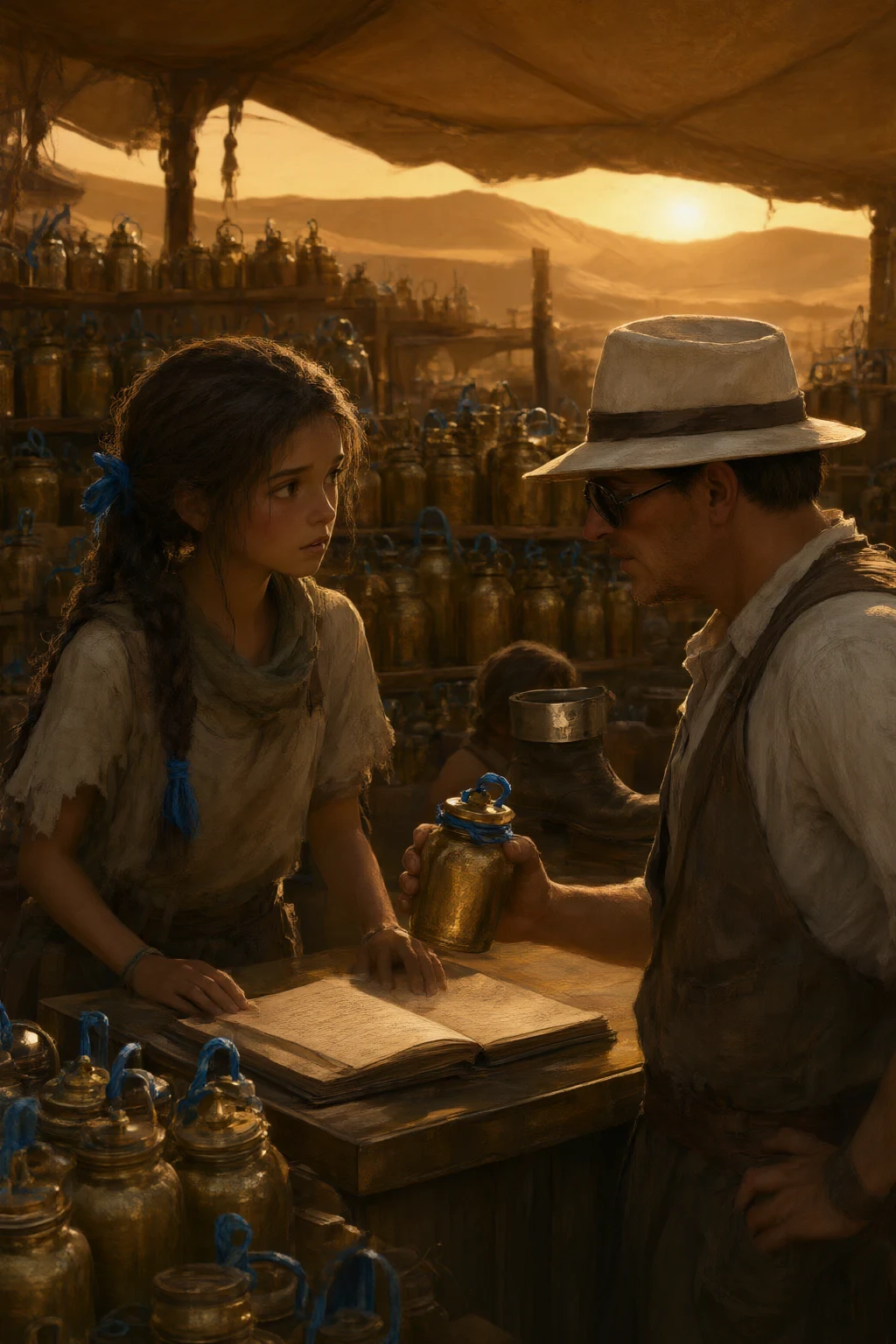
The Long Noon went east that afternoon with the Long Noon always going east, and Harl Quist was already in the third coach with his daughter. He was forty-six, a hand-cart foreman on the Sirocco freight, broad through the shoulders and going soft at the neck, and he had a jar of hours on his knees under a coat with a piece of sailcloth over it to keep the sun off, and the jar had a loop of blue twine on its handle and was sand-crusted to the shoulder and hummed faintly, and it held forty-one minutes, and he had bought it for nineteen of his own on the previous market day, which was the whole of what he had. It had been the best price in the Basin for a ticket to Kellvetch, and it was not a price, it was a favour, and he knew the difference.
His daughter Tamsin was nine and had been on a train for the first time and had decided, with the total conviction available to a nine-year-old, that trains were simply places where time went faster. She had been given an hour out of the jar at Sirocco, by her father, out loud, in front of her, so that she would not be frightened, and she had spent it in the first hour and had liked it, and had not noticed, as nobody on earth ever does, that she was carrying a hole shaped exactly like an evening and could not put anything in it. “Where are we going,” she said. “Kellvetch.” “To see Uncle Petru.” “To see Uncle Petru.” “He’s ill.” “He is ill.” “I know. The cook’s boy told me on the cart. He said the pit air does a thing to people’s chests.” She considered this. “Does the pit air do a thing to people’s chests.” “It does a thing to people’s chests,” said Harl Quist. The Long Noon stood two hours in the middle of the desert for the Sirocco market, and the market opens when the first train releases a jar of stored morning light, and every stall in the Underdune Bazaar lights its own lamps with bottled sunrise, so that the whole place runs in low amber light from before dawn until noon and nobody there can tell you what time it is.
Harl Quist went down the aisle with his daughter and came back forty minutes later with a second jar, which he did not show her, and which Tamsin did show Nim Ferrous, standing on the step of the brake van with the piece of sailcloth over it to keep the sun off. “That is a man selling Tuesday,” she said, in a confidential whisper, at volume. “He bought it off a man in a white hat with glasses made out of a window, and the man said the price out loud before he agreed to anything, and then he said it again at the end, and I think that is because he is lonely. I have noticed that about people who say the price twice.” She was nine, and one boot was a full size too small with its cuff patched in cut tin, and she had come out from under the brake van at six that morning, which she was not supposed to do, and which nobody on earth appeared to have any objection to. “Go back underneath.”
“The cook’s boy says the red one is for a man called Vail and it is not ours, and the cook’s boy is not a very good liar, so it is.” She leaned on the door frame. “You can go and look at it. I have already looked at it. It is a very good red one and it has got a string on it and there is a whole wall of them.” Nim Ferrous went and looked at it. Septimus Vail traded out of a pitch at the back of the third aisle with a folding table, a ledger of his own that was not a Line ledger and was therefore not in green, and a case of samples, and he did the thing he did, which was to state the price before agreeing to anything. “Ninety minutes to Kellvetch,” he said. “Posted is two fifty-one. I am not going to pretend to you that I do not know what the difference is, because you are the only person on this railway young enough to ask, and I would rather be honest with you and have you once than dishonest with everybody and have you always. Ninety is the price. It is a good afternoon, it is the whole of the travel, and you will get there as though you had not travelled. Same again?”
Behind him, a rack of jars stood four hundred deep in rusted iron, and every handle in it was tied with one loop of blue twine so that a bad one could be spotted from the end of the aisle, and the aisle was full of them, and they hummed. “Where does the time come from,” said Nim Ferrous. “From the Line, which is where everything comes from. Out of the standing charge, which is a very dull thing, and I am not going to insult you by pretending it is a well.” He turned a jar over on the table without looking at it, which was a thing he could do. “Listen. I am not a monster and I am not going to tell you a story about it either, because you would see through the story and I would have wasted a morning. A man buys an afternoon from me. He gets the afternoon. He arrives and his daughter is nine and she has got her father for the whole day, and he has got the whole day, and there is not one thing wrong with that afternoon. There is no side to it. That is the entire argument, and I have been making it for nineteen years, and you are the fourth person this season to walk away from this pitch faster than you came to it.” “And nobody tells them.” “Nobody tells them what?”
And there was the second question, sitting right there on the end of his tongue, and it was this: and what does it cost the man who has not bought one. And Nim Ferrous was fourteen, and had a day book under her arm, and had been taught since she was eleven that a fare is a promise made in both directions, and she looked at the second question, and she did not ask it, and she went back up the step of the brake van and did not think about it again for two days, and there was no moment afterwards in which anybody could have found the moment and pointed at it. That is the part nobody ever puts in the books. Not the man who does the taking, and not the man who sells it cheap, and not the machine, which cannot lie, and not the woman who writes it down correctly. The moment where a child declines to ask. At the ticket gate, a hundred yards from the pitch, Ivo Tarrow was buying nine minutes of the posted fare with his own money out of a jar of his own, in a white stub of an eyebrow and a good coat, and he counted them out onto the clerk’s palm one at a time, and he did not look at Vail’s pitch at all, in the way of a man who has looked at it very thoroughly and has decided what looking at it costs.
They came to Balloonmast Ridge at the wrong hour, which was the fault of a valve. The six mooring masts stand eighty feet on a bare spine of red rock, each guyed with a hundred and forty yards of cable, and the ridge roars with the hiss of valves from before dawn, and the lower mast is polished smooth by three generations of children who climb it for nothing. The Long Noon came over the top in the flat gold light with its six gasbags stacked in a column behind the funnel, enormous and backlit, and it was over-ballasted by ninety tons on the day because Kellvetch had sent up four extra racks, and the ballast valve on the forward firebox stuck at the fourth mast with a sound like a man clearing his throat. “Right. Listen,” said Captain Ferrite, from the walkway, in the voice he used for the engine and the voice he would have liked to use for people. “Nobody moves the valve while my hand is on it. Ferrous, get the day book.”
Nim got the day book. The day book is a single sheet per hour, carried from the Ledger Room to the cab and signed out and signed back, and the hour on the sheet is the hour the Line spends moving, and the hour must be entered in the register before the next hour begins, and the rule is not a formality, because an hour that is not entered is an hour the Line did not spend, and the Line does not get to have those. The fourth sheet went out at nine in the morning to a fireman called Ost and came back at twenty past ten, and in the meantime Nim Ferrous sat in the brake van with the open day book on her knees, because the day book travels with the train and the train was not going anywhere, and there was an hour in the world that belonged to nobody. Harl Quist came back along the ballast at eleven o’clock with the jar under his coat. He had been in the fourth coach for two days with a thing he could not put down, and he had spent those two days finding out that he could not put it down, which is how a man arrives at a brake van. “I want to buy an hour,” he said. “You have bought one.”
“I have bought forty-one minutes and I have had my hour.” He sat down on the crates opposite her, heavily, the way a man with sacks does. “I have been short since Sirocco. There is a piece of the day gone and it is not sleep, I sleep, and it is not drink, and it is not the heat, and it is shaped like a Tuesday evening and I have looked at it from both ends and there is nothing in it.” He turned the jar over in his hands. “I am not a stupid man. I know what I am. I know what this trade is. I did the sums at Sirocco for two years before I took a crew, and I know exactly what is in that jar and I know exactly who is in it.” “Then what do you want.” “I want you to put his name in the book.” Nim Ferrous was fourteen years old and she had read the line in the schedule twice that morning, and the line was the second line under her name, and it was there in Ivo’s square hand for exactly this, and it was the reason the rule existed, and the reason the rule existed was that people would come to her and ask, and the whole machinery of the Basin worked because it had arranged, forty years ago, to put a person between the asker and the yes.
“Who is his.” “Petru. Petru Quist. My brother. He is at Kellvetch in the pit air and he has eleven weeks.” He nodded at the book. “They say you can put a name in a book and it comes off. They say it in the yard, in the tea, they say it like a charm. Petru’s hour, off my account. I am not asking for Petru to be well. I am asking for an hour off my own clock, and I am telling you his name because that is the form it takes.” They sat with the ridge going about them, the hiss of valves, a hundred feet of polished red rock, the sun coming sideways off the stone and turning every face into a mask. And Nim Ferrous, who was afraid all her life of being told that she was not ready, and who had therefore spent two years agreeing to things before the question was finished, opened her mouth and answered the two words at the end of his sentence. “In the book,” she said. “Yes. I can do that.” She wrote it down immediately, which was the second of the mistakes and was the one that could not be taken back, and she wrote it in the register on the knee of her own opposite number, and she wrote the fare, and she wrote the name. Harl Quist watched her do it and did not read it, because he was forty-six and tired and because he had said what he came to say. “Will it be long?” “A moment. It has to be in the book, it cannot be in the air.”
Two things went wrong in the next four minutes and neither of them was the name. The first was that the hour had no bottom. A discharge is entered against an hour: the name, the hour, the account it is set against, and the entry is only a discharge if the hour it is entered in is an hour the Line admits to having spent. The fourth sheet was out with a fireman called Ost. The register was therefore sitting on a gap, and the entry went into a space that was not yet an hour, and would not become an hour until the sheet came back and was entered and the tick in the floor counted it in. The second was that she had written the fare. She had been trained for two years on the fare before the name, and the fare is the whole of the job, and the fare is what a passenger gives so that the Line may move. And she had written a fare of forty-one minutes under the name of Harl Quist, and she had not cut it, because the jar had been bought at Sirocco, and Vail’s jar was a jar, and a jar is a jar, and she had seen nine thousand tickets written over jars and it never once occurred to her, in the whole of her fourteen years, that the machine did not care where the minutes came from.
Nobody had told her. That is the sentence. She has gone over it a great many times since, in a warm room that smelled of ink and hot brass, and there was no moment at which anybody looked at a child and said the machine does not care, because nobody in the whole of the Ochre Basin says it out loud, and the man who sells the cheap minutes is the last person on earth who would say it, and she had met him twice.
Ost came back at four in the afternoon. The train went down off the ridge and the hours resumed, one at a time, half a beat behind the tick, and at Sirocco Sol Brannen did a routine pass on the day sheets with the air of a man reading a tariff, and stopped. The Ledger Room of the Long Noon is one desk, one lamp with a green glass shade, and forty years of green-ink registers in oak shelves, and the engine’s heartbeat comes up through the floor as a slow tick, half a beat behind the writing. Sol was forty and his right thumb had a permanent green stain ground into the white glove, and he read the fourth sheet of the Ridge, and then read the register, and then read the fourth sheet again, and then put the pen down and took his glove off and looked at his own thumb as though it belonged to somebody who had just been told something. He sent for her at the hour stop and he did not send for anybody else, and he had the door shut, and he asked her to sit down and she sat down. “Read the fourth sheet of the Ridge aloud, and then read page nine.” She read them. “Now. Tell me what you have done.” “I have put a name in a discharge column and I have written his fare.”
“You have put a name into a gap.” He did not raise his voice and he did not need to. “There is no hour at the Ridge. There is a hole where the fourth hour should be, and you wrote into the hole, and a name spoken into a hole is not a discharge, it is a man saying a word in an empty room. There is nothing there to take an hour off.” He turned the register round. “Look at the column. What does the column say.” “The column says void.” “The column says void, and the column is right, and the column will say void in one hundred and forty years after both of us are a photograph in a tin frame with a piece of blue twine on the handle, because that is what a machine does with a thing it cannot use. It does not give it back. It files it.” “And the year.”
“And the year.” He put the glove back on. “The bar attached when you said it out loud, not when the book accepted it. There is no part of the rule that depends on the book. You were on the train, in company, in a place with rock on three sides, and you said the name, and a witness is not a formality, it is the mechanism. In a year you may sit in a coach again. Not one day sooner, and not by a written permission, and not because it did not work.” Nim said, “Then I have lost a year and he has got nothing.” “Yes.” “Then what is the use of it.” Sol Brannen turned the register round again so that it faced her, and put one white-gloved finger on the fare line, and the finger did not move. “He has got three hours and thirty minutes,” he said. “That is the fare you wrote, forty-one minutes, against a posted fare of two hundred and fifty-one, which is the difference, which is the payment the Line was owed and did not get, and the Line has taken it out of him out of his body, out of the clock, at the time of travel, without a jar and without an entry, and he is going to arrive at Kellvetch three and a half hours shorter than he left, and he is not going to be able to say when, and neither are you, and that is not a mystery, Ferrous, that is a mechanism. Confirm you heard that correctly.” “Confirmed.”
“I am required to read you a second figure. You are short one hour.” He waited, and then said it, because he was a man who read figures aloud. “One hour, exactly, at the Ridge, and there is no way in the book to account for it, because the hour is not in the book, and the hour is yours, and it is gone.” He looked at her for a moment. “I am not the man who took it and I am not going to pretend to you that it is a mystery, and you are not going to be able to find it, and I have to say both of those things in the same breath because if I say only one of them I am doing to you what the hour did, which is deciding what you are able to account for. One hour. Confirm.” “Confirmed.” “Good,” said Sol Brannen, and put the pen down, and did not look at her kindly, and it was the only decent thing he did, because it was the only thing available.
She found Harl Quist in the yard at Kellvetch, in the first cold hour before the sun, because the Hour Yards are dry clay pits stacked four hundred jars deep in rusted iron racks that go down into the ground like corkscrews, and the air hums faintly and smells faintly of hot iron and cut grass, and the packers move through the aisles in shirtsleeves, and every handle in the yard is tied with a loop of blue twine so that a bad one can be spotted from the ridge. He had walked to the gate to meet her. He had been awake for a night, which she could see, and which had cost him in the face, and which was three and a half hours and not a night. “I am not going to shout,” he said. “I have had a lot of time to work out what I would shout.” “I have not got it.”
“I did not think you had.” He turned his cap over in his hands. “I have got a name in a book that did not do anything, and a promise from a licensed officer of this railway, and I have got three and a half hours that I cannot find, and I have got a brother in the pit dormitory with eleven weeks, which is now nine, and I have got to decide whether to tell him I am here or whether to save it.” He looked up. “Can you give them back.” “No.” “Any part of them.” “No.” “Then what have you got.” Nim Ferrous stood in the yard with the hum of it in her ears and the blue twine on four hundred handles going up the sides of the pit like handwriting.
“I have got a correction,” she said. “A Ledger-keeper can enter a correction without a counter-signature. It will strike your line and put the true fare in its place, and it will say in the register that you travelled west to east on two hundred and fifty-one minutes, of which you paid forty-one, and that the balance of two hundred and ten was taken from your person by the Line without your consent and without an entry, and that this is the Line’s debt and the Line’s doing.” She swallowed. “And it will be true, and it will be in there for ever, and there is no money in the Basin that will pay it, and you cannot sell it, and you cannot give it away, and nobody can take it off you. But it will be in there, in your name, in ink, saying that you were done to. That is the whole of it. I have checked.” Harl Quist was quiet for a while, and the packers went past them in the aisle, in shirtsleeves, with hooks. “You have checked.” “Yes.” “And that is what there is.” “Yes.” “I have my name on the board at the Sirocco gate,” he said. “I have had it there nineteen years. I do not know what a difference it makes, a line in a book, when you cannot do anything with it.” He put his cap back on. “Write it.”
The discharge was on the second day out of Kellvetch, in the Ledger Room, at eleven in the morning, with the door open, because Ivo Tarrow had come four hundred miles to watch it happen and had said so, and because a discharge is not valid in an unrecorded room. “You are certain you know the term of it,” said Sol Brannen. “One hour of the Line’s debt. Once. Never again. And a year off the Line, from the moment of the speaking.” Nim Ferrous had it by heart and had had it by heart for two years. “I have read it out. I know what it costs.” “You know it is not a refund. It does not go back to him. It comes off the top.” “I know.”
“And you have a hole in your own account of one hour at the Ridge, which this will not fill, because that hour was never in any account, it was in the air, and the air is not the Line’s to give away.” He turned the register to the discharge column. “The total stands at nine hundred and twelve hours. You will take one hour off it and it will stand at nine hundred and eleven, and you will be off this railway for a year from the moment of the speaking, and the year does not come off the debt. It comes off you. A year of a life at fourteen is the best twelve months you will ever have. Confirm you heard that correctly.” “Confirmed.” Sol Brannen dipped the pen. “A true name spoken once.” And Nim Ferrous, who had a schedule in her own name in a registry in an oak case with a glass front, and who had spent two years being afraid of being told she was not ready, and who had answered two words at the end of a sentence in a bad hour on a rock in the middle of the desert, put her hand flat on the book and said her own name, once, into the register of the Long Noon, and did not say it twice, and did not say it softly, and did not say it for the room.
The room was warm. The pen smelled. Somewhere under the floor the engine went on keeping the half-beat, indifferent, as it had been keeping it for forty years. “Nine hundred and twelve, down to nine hundred and eleven,” said Sol Brannen, reading it out. “One hour cancelled. One year, from the moment of the speaking, and the entry stands in your name in your own hand, and it is the only line in this book I have ever entered for a person who is not dead. Confirm you heard that correctly.” “Confirmed.” Ivo Tarrow’s ticket window at Emberwhistle Halt is a brass rectangle set in a plywood cabin, and outside it there is a chalked board of fares in minutes, and the platform stones are warm at night because the hour-pipe runs under them, and beyond the platform there is nothing at all in any direction but sand. She did the year there. It was not a punishment in the way a punishment is usually built. Ivo gave her the board, because the board is the easiest thing on the railway and the most difficult, and then he left her alone with it, and came back at four o’clock, every day, for three hundred and sixty-four days, and stood on the other side of the window and did not say a word while she did the sums. “You are getting faster,” he said, on about the fortieth day. “I am getting faster.” “You are getting faster at writing numbers. You are not getting better at the thing the numbers are for.” He leaned on the sill. “What did that man want?” “An hour back.” “What did you tell him?” “That he could not have it.”
“Right.” Ivo rubbed the white stub of his eyebrow with the edge of his thumb, the way a man does with a thing that has never once explained itself. “In nineteen years I sold nine thousand fares and I never once gave a man back what he had paid for, and not one of them ever asked me for it, and the reason not one of them asked is that they had all already worked out what I was, in about the first year, and stayed on the train anyway. Everybody knows. Knowing is free. That is the whole trade, that is the arrangement, and every one of us on this railway has agreed to it by continuing to run.” He looked out at the sand. “Twenty years I wanted a discharge out of a page that had no name on it. You wanted an hour back for a man. It is the same wanting. It is a wanting that has no exit in it, and there is no way to make the wanting stop, and the only thing you get at the end of it is a rate.” “What rate.”
His hand went to the board. “Eleven minutes to the mail siding. Nineteen to Sirocco, and that is the cheap fare and that is the fare he is not going to get. Twenty-two to Sirocco, posted, with the jar. Thirty-one to the Ridge. Four hours and eleven to Kellvetch.” He took the chalk and did not use it, and put it back in his hand. “That is the arithmetic of it.” “Whose.” “Everyone’s. Yours included.” The bell went out in the yard, once, for nothing, and stopped. “You have got a name and you have spent it, and it bought one hour off a number that has no name on it either, and it cost you a year of being fourteen, and if you spent it twice there would be nothing left to spend, which is the one advantage of the arrangement and the only one. One hour. One year. That is the rate, and there is nowhere better to shop.”
She came back to the Long Noon on a Thursday, a year and two days after she left it, which is how it is done, since the bar runs to the day and not to the hour. The registry was in the Booking Office and Ivo had the key and she wrote her own name in her own hand, with the date, and the place, and the number of the engine, and under it a second line, in her own hand and a later date, which said: restored by discharge of 9th. One hour. Never again. She had thought, on the way out of the eastern yards, that she would feel different. She had a plan for how she would feel different. She had expected to be a person who had paid something, and the expectation was not vanity, it was arithmetic: a person who has paid is a person whose account is settled, and a settled account is a thing she could rest on.
The arithmetic held. That was the trouble. The rate was exactly what Ivo had said it was. One hour, one year, never again, and no resale, no discount, no broker, no ninety-second minutes, no parcel of it, and no way to lend it to somebody else and get it back. She had gone into the trade at fourteen with a scarce thing that nobody could bargain with, and she had spent it in eleven words on a rock, and what she had in exchange was a page. The first fare of the day came to the window at ten past seven, from a man going to Sirocco with a hand-cart ticket, and she read it out, because that is what a junior does, and then she said, “Nineteen minutes. Confirm you heard that correctly.” The man said, “Confirmed.” She took the nineteen. She took it in her own hand and entered it in her own book and the entry was correct and the fare was right and the jar was right and the twine was right, and there was nothing whatever wrong with it, and she countersigned it, and gave the slip back.
Then she said: “Go to Kellvetch, or do not go to Kellvetch, but understand what you are buying. Two hours and fifty-one minutes, and the Line will take every one of them out of you and you will not find where they went, and at the end of it you will be a man who is two hours and fifty-one minutes poorer and cannot prove it, and the only protection the Basin has ever invented for that is to have somebody who knows what it costs and says so out loud, and it is not enough, and I have spent a year finding out that it is not enough, and I will say it anyway, and it is nineteen minutes, and the jar will do it for you, and you do not have to buy it off me.” The man looked at her for a moment, and put the nineteen minutes on the sill, and said that his daughter had crossed the Ridge in the spring and had been fine, and went to find his cart, and Nim Ferrous wrote the crossing in the day book, and at the end of the column, in her own hand, she wrote the word she had entered once into the register of the Long Noon and would never be permitted to enter again.
Ivo Tarrow came to the window at four o’clock, as he came every day, and stood on the other side of it, and did not ask. Nim Ferrous looked at him over the board of fares in minutes, at the green-edged bell standing still in the yard, at the sand going out flat and orange past the end of the platform to the place where there is nothing at all. “Mr Tarrow.” “What is your name worth.” The last two words he had said were your name, and she had promised herself, on four hundred miles of train, that if it ever came to this she would not do it, and she did it. “Your name,” said Nim Ferrous.