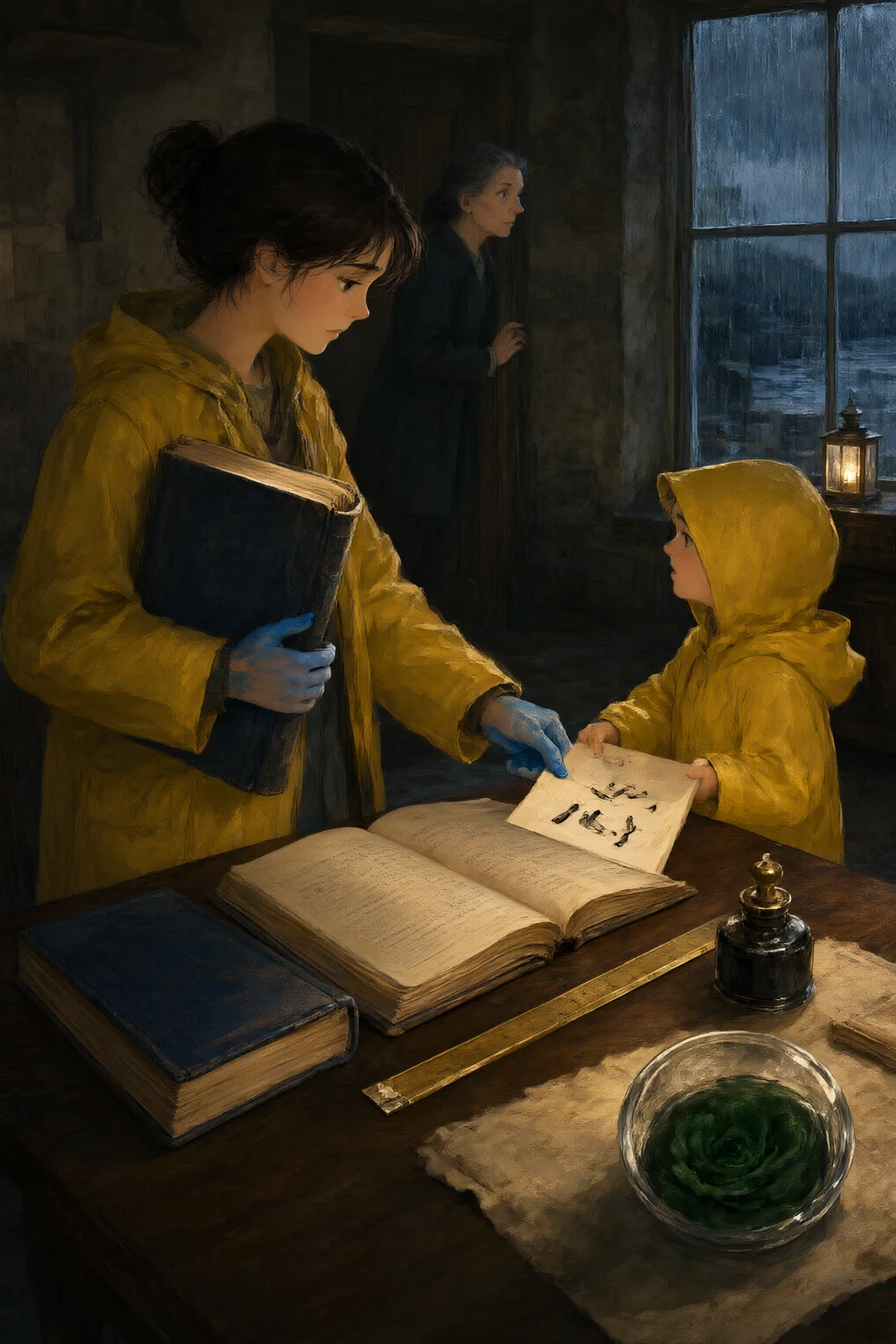
The Great Oweing Book had been copied out twice, and for fifty-five years nobody had ever thought to lay the two books on a table together, because there was no reason to. Books are not compared. Books are kept. Wren Adry compared them on a wet Tuesday in November in the counting room of the Harbour Council house, with the tarblue cloth of the binding pushed back behind her ears and a cold cup of tea going sour at her elbow, because a Tuesday when the lamps are already lit is when a plaque-keeper has time to look at a plaque. She was fifteen, and the Book was Halla Skerry’s, and Halla Skerry was thirty-four and the Council’s hand with it, and Wren was her apprentice and would be the one holding it when Halla Skerry could not hold it, and the Great Oweing Book had come to Wren at the age of nine out of a dead man’s desk.
The Ridge Line was raised in 1846. It is lit from Michaelmas to Candlemas, one hundred and fifty dusks a season, and there are nine lamps, and a lamplight is one hour of a life given to one post. So the coast owes one thousand three hundred and fifty lamplights a season. Fifty-five seasons of that is seventy-four thousand two hundred and fifty. Wren Adry had it in a sheet of foolscap by four o’clock, and it was the only number she had ever wanted, and she had wanted it since she was ten.
Her grandfather had kept the book for thirty-one years and had died of his lungs in March, and on the last afternoon of his keeping he had sat at this table with Halla Skerry and gone through the arithmetic of a whole season aloud, slowly, twice, so that the girl would have it and so that somebody would write it down. He had a good hand. It was small and even and it sloped very slightly forward, as though it were hurrying to get somewhere polite. Halla Skerry had a different one. It was larger, slower, and pressed hard enough to emboss the leaf from underneath, and the Coast Copy at the Council house was in it from the first page to the last, because the Council had told her in 1871 to start one.
The tallow entries began in the same hand as the rest of the Coast Copy, which is to say that they did not look like a different hand at all, and that was the trouble. The Book said the same entries twice, in two books, in two inks, in two hands, for thirty years, and the entries agreed to the last figure, and a town that has two books which agree has what it thinks is a witness.
Here is what the arithmetic said, and it said it correctly, in every direction, which is the part that nobody warns you about. Entered: seventy-four thousand two hundred and fifty lamplights. Delivered: seventy thousand seven hundred and one. Arrears: three thousand five hundred and forty-nine. Three thousand five hundred and forty-nine, and only that, out of seventy-four thousand two hundred and fifty. That was the number the coast believed: the account clear, the ledger honest, three and a half thousand lamplights the whole width of a deliberate mistake. She could prove it, because the Book was the coast’s own sworn witness, kept by the Adry line for three generations and then by Halla Skerry, and had never once been late. She had the whole of it on foolscap. She was fifteen. “Listen - she has done it,” said Neel Ferrin from the doorway.
Wren did not look up. “Seventy-four thousand two hundred and fifty entered, seventy thousand seven hundred and one delivered, three thousand five hundred and forty-nine short. Nine a dusk, one hundred and fifty a season, fifty-five seasons, never once a different figure, not in a bad month, not in the year of the fever.” “It is nine a dusk,” Neel agreed. “I have trimmed for nineteen years and it is nine a dusk.” “Three thousand five hundred and forty-nine,” said Wren Adry, “is the entire amount by which this coast has ever failed anybody.”
The trouble began with a very small thing, and it began with a wick. Neel Ferrin came in out of the wet with her slicker streaming and her hood up, indoors, in a warm room, because she always had. She had a paper twist in the flat of her hand. “Show me the running column for the tallow years,” she said. “The entries under TRIMMED TO.” “It is not a column. What is it to you?” “Show me.” Wren showed her. The entry for a tallow-era dusk read, in her grandfather’s hand: WICK TRIMMED TO SHOULDER. FOURTEEN TO THE POUND. “That is an oil trim,” said Neel Ferrin. “It is a trim.” “It is an oil trim. You take a wick back to the shoulder and leave it fourteen to the pound, because oil carries up a thin wick and if you cut it shorter the flame walks and gutters and the glass sweats. That is what they did before. I have been sorting burners out of the bin at the Lamp House since I was nine.” “What does it say for the tallow years?” “It says the same thing,” said Wren Adry.
“It says the same thing because your grandfather wrote the same thing every night for thirty years without once going out to the post to look, and because when they changed the fuel they changed the man who filled the lamps and not the man who wrote the book. The man who filled the lamps was my father. He burned tallow for thirty years, and tallow wants a wick cut to the knuckle, seven to the pound, and I have cut ten thousand of them to seven to the pound with a knife I sharpened myself, and they are in the bin, in a twist of paper, from every year of it.” She put the twist on the table and opened it. There were perhaps forty charred wick ends in it, black, curled, brittle, laid side by side like specimens in a schoolbook, and they were all short. Not one was longer than the joint of a child’s finger. “They are not dated,” said Wren Adry.
“No. That is why I have brought them and not said it out loud. I cannot prove which year. I can only tell you that there is not one in this twist that was ever cut to fourteen to the pound, and I would know the difference with my hand behind my back. I would know it now, at fourteen, and I knew it at nine.” Wren Adry looked at the wick ends for some time. “The trims are not the point,” she said. “The trims are only a man writing down what he wishes he was doing. What I cannot find is the fuel.”
She went to the Glass Book at four o'clock, because she had been thinking about three thousand five hundred and forty-nine since the morning and could not make it let go. The Glass Book was kept because a chimney costs four shillings. Each entry gave a post number, the date the glass was blown at Nettlefold, and the date it was taken down. Ninety-one lanterns on the pegs at the Lamp House, nine of them on the Ridge Line, and the Glass Book had all ninety-one. In the twenty-five years between the raising of the line in 1846 and the tallow in 1871, a chimney on the Ridge Line stood eleven, twelve, fourteen years. After the tallow it was seven months. Seven months, twenty-two times across, all of them within the harbour five, all of them the first five.
Wren Adry sat with her finger on the entries, and then went and got the coast’s oldest surviving glass, which was the ninth lamp at Cormorant Head, and which she was not permitted to touch and touched anyway, with a cloth, holding it up to the window. It was brown. It was not green. It had a bloom on the inside, a fine green fur standing up off the glass in a soft rotten velvet about the depth of a thumbnail, and she had seen that bloom a thousand times in her life and had always thought it was damp. Then she took a rule out of her pencil case and measured the bloom on the first lamp, standing in the corner because it was the spare, and on the second, and on the third, which was the one from the previous winter, and on the ninth, which was from before she was born. First: a sixteenth of an inch, and green. Second: a thirty-second, and green.
Third: a sixty-fourth, and green. Ninth: two sixteenths, and brown, and thick enough to scrape with a thumbnail. She wrote the progression out on foolscap in a column of her own, because the Glass Book had dates and dates were not the right instrument. Sixteen. Eight. Four. Two. Six. Fifteen. Thirty. Which was not a rate. A rate would have gone one to two to four to eight. This went sixteen, eight, four, two, and then instead of continuing it stopped and went six, fifteen, thirty. The bloom was not growing. The bloom was being cleaned off. That was what the fourth spare was for, and the fifth, and the sixth. Once a season the Chief’s men scoured the inside of a chimney down to the glass, and the glass came up clear like a window, and the next season the bloom came back further, because whatever they had put in there was eating the glass faster than a chimney of oil ever had.
“If the bloom is a season’s work,” she said out loud, to an empty counting room, in a voice that made her own skin go cold, “and the scour takes off a season’s work, and the harbour lamps are scoured every season, then those lamps have had a season’s worth of bloom re-deposited thirty times a year for thirty years, and they are not ageing at all. They are being kept young. Deliberately. And the one at Cormorant Head, which nobody can reach cheaply and nobody scours, has been left to go its own way, and it is thirty years old, and it is brown.” She sat with her hands flat on the table. “The scoured ones will not tell me anything. I have to use the one nobody touches.”
Then she broke the arrears into the two parts it was made of, because that is what you do with a number, and the two parts were not the same size. Three thousand five hundred and forty-nine, less three thousand, leaves five hundred and forty-nine. The three thousand had a shape. Four thousand five hundred tallow-dusks had been rendered and burned since 1871, and every one of them had been entered in the Book as a full lamplight, and a tallow-dusk delivers a third of what a lamplight delivers, which means that of four thousand five hundred entered, three thousand was never shown to anybody, in any book, on any board, in any year. That was a clean number with a clean explanation, and the explanation was a substance, and the substance had a smell, and Wren Adry had been in its smoke for two years without ever once asking what it was made of. The five hundred and forty-nine had no shape at all.
She went looking for it the way you look for a man in a crowd by counting heads, and she got nowhere, and it took her until the lamp light came on the window. The Book carried a line for the unposted. Thirty-one people went into the water. Nine of them have a post. The other twenty-two have never had one, because a tenth lantern cannot be raised on this coast and a seventh name cannot go on a lamp, and every plaque-keeper since 1846 has known that and written it down and gone on. And yet. For thirty years, in the running entries, beside the nine, there had been a column headed CARRIED UNPOSTED, and it had a figure in it every dusk, and the figure was the nine carried on again at the rate of the nine, lamplight for lamplight, for twenty-two people who have nothing to light. Five hundred and forty-nine over thirty seasons.
She could not source a single one of them. Not a post, because there is no post. Not a plaque, because there is no plaque. Not a name in the bay’s own list of the taken with a lamp against it, because the bay’s list has thirty-one names on it and nine of them have a lamp and twenty-two have a hole where a lamp would go, and the sea has never once asked this town for anything on behalf of the twenty-two, and there is no letter and no bill and no demand, because the sea does not send bills. It takes what is put in the lamp or it takes nothing.
It had been entered at the rate of the nine anyway. Somebody, in 1871, in that slow heavy hand, had carried the dead of this town against themselves at the going rate, for thirty years, in a sum nobody could check, on the assumption that what is owed for a man with a post is owed for a man without one. “Because we always assume it,” said Wren Adry, to the counting room. “That is the whole reason. Not because anybody knew. Because it is a rota, and a rota is a habit with a column in it, and a habit does not ask whether the thing it is carrying is still there.”
She did not go to the Council that night. She sat on the counting-room floor with her back against the warm stove and the foolscap on her knees and did the last sum, the one she had been putting off since the morning, which took her a very short time, and which was the only one of any use at all. Three thousand five hundred and forty-nine divided by nine is three hundred and ninety-four nights and one hour. Three thousand five hundred and forty-nine divided by one hundred and forty-one doors is twenty-five hours and ten minutes. Twenty-five hours and ten minutes, a doorway, every year, for as long as there are doorways.
And then, because she could not leave it alone, and because it was the only number in the whole of the arithmetic that nobody in Brinehold had ever once said out loud, she took the remainder. The one hour that is left over when three thousand five hundred and forty-nine is divided by nine four hundred and one times. A lamplight is one hour of a life given to one post. Give it to a post and a man is kept warm. Give it to the column, and it is a line of chalk going round the side of a wagon, and it keeps nobody at all, and it is the whole difference between a rota and a rate. Wren Adry sat on the floor of the counting room and looked at that for a long time.
Because the remainder hour is the entire lie. The nine and the five hundred and forty-nine are both made of real hours, real lamplights, hours somebody gave on purpose with their hand on the brass. Only the last one is imaginary. And it is the last one, and it is the smallest, and it is the only one that is nobody’s. The Harbour Council met on the Wednesday in the counting room with the fog in, and Osa Kilbride in the chair at sixty-six, and Hadren Vole standing at the back with his hands behind him because he had never once sat on that council in his life. Wren Adry put the two books on the table side by side and read out the number. “Seventy-four thousand two hundred and fifty entered. Seventy thousand seven hundred and one delivered. Three thousand five hundred and forty-nine short, and that is all of it, and the Book has carried that figure every night for thirty years and the Coast Copy agrees with it to the last stroke, and that is why the coast believes the account is short and not itself.” Somebody said, “Then we are owed.”
“No,” said Wren Adry. “The sea does not send a bill and there is no letter. The sea does not dun anybody. It takes what is put in the lamp or it takes nothing, and it has been taking less and less for thirty years, and there is no office anywhere in this world from which a demand would come.” She put her finger on the two lines. “Three thousand of it is tallow. Four thousand five hundred tallow-dusks entered as full lamplights, each delivering a third. Five hundred and forty-nine is the column for the twenty-two who have no post.” Halla Skerry had not moved. She was thirty-four and pale and had the Great Oweing Book under her arm, because it was still hers, and because she had brought it to be looked at. “Ask her,” said Wren Adry, to the room, and did not look at her. “Ask her about the trims.”
Neel Ferrin put the paper twist on the table, and then the brown-stained glass from Cormorant Head beside it, and nobody in that room said anything for some time. Then Halla Skerry said, in a level voice, “I entered the tallow.” “Wren,” said Halla Skerry, turning to her, and it was the first time she had used her name in front of the Council. “I came into this room in eighteen seventy-one with the Coast Copy under my arm and your grandfather’s own book open on this table, and I said that the tallow must be entered as a lamplight, because the Book is a record of intent and the intent is nine a dusk, and because if we entered it as something else the two books would not agree and the two books agreeing is the only thing this coast has ever had.” Nobody said anything.
“He copied them in. Thirty years of them, straight down, in one summer, with his lungs going, and I have the pages in this building and I can point you at the night he stopped in the middle of a column and had to be helped in from the stair, and he did it to keep the two books level, and I asked him to.” “You asked him to.” “I asked him to,” said Halla Skerry, “and he did it for thirty years, and he never once asked me what we were boiling, and I never once told him, because we were boiling it out of the rendered fat of sleeping townsfolk, and I have known that since the sixteenth of October 1871, and I have put in both books every night since.”
They let her keep the book. That was the vote, and it was unanimous, and Hadren Vole did not vote because he was standing at the back with his hands behind him. It was half past three when she came out, and the lamps were due, and the fog was up to the Lamp House door, and the harbour end of the Ridge Line was already going, because Ansel Quance was out on the walk ahead of her with a pole and a list and no spare key.
“Five lamps in the harbour five, and one past the head,” said Ansel Quance, arriving at the end of the walk in the fog with his breath coming in little ragged bars, a red mitten on and the other one in his pocket, and his hands white to the second knuckle. “One, two, three, and the first one is going. I can see the bloom on the inside of it from here and it is a bad one. I am not going to be the one standing there when that one goes out on its own, because the tide board says lights go from the inside outward, and I have read that board since I was six.” “Ansel.”
“I know,” said Ansel Quance. “I have got a jar. That is not a solution, that is a bad habit, and I have known it was a bad habit since I was eleven, and I am not throwing it away tonight either, and if you want to write that down you are welcome to write it down.” Nobody wrote it down. Wren Adry walked up to the ninth lamp at Cormorant Head with the Chief and a can of eiderdown oil and a chamois, and she did not touch the lamp, because she was fifteen and has never been a bearer, and she stood four feet away with the can in her hands and gave it to him when he put his hand out for it. Below them the whole bay lay out flat and pale and going black slowly from the middle outward, and there were eight small orange sparks strung along the cliff top and one dark post where the ninth ought to be.
“Three thousand five hundred and forty-nine,” said Hadren Vole, when the flame was up and the plaque had filled. “I have been the man who wrote one, three thousand and forty-nine of them. Thirty years. And I did it at thirty-one years of age in one afternoon and I have never told a living soul, including my own wife, and I was not even in the room when they rendered the first of it.” “I know,” said Wren Adry. He looked at her then, properly, for the first time in his life, and there was a lamp-black thumbprint in the crease of his right hand and the sea-foam white along his jaw, and he said, “Then it was cheaper.”
“No,” said Wren Adry. “It was cheaper. That is not the same as being right. It is not even the same as being wrong. It is a third thing, and it is what this town has been doing for thirty years, and it is written down in two hands, and both of them are our hands, and one of them is mine.” She did the last of it at nine o'clock, when the fog had gone and the whole of Brinehold Row had turned amber from above, the way it does every night of the season, the way it has done every night since 1846. The tide board is nailed by every door in Brinehold, and on it is chalked the evening’s nine lamps, and beside them the line of blue strokes that records what the coast has spent this month, which the Harbour Council has kept since the compact, and which for thirty years has been in the same hand, and which has never once been right.
Wren Adry took a stick of chalk and stood in the middle of the row with a lamp hooked off a pole to give her the light, and the shadows of the drying nets striped the wall behind her like handwriting, and she wrote the month’s figure in, and then she wrote under it the second figure, which was the one the Book had never had a column for. The figure the coast had entered, in lamplights: the same as always. The figure the coast had delivered, in lamplights: three thousand five hundred and forty-nine short. The figure the sea had asked for: NOTHING. NO COLUMN. It never has. It has been asked nothing, ever, and it has never sent a bill, and the only thing in ninety-eight years of honest record that has ever been owed anything is a line of chalk on a wagon. And under that, smaller, the number she was certain of: FIVE HUNDRED AND FORTY-NINE — CARRIED FOR THE TWENTY-TWO WHO HAVE NO POST — UNSOURCEABLE.
Eleven people watched her do it, which is the entire population of the upper Row above the Lamp House. Halla Skerry watched from the step of the Council house, with the Great Oweing Book under her arm, because it was still hers that evening and would be Wren’s in the spring. Then Wren Adry put the chalk down, and squared the Book against her ribs the way other children carry a doll, and said the sum out loud, because that is what she is for, and because it had to be said in front of neighbours, and because nobody on this coast had ever been willing to say it and the sea had made very sure of that. The sum was right. It had been right in every direction except the one that mattered, which is a thing that can only be found by somebody willing to sit on the floor of a warm room for an afternoon and be wrong about something she loves, and then to be right about it, and then to say so out loud, standing up, in a street, with a piece of chalk, in front of her teacher.