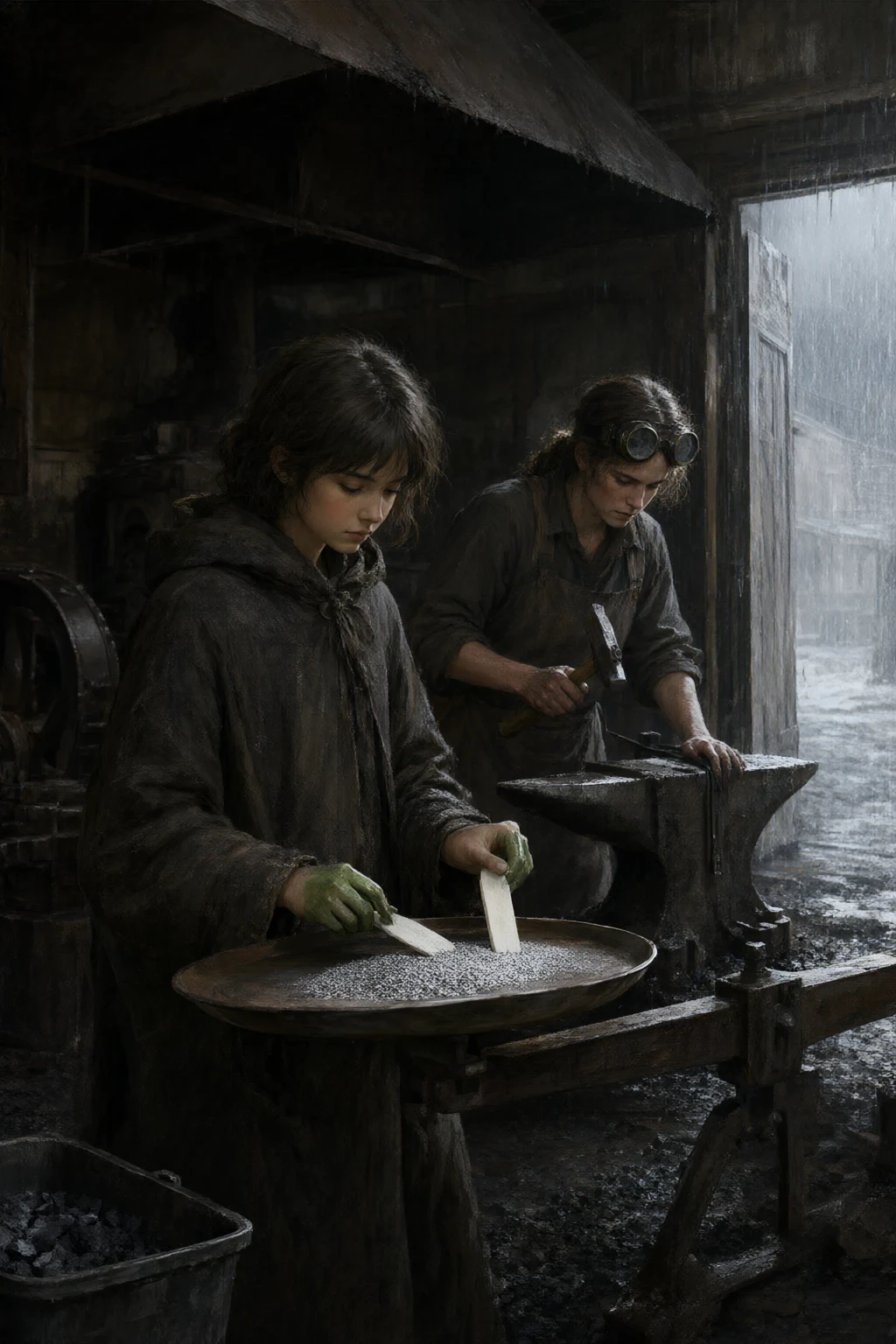
The Cindermill's beam balance had two pans and a tongue in the middle, and in four hundred years the tongue had never once lain level. The smiths would not have it otherwise. A balance that lay dead level in this valley, they said, was a balance lying. Nessa Brack was fourteen and in her third season and stained green-black to the second joint on two fingers of her left hand, which she did not hide, and she was the only person in Nettlefold under thirty who could read a filing ledger. That is not a compliment. It is a way of describing a girl nobody else wanted to sit with all night doing sums. The key to the balance case hung on a string round her neck. It had been Elder Ashdown's, and before that her mother's, and the string had been knotted twice by somebody in a hurry. “You will want the Scriptorium key as well,” Ashdown said. “Not tonight. Tonight I want you to understand what you are about to do, which is nothing.” “What I am about to do is sums.”
“You are about to read four hundred years of sums and to find out whether anybody has been honest.” Ashdown set her hand flat on the oak stand, and her good eye went along the board the way a finger goes along a rail. “There are two ways that ends, child. You find the book clean and you have wasted a winter. Or you find it not clean, and you will have to say so out loud, in a room, to people who will lose something. Decide now which you would rather have. It is much harder to decide afterwards.” “I would rather know,” Nessa said. “So it goes,” said Ashdown, which was not a phrase she used, and which Nessa noticed, and did not think about again for some time.
The Scriptorium was a cold upper room over the tithe store with one north window, and the smell of it was old bark and cold ash and the particular sourness of sap that has gone a long way in a cold place. The pact-board filled one wall: forty-one lines of glossy dark script on pale bark, each line a separate strip of birch nailed to oak, the letters faintly crawling even in the flat light, as though they had somewhere to be. Beneath the board, set into the floorboards, was the seal-pan. It was a shallow tray of cold iron, two hands across, with a raised lip. The cold-iron nail that sealed the pact stood through the last line and down into the middle of it. The nail was square-headed and black, and it had never once been warm, not even in the July of the year the old mill caught and everyone said it must be iron, it is iron, iron does not do that.
Once a year, at the Samstag reading, the Warden poured into that pan the whole of the year's filings, every pound of bog iron the enclave had rendered since the last reading, and the pan was weighed, and the weight was read aloud, because an exchange that is not named out loud has not been paid for. What the village took out of the bog was paid to the Wood in cold iron. What the village asked of the Wood in return was paid in sap, and the sap went into the lamp oil, one spoon to a lamp for the season, and that was the price of the light, and everybody resented it, and nobody refused it. The tally of the pan stood in a birch strip nailed to the skirting. Four hundred and nineteen entries. The first was four hundred and twelve pounds and six ounces, and the last was nine hundred and sixteen pounds and fourteen ounces. Nessa read that line nine times. “You have found something,” said Ashdown. “Your face has gone all of a piece. Sit down before you fall down.” “There is a difference.”
“There is a difference,” said Ashdown, “and you have been counting since you came in, and you have got to it faster than I did, and I have been at this board fifty-one years. So tell me the difference in a sentence, and then go and eat something, because you will not want to eat anything after you tell me.” Nessa looked at the strip again. “It goes up the same every year,” she said.
The filing ledger lived in the tithe store on four oak boards, kept by a system nobody had ever explained to anybody and that Nessa worked out in a week. Iron came out of the bog at the west cut in barrow-loads, and it was weighed at the Cindermill by the balance, and it was rendered. Rendering produced two things. There was iron fit for the work: nail stock, hinge stock, drip-pan, lamp-frame, and so on. And there was iron too fine, too burnt, or too full of scale that would not take a heading. That second kind was called the sweepings, and the sweepings went into the pan, and the sweepings were the oldest entry in the whole ledger, older than the founding, because a thing nobody thinks of is a thing that has always been there. So the year went: rendered, and then divided into three columns. Spent in the enclave. Sold at the cross. Poured into the pan. And the three columns ought to make the rendered column. Every pound that came out of the bog ought to be accounted to the ounce, because bog iron is not like corn; you cannot lose a pound of it in a barn. If a ledger loses a pound of iron, then somebody has carried a pound of iron off in a sack, and a sack is a thing you can see from the road.
Nessa did the sums at night in the back room of the tithe store, with a scrap of candle and the board across her knees. She had rules for it, and she had made the rules herself, and they were good rules. Rule one: do not look for the mistake. Look for the habit. A mistake happens once. A habit happens every year, the same, without anybody deciding to do it. Rule two: when a difference repeats, it is not an accident, and it is not a lie, either, not at first. It is a practice that was reasonable when somebody started it. Rule three: be suspicious of any year in which nothing happened. Nothing happened is when you find out what people do when nobody is watching. The difference was four pounds and eight ounces. Half a pound. She wrote it out nine times before she believed it, and then she went back and wrote the year beside it, all nineteen years, and every year said four pounds and eight ounces, and not one year said anything else. Half a pound is the weight of two full tea-cups. Half a pound a year for nineteen years is eighty-five pounds and eight ounces, which is the weight of a grown man and a good bit more. It is also nothing at all, if you never once lift the pan.
“It is half a pound,” she said, to the candle. “Half a pound a year. Nineteen years.” The third winter back, the water had been low and the race frozen and the wheel had not turned for nine months. The eight anvils had been cold. There had been no sweepings, because there had been no smelting, and no filings, because there had been no iron, and on the strength of the ledger the pan ought to have gone down that year, and down by a good deal. It went up four pounds and eight ounces.
She took the finding to the Cindermill, because the sweepings were the Cindermill's, and because Tace Aldren kept the second half of the filing ledger and would know about a pound of iron the tithe store did not. Tace was nineteen and third generation, with a burn-scarred inner forearm she made no attempt to cover and brass forge goggles pushed up into untidy hair, and she was hammering a hinge-strap to a count of ninety because the shed took sound badly and the smiths worked by ear. Nessa waited. She had learned to wait. It is more use than talking. “Say it, then,” said Tace, without stopping. “The pan went up four pounds and eight ounces in the year you made nothing.” Tace's hammer came down one time more, exactly on the beat, and then stopped. “Say the rest.” “There were no sweepings. There was nothing to sweep. It went up anyway.” “Ah.” She set the hammer down and turned the goggles down over her eyes and pushed them back up, which is what she did instead of thinking. “That is not the mill's half, then. Is it.” “No.” “No, it is not.” She wiped her face with the back of her wrist. “Draw-filing hell. I have been telling them for nine years that the cross buys more filings off us than it has any business buying, because who in slag's name wants a hundredweight of fine iron filings?”
“Snails,” Nessa said. “Nails. Small work. The ledger says nails. The weight does not go like nails. It goes like it never arrived.” Tace looked at her for a while. “Eleven years I have been at that bench and I never once asked where the coarse went,” she said. “You have been at the book a fortnight.” “I have had nothing else to do.” “Slag luck.” Tace picked up the hammer again and did not start with it. “Go and ask the man at the cross, then. And Nessa—” she waited until Nessa was at the door “—do it in the daytime and take somebody with you. I am not saying he will do anything to you. I am saying nobody in this enclave has ever asked that man a question with a number in it, and a man who has never been asked a question with a number in it is not a man you want to meet with one at dusk.”
Osmund Rigg had sold charcoal at the Cross for thirty-one years. He sold charcoal in sacks, and peat, and lamp oil in churns, and a bad tea, and he was the only man in Nettlefold whose cart stood a hundred and forty paces east of the boundary mark, which was the closest to the line anybody could work without a nail in the ground to say why. His cart stood east of the mark because east is flat and firm, and the ground west of the mark is bog under a foot of bracken, and he has watched two wheels sink to the hub in that bog and had the sense to learn. That is the whole reason. Everybody knows it is the whole reason. Nobody has ever said so in front of him, and there is a rule in this place about the mark, and men with carts respect rules with holes in them. He was fifty-eight with a cold in his chest that had been there since the flood year, and when Nessa and Merrin Vale came up to his cart at four in the afternoon he was sitting on a turned-out bucket with his hands inside his sleeves. Merrin had asked to come. Nessa had said no. Merrin had said “is that allowed?” and Nessa had said “no,” and Merrin had come. “You want to sell me candles,” said Osmund Rigg.
“I want to ask you about filings.” The hands came out of the sleeves. “Sit down, lass,” he said, and pulled the other bucket over with his foot, and said nothing else until she was on it. Then: “How much.” “Four pounds and eight ounces a year. Nineteen years. Eighty-five pounds and eight ounces.” “That is a very small amount of iron to come all that way about.” “It is a very small amount of iron to have been taken out of a bog in this valley nineteen times without leaving a mark on the road.” Osmund Rigg looked at the middle distance for a while. Then he said, “Nobody took it out of the bog,” which is the first thing a man says when he has decided to tell you.
“The filings are rendered from bog iron. The filings you buy are rendered from bog iron. Yes. I pay for them. I have paid for them every Thursday for nineteen years, and there is a note of every Thursday, and my wife kept the first eleven of them before she died, and I have the rest in a box under my bed, because I am a careful man and not because I am a good one.” He straightened up, which cost him something. “I have paid market. I could not carry them home without putting them down somewhere first, so I put them in the pan. The pan is a better place than a cart. The cart is out in the weather. The pan is under a floor with a lock on the door.” Merrin said, “But the board reads it.” “The board reads a number, lass.” “The board reads a number, and the number is the whole of what the Wood is given to know, and the Wood does not know the difference between iron you rendered and iron you sold and carried back, because the Wood has never heard of a Thursday.” “No,” said Osmund Rigg. “The Wood has not.”
Nessa took out the paper on which she had written the whole of it, and she had a rule about that too, which was that you do not hand a man a number you have not first tried to break yourself. “Here is why you are wrong,” she said. “It is not wrong that you paid. I have checked the ledger; the sales are all marked, and they are all marked in round numbers, and they are all marked to the pound, and that is the one thing in the whole book that is not to the ounce. So somebody is selling you iron by the load and not counting, and you are owed a great deal more or a great deal less than you think, and I cannot tell you which, and neither can he, and that is the first thing. “The second thing is this. Iron is not what the Wood eats. You are feeding the seal with the same metal the village smelts out of the ground under the Wood's feet. The Wood does not live on bog iron. The Wood lives on sap, and the sap goes into the lamps, one spoon to a lamp for the season, and the number of lamps has gone down from one hundred and forty-four to one hundred and thirteen, and the Wood has not had a full meal since the year your first bag went into that pan.” Osmund Rigg sat on his bucket with his hands in his sleeves and did not say anything for long enough that Merrin counted, which she did not have to do twice. “Then I have been robbing it,” he said. “You have been putting your own money into the wrong bucket for nineteen years,” Nessa said, “and the village has let you, because the village wanted the pan to look fed.”
The paper went to the notice-slate, because the notice-slate was where orders went so that anybody could be angry at them on schedule, and this was not an order yet. It was a finding. A finding that went up on the slate became an order the moment somebody nailed it there. Oren Vall read it standing, with his staff against the standing stone and his left knee making its noise in the cold. He read it twice, and he held the paper a long way off with his arm out straight, because at sixty-two you can hold a thing at arm's length longer than you can hold it at your nose. “Who did the additions,” he said. “I did the sums. The sacks are the man's. I have not proved them and I have not accused him, and he told me himself, in front of the child.” “Aye. Aye, but—” He stopped. She counted. Four, five, six. “They came from outside the mill,” he said. “They did.”
“Then it is not the mill's doing, and it is not Sarn's, because Sarn died eleven years back and the first of those nineteen is eight years before he died.” His thumb went along the staff where it was worn to a shine on the left side, which it was, and which everybody had seen for forty years. “But Sarn told me once, when I was twenty-three and had been in the ward six months, not to ask what went into the pan. I asked him why. He said: because you will not like the answer, and you are young, and there is a difference between a man who asks and a man who knows. I have had thirty-nine years to think about that sentence. I would have been better served if he had said: because it is half a pound, and nobody is harmed.” He put the paper down on the standing stone and squared it with two fingers. “Lass. The lamp oil has been cut nine winters. Nine. I nailed that order myself, in my own hand, on this same slate, because the pan said we were square. I stood here and did the sums wrong, and the sum I did wrong was the pan. I have slept on it ever since.” He picked the paper up again. “What does the lamp oil come to.”
Nessa had it ready. She had hoped he would not ask, and had the figures ready anyway, which is the whole of what she was. “Thirty-one lamps,” she said. “One spoon to a lamp for the season. Nineteen years. That is five hundred and eighty-nine spoons.” “And a spoon is two ounces.” “Two ounces, by the tithe measure. Five hundred and eighty-nine spoons is one thousand one hundred and seventy-eight ounces, which is seventy-three pounds and ten ounces of sap.” “Sap,” said Oren Vall. “The living substance of the trees. The Wood is short seventy-three pounds and ten ounces, and the seal is heavy with eighty-five pounds and eight ounces of nothing, and both those are true at the same time, and I have not found a way of making them not true.” He was quiet a long moment, and then he laughed, once, with no amusement in it at all, and it sounded like a hinge. “Put it on the slate,” he said. “Both numbers. And put my name under them, and the year, and the words: the lamp oil was cut upon the assurance of the pan. And nail it up at dawn, before the market, so that the man with the charcoal has to stand there and read it before anybody can come over and tell him what it says.”
The Samstag reading is not a service. There is no word for it in Nettlefold and no word would do, because a service is something done to you and the reading is something done at you, on a schedule. The whole of it takes about eleven minutes. Everybody in the enclave may stand in the Scriptorium, and Merrin Vale is the only child permitted, and she is permitted because she asks. Ashdown read all forty-one lines in a soft sing-song, and after every line she stopped and said the same line again, slower, as though the first time had been for the room and the second was for the trees. And at the end, where the reading has always ended, before the two parties go out into the dark and the Wood does whatever it does for the rest of the night, the Warden stands up and reads the pan. That is not in the forty-one lines. That is an arrangement, and it has never needed to be in the lines, because anybody who was alive last year knows the arrangement, and an arrangement everybody knows does not have to be written. The reason it has never had to be written is that it has never once had anything to say.
Nessa had to say it. Her arithmetic was the only arithmetic in the enclave, and Oren Vall could not do sums in front of people any more than he could climb the stairs without telling them about his knee, so she stood at the reading stand with the paper in her sap-black fingers and read the numbers into a cold room with one north window. “The pan stands at nine hundred and sixteen pounds and fourteen ounces,” she said. “It stood at four hundred and twelve pounds and six ounces at the founding. The filings of the nineteen years since are four hundred and eighteen pounds and twelve ounces. The true weight of the seal is eight hundred and thirty-one pounds and two ounces. There is in that pan eighty-five pounds and eight ounces of iron the village did not render, and I cannot account for a pound of it.” Nobody said anything. “And the second number,” Nessa said, “because I was told to say both, and I have thought about that on the stair, and I have decided that a person who reads half a number is the same kind of person as a person who takes half a shift. Thirty-one lamps out since the founding. One spoon to a lamp for the season. Nineteen years. Five hundred and eighty-nine spoons. Seventy-three pounds and ten ounces of sap the Wood has not had.”
Oren Vall got up. He got up the way he gets up, with the staff and the pause, and stood beside the stand, and did not read from the paper. “The lamp oil was cut upon my assurance,” he said, “and my assurance was the pan, and the pan was fed with a sack of iron bought at my own order by a man who has never once been thanked for it and has never once been asked to be. Nettlefold is short of sap by seventy-three pounds and ten ounces, and the seal is heavy with eighty-five pounds and eight ounces of nothing, and both of those are true at the same time. That is what a starved document looks like. I did not know. I want that in the room, because I am going to be told for a year that I knew.” He looked at the board, all the way along it, at the crawling letters. “I invoke the thirty-eighth line,” he said. “A matter has been spoken at the reading that is not upon the board. The board is not amended. The parties shall within thirty days convene a full assembly, and there the board may be made whole, or the pact may end.”
It was quiet in the Scriptorium for a while after that, in the way a room is quiet when everybody in it is doing arithmetic. Then, from the open door, a sound that nobody in the room made and everybody in the room had been listening for all their lives: the birds, out in the Wood, coming to the end of something. They had cut off, mid-phrase, for four hundred years. The birdsong in the Walking Wood has always known better than to finish a phrase, and there is not one child in Nettlefold who has not heard it happen ten thousand times. Merrin said, “They finished it.” Nobody asked what. There was nothing to ask. It had been going for a little while by then, and it had the sound of a phrase that has been held for a very long time and has finally, carefully, let go. Nessa stood at the stand with the paper still in her hand and did the last sum of the evening, which was the only one that was not hers to do. Somewhere below, in the dark, a tree that had been standing at the edge of the light for nineteen years took one step, and put its weight down, and did not go any further.
At dawn the order was on the notice-slate at the Cross, with Oren Vall's name at the foot of it, and the two numbers, and the two dates. Osmund Rigg was standing at the back of it, in the cold, with his hands in his sleeves and his cart where it always stood, a hundred and forty paces east of the mark and not one pace nearer. He had got there before the market, which meant he had got up in the dark, which meant he had not trusted anybody to read it to him and had walked two miles to read a slate himself. He read all of it. Then he read the part with his name in it, which is to say there was no part with his name in it, and looked for it a second time, and could not find it, and Nessa, watching from the head of the Row, understood that this was the thing going to cost him. Not the money. Being the whole of the explanation. He caught her eye across the square and lifted one hand, the way a man does at a dog he is not going to take advice from.
Nessa came down at eight to start her round, and found the slate already crowded, which was nothing unusual, and read the last line, which is the line somebody always adds in chalk, and which is the only line on any slate in Nettlefold that is not the Warden's. It said: full assembly, thirtieth day, the Scriptorium, all households of the Row and all of the Wards, and the finding of the pan to be read into it entire. Underneath, in a much smaller hand, a girl who had not been asked to write anything had written one word, and had rubbed half of it out, and had left the rest, because rubbing all of it out would have been a decision. It said: honest. Oren Vall read that too, on his way past, and stopped, and clicked his knee twice on the gravel of the Cross. “Aye,” he said. “Aye, but that is a word we will want defined before the thirtieth.”