The Maps Room keeps its schedule in a hand that does not vary. Perran Hesk took the Room on the sixth of February, 1878, and by the twelfth he had begun on the schedule of unclassified charts, because that schedule is the first thing a new keeper does, and there are one hundred and six of them, and every one is a chart of a place the Library has never been. They came in a lot of forty-one, bought at the Greyhaven sale in January, all paper, all rolled, all water-stained along one edge in the manner of things that have hung a long while in a netloft. The Library buys at sales. It has never been able to refuse anything, because a refusal is a decision, and a decision has to be entered somewhere, and the building has never had a column for it. The hundred and sixth was not a chart of a place. It was linen-backed, folded twice, the folds gone soft the way a crease goes when it has been folded and unfolded and folded again by somebody deciding. One corner was patched with tarred sailcloth sewn on with waxed thread in a small neat hand. The drawing was in copperplate, and it was a section: the Tide Library in cross-section from the east, the way a man draws a thing he has been asked to see inside of.
The eighty-one stilts, numbered along the bottom in a figure running to three digits. The seven steps. The oiled slate. The gutter inside, drawn with a line that dipped and came back up, which told Perran that the draughtsman had stood in the Spine and looked down into it. The long low rooms with their shelf-marks ticked against them, the whole upper floor given over to one room with a kettle in it. And beneath the widest room, beneath the long table and the great globe on its brass meridian, at the height of the tidemark on the wall, a door. Twenty-one inches. Perran measured it twice with the brass dividers, because it was a survey and a survey is measured. A stair went down behind it, nine steps, into water. The water was drawn as the sea is drawn on the maps of this coast: a single flat line with three small curls on it, and the curls meant nothing. Beside the door, in the same copperplate: the door is 21 inches and my shoulder is 19 Perran Hesk read it four times. Then he turned the sheet up to the lamp, because the Maps Room is lit low and a nine-year-old’s copperplate deserves daylight, and at the bottom right, under the flat line, where the draughtsman signed: P. Hesk, aged nine. Easter, 1878. It was the twelfth of February, 1878. Easter was ten weeks and twelve days off.
He verified in the order the verification should go: the hand, then the date, then the fact. The hand was a child’s and a good one. He had ruled the tidemark with a straightedge and numbered the stilts, which no draughtsman does. Then the name. The Library keeps a Readers’ Book, eleven volumes, every borrower in three hundred years with the date of first entry and the date of last. He ran the index twice. There are eleven Hesks in it, and eight are a tailor’s son, a wrong chart of the Shelf, a bible, an entry with no exit, and Peter Hesk of 1802, who was Perran’s own great-grandfather and whom the house had called the only Hesk who ever read anything at all. Nine. And then two more. His sister’s girl, Vess, entered at the age of seven in the September of 1875, the only child in thirty years, with the annotation UNDER THE CARE OF A. ROE, KEEPER, in a hand that was not his own, and nothing else in the volume in Anja Roe’s hand, which was itself a datum. And a nine-year-old Hesk, born in 1869, who was not on any roll in the building.
He wrote the finding on a slip of paper, the way a man writes down a finding he does not believe, and dated it, because the date is part of the finding. The slip says: The chart is signed by a person not yet born. The section is accurate to within an inch. Signed P. Hesk, aged nine. Easter 1878. Verifier: P. Hesk, aged forty-five, twelfth of February 1878. Both signatures are in the same hand.
He went to the Servery, where the unofficial readers are, because if a Hesk of nine had drawn a section of the Library then there was a Hesk of nine in Greyhaven who could say whether it was hers. She was at the long amber table with her feet off the bench and a pen-knife she was not supposed to have. The Servery holds no books, which is why it is the safest room in a building that takes a part off everybody who turns a page: a room with no pages is a room where nothing can be taken. The kettle was singing, and Niko Sarran was standing up, reading a tide table off the wall slate out loud, to nobody, seventeen years old, a wet navy streak of ink across his left palm that had been there a year. “—and the eleventh night is the one that takes the Gallery,” Niko was saying. “But who decided that? If it’s on a slate it’s a rule, and a rule is a person’s decision, and a person can decide a thing wrong, and then what?” “Alys,” said the girl, without looking up. “Alys who?” “Alys Skell, and she is not a book, and I am not going to talk about it.” Vess put the knife down. “You have had that paper in your hand the whole time and your hand has been going, and then you will tell me.”
He gave it to her. She turned it round and looked at it for a long while, the way a child reads a house, by the outsides and the sounds. “That is not the house I drew.” “You have drawn a house?” “I drew a house for Marda and she is going to hang it up, and it has got a door and everything.” She turned the chart so the door was nearer her. “That is not it. That door is the wrong shape.”
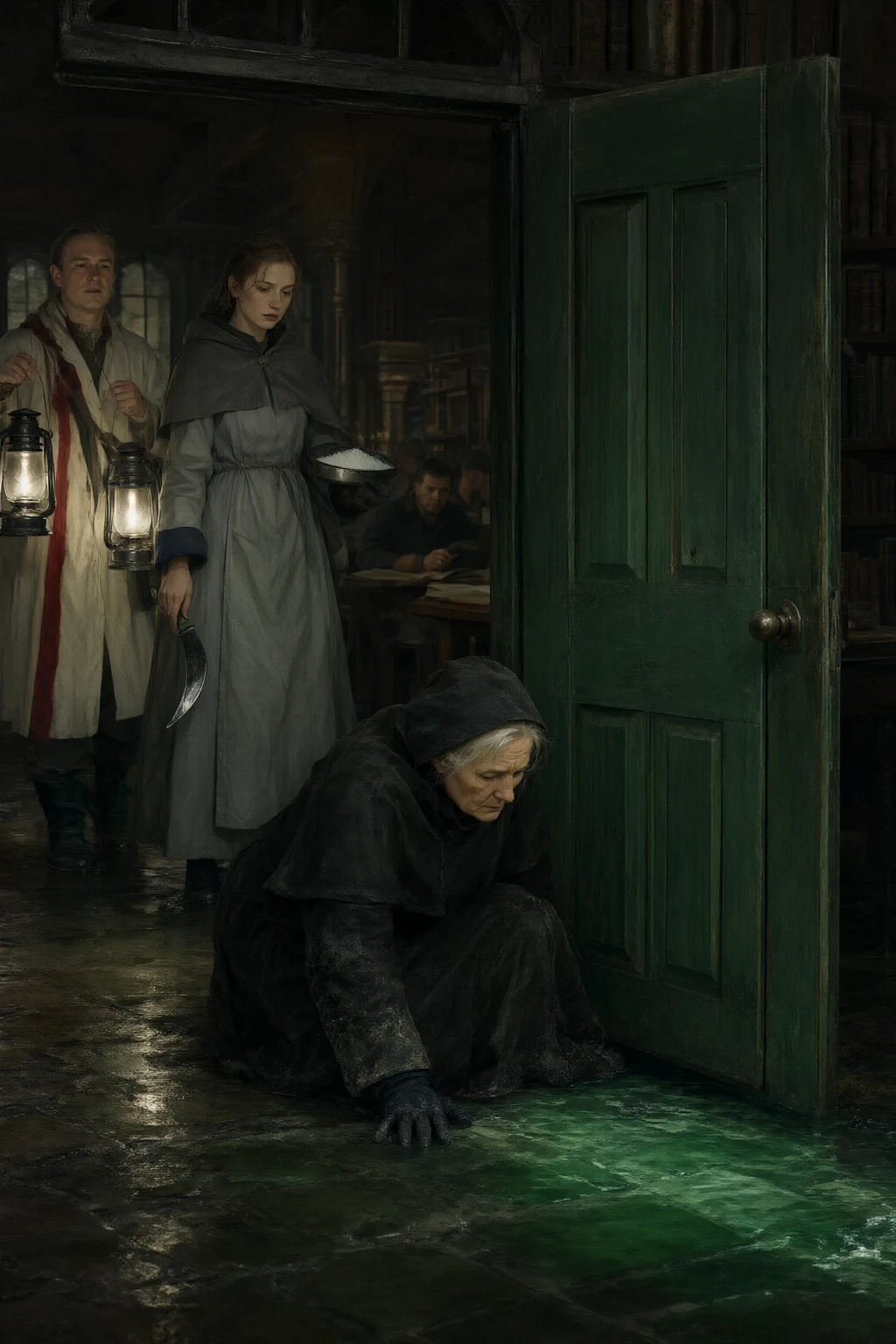
“Wait,” said Niko, who had come across the room without any sound and was reading the corner of the sheet upside down, as people do. “Wait. Twenty-one inches. And under the Atlas table. Anja,” he called, without lowering his voice, which is a thing you do not do. “Anja, come and look at a door.” “Now then,” said Anja Roe, from the stair, and came. She is sixty-one and has been senior keeper for thirty-four years, and she came down into the Servery in a heavy black cassock gone stiff and salt-bleached to the hem, her hood slipped back and staying there, her right hand in a blackened wool glove. She looked at the chart for a long time. Perran watched her look at it, and catalogued the order, because he could not help it: the stilts, the steps, the section, the tidemark, the door. She did not go to the door first. She went to it last, stopped, and then ran one blackened finger along the tidemark without pressing. “That is at the right height,” she said. “That is exactly at the right height.”
“On the twelfth of February, with a date of Easter, which is a date a child is given by his grandmother and does not choose.” She turned the sheet over. On the back, in the same copperplate, faint: the top of a sail, a mast, a hull going down, and no sea. “It is on the back of a chart of a ship.” “It came in the January lot. I know the lot of forty-one,” she said, and squared the chart to the edge of the table, which is a keeper’s habit and not an archivist’s. “Now then. Who put it in the schedule?” “I did. It is the hundred and sixth. I entered it this morning under the second column.” “The second column is the subject of the chart.” “The subject of the chart.” “And what is the subject of that chart?” Perran said it, because there was no way not to. “A plan of a door that is not in the building.” “Then it is not a chart of a door that is not in the building. It is a chart of a door that is in the building, and the building has never been surveyed.” She took her glove off, which Niko and Vess both noticed and neither mentioned, and the hand underneath was white and the knuckles were wrong. “What happens to a thing in this Library that is not entered?”
“It cannot be cited, it cannot be relied on, and it cannot be destroyed without a minute, because the column for the destruction of a chart wants two signatures and a reason. A door no keeper has entered is a door any man may open and nobody may be blamed for. Do you know what you have done with your second column?” “You have understood it faster than I did.” “I have understood it before you did, and for thirty-four years, and I have never said so.” She straightened. “The Higher Stair is how this building makes a keeper. It puts a step somewhere, and you are meant to take it, and then you are a keeper. Nobody is taught anything. The small door is where the keeper pays. One for one. That has always been the price, I have paid it once, and I have never told anybody. And now you have written the door into a schedule, and a schedule is the only thing in this Library the building cannot get its teeth round without asking somebody to sign for it.” “Anja.” Niko had gone the colour of the wall. “There is a door under the Atlas table.” “There is a door under the Atlas table,” Anja agreed, “and it has been there since before the tidemark was painted, and it is why the Quire is unnumbered, and it is why I am called what I am called. Nobody calls it that. The girl called it. Now then. Fetch Anwen.”
Sister Anwen Tarn came down the sixty-one steps from the Verandah with her short grey cloak over her arm, because it had begun to rain on the low side, and she was carrying the small steel key ring in her good hand and a leather roll in the other. She is twenty-nine and of the House, and the House is eleven wardens who scrape, salt, cut and burn, and the House keeps the only record of what has been warded. She looked at the chart, and then at the glove, and then at the floor, and Perran understood that she had heard about the door before this and had decided not to be the person who said so. “All right,” she said. “Blade, lamp, salt, ledger, chalk. Perran, you are not going down.” “I am the verifier.” “You are the man who put it in the schedule. If there is a door under that table and no keeper has entered it, then the person who entered it last is the person who has to stand beside it.” She was already counting. “One. Two. Three.”
Anja went down on one knee under the table. Perran held the lantern. Anwen stood in the doorway and counted again, because it is one thing to count before you open a door and another to be standing in one. Underneath the Atlas table, against the north stilt, at the tidemark, there was a door. Green-black wood, a brass knob, the size of a bread oven, and no lock on it, and a clean bright line round the jamb where something had been let in and out a great many times. Salt had built up on the sill and had been kept, by somebody, in a shallow groove. “Twenty-one inches,” said Perran. “Who cut the groove?” “I did, in the year I was appointed, with a pen-knife.” She straightened, and her voice did the thing it did at the end of things. “I am going to say a thing, and then we are going to go down, and nobody is to write it down, and I want it understood that I have said it. Ink dries. Go on.” She did not wait to be answered. She turned the knob, and the door came in on the tide without complaint, and the smell that came out was cold iron and green weed and paper. There was water on the other side. Nine iron steps going down, wet, with the ninth one under, and a green light at the bottom with no source Perran could find.
The crawl under the Library is not a room. It is the space between the mud Shelf floor and the black flat, a hundred and thirty feet of it, eleven feet high at the crown, standing on the same eighty-one stilts, and it fills first on the seventh night, because the sea comes at the flat and the flat is what it comes to. There is a green light in the crawl. It is not the spindle lamp; the spindle lamp burns green and eats ink, and this light is cold, and it is the light of a shallow sea over sand, and it moves on the ceiling the way light moves on the underside of a boat. There are eleven tables, made of the Press’s own scrap, deal, with the knots left in. At them are eleven people, and the people are whole. That is the part that stops the breath. They are wet to the thigh, dressed in the clothes they were wearing when the water took them into the building, and they are breathing, and their eyes move, and they turn their pages. They do not look up. Perran understood that they had heard the door and were not going to give it the courtesy of a look, because a person who looks up has finished, and these were not finished. The water came to the second table and lay there level, a foot deep.
He counted eleven. Then he counted against the Quire, which was the only reason he had come, and his face did a thing he was glad nobody had a lamp on. “It is eleven,” he said. “The Quire says nine.” “It says nine because nine is what was there the last time anybody counted, and nobody has counted since,” said Anwen. “The last count is in my book. It is dated the nineteenth of March, 1877, and it is signed by a warden who is dead, and I will not write a number I have not seen twice.” Nobody answered that. Perran noticed that the two new ones were not new in the sense of recent. The crawl does not keep a date. But the third table along held a man in a coastguard’s coat with the buttons gone green, and the coat was a hundred and ten years old, and there was a chalk mark on the stilt behind him at the height of a child’s reach. And on the second table along, on the left, in the position where a person puts the thing they are reading so that they can reach the kettle, there was a woman.
She was perhaps fifty. Her hair had gone the colour of the wet rope on the mud Shelf, which is not grey. She had a slate on her knee, and the slate was the Servery slate, the one with the Rules of One and the Rule of One scratched out underneath in a knife hand that anybody in the building could identify in a dark room at forty paces. She had the slate turned round and upside down, and her finger was going down the list, and her lips were moving. She was making no sound. The woman did not look up. Anja went along the row slowly, on the silt, holding the green light off herself, and stopped at the woman’s left, and did not say her name. That was the part Perran thought about afterwards, for a long time, and it is the part he understood last. There is a rule about names. It is not on the Servery slate and it is not in the Quire, because a keeper learns it in the first year the way a sailor learns a reef. Below the tidemark you do not say a name. Below the tidemark a name is a key, and a key is a promise you have made to the building, and the building does not take offers back.
So Anja Roe, senior keeper of the Tide Library, who had been down here before, knelt in eleven inches of green water in front of a woman who was her mother, and looked at the slate, and did not say the name. Instead she reached out and turned the slate the right way up, so that the reader could go on. And the woman’s finger went on down the list. And the first rule on the slate is the one a borrower is taught before anything else is taught to them: A borrower gives a part, and takes a book, and gives it back wet. And the second thing on the slate, scratched out eleven weeks ago by a pen-knife in a black glove, was the Rule of One, and under the Rule of One, in a hand so much older that the salt had taken it down to a shadow, were three more lines, and they said: A reader is not asked to read a second book. A reader is not asked to be a witness. A reader is alone.
The crawl had a door on the far side, and it was not the door they had come in by, and Anja crossed to it and put her hand flat on it and did not open it. “This is the door you pay at.” “How do I pay?” said Perran. He had not expected to ask it, and he asked it in the voice of a man asking for a schedule. “Here. On this side, and not the other, because the other side is theirs. One for one. It has been that since the building went up. I did it in the year I was made and I have never spoken of it, because when it is done the other one comes up and does not know where she is, and she cannot be told, because the person who paid cannot speak.” “Who came up for you?” Nobody answered him. Anwen made a small sound, a single syllable, and stopped.
“My mother,” said Anja Roe. “In 1825. I was eight. The Library came to me at the table on a Thursday, the way it comes, and it wanted the passage about the ship out of the book about the ship, and it wanted it out of her, because it had come to her for it and she had nothing else that was mine and not hers. So she stood up at the Servery table with the kettle boiling, and she said, out loud, meaning it, that she would be the book. And the price is the voice, and after the voice there is a price for every year you go on being a book, and she has been in here fifty-three years.” She took her glove off again and showed the white hand to a room that had never asked. “I have spent thirty-four years being the Keeper of Small Doors, and fifty-three years telling myself there was nobody in the crawl at all.” “I opened it four times in fifty-three years and shut it again and did not go past the third step,” she said, when he asked. “I am not a coward, Mr Hesk, and I will thank you not to make me one in a report.”
“I know the price of the door. A person for a person, and it is not a price you pay in a part. It is a price you pay in the whole of what you have not spent. And there is a thing about it nobody tells you, which is that the building can only take what you have not written down.” She said it the way a woman says a thing she has been keeping fifty-three years. “A thing in a schedule can be scraped. A thing in a book can be scraped. I have put every day of my life in a book, and I am going down into that water tonight with the whole of it in the Quire, and the Library can take every word, because every word is already written down and I did not need to say it again.” Anwen Tarn said, very softly, “Anja. No.” “Anwen. Count the table. You are very good at it.”
What Anja said next is in no record, because the crawl is under the mud Shelf and the mud Shelf is not a Room, and this building keeps no record of the space between its own stilts, which is a sentence that has been true for three hundred years and turned out that night to be the most expensive sentence anybody had ever published. She said it to her mother, out loud, meaning it, with a woman’s name in it, because her hand was flat on the woman’s knee, and because a name spoken above your own two hands is not a key, and the building is not a devil, it is a filing system, and it does not take what you do not offer. It took the voice. It took it in the middle of a word, the way a knife takes a stitch, and Anja Roe made a sound that was not a word and put her hand over her own mouth and stayed there, and none of the eleven readers looked up, because none of them had ever been able to help, and all of them had wanted to.
It took the passage, too. That is the second price, and it is the one nobody expects, because it is not a part and it is not a secret. It is what you love that you have never once said to anybody else, and it went out of her the way a light goes out of a window, and it was a passage about a ship, nine lines long, about a ship that went out of Greyhaven on a Tuesday with a cargo of salt-cake and came back with four of eleven. On the second table along, the woman lifted her face for the first time. Perran Hesk put his hand over his own mouth and turned away, and was sick behind the second trestle into the water, quietly, in the cold, and nobody heard, and he was the only man in the building who could have kept his face.
It took some time. His own note says the two lanterns he had left in the Atlas Room were both out when they came up, and he had set them at the fourth hour, and the man on the mud Shelf ladder said the ninth hour to the bell, and by then the rain had stopped, and the tidemark was where it had always been. The woman sat down on the step of the Atlas table with her wet hands on her knees. She was cold, and she was whole, and she did not know where she was. Anwen Tarn got her boots off, because her feet were ruined, and did it in silence, and did not count. Anja could not ask her anything. She sat on the floor with her back against the north stilt and her gloved hand over her mouth, and she tried twice, and there was nothing in there to make a sound with. The woman looked at her for a long while. Then she reached over and took the hand that was not gloved, and held it the way a person holds a hand they have held before, and she said, and her voice was the voice of a woman of this coast and it was not a whisper and it was not strange: “You have got the wrong end of it, love. I could not go on. I wanted to stop reading.”
The second column, subject: Survey of a keeper’s door beneath the Atlas table, in section, showing nine steps to the water and one offt. The fourth column, the hand: Copperplate, unassigned. The fifth column, the date of the drawing: As given. The sixth column, the date of the survey: Twelfth of February, 1878. The seventh column, the verifier: P. Hesk. The eighth column is the one for the person who may take a chart out of the schedule, and there is no such column, and there has never been one, and Perran Hesk looked at the ruled space before he closed the book on it. A door that is entered in the schedule is a door the tide may not use. Anja Roe read it standing up, from behind him, with a blanket round her shoulders and nothing at all in her voice. “Now then,” she said, and could not go on, and put her hand over her mouth again.
The Servery at the ninth hour, when the tide was going out and the whole Shelf lay west of the building like a floor with the water drawn off it, and tomorrow it would be the seventh night, and everybody in Greyhaven would be up on the Ridge Road with their lamps. The kettle was singing. There was a woman in a dry shift at the long amber table with a blanket round her, asleep sitting up, with her hand on a slate. There was a girl of nine with a pen-knife making a house. There was a boy of seventeen standing up, looking at the slate on the wall. The slate lists the Rules of One. It has listed them for three hundred years. And under them, scratched out in a knife hand in the November before last, was the Rule of One: only one reader in the Servery at a time, given so that no reader here is ever asked to read a second book, and no reader is ever made a witness to anybody else giving anything. Anja had scratched it out on a night when she understood that a rule whose only enforcement is that nobody tells anybody is not a rule against the Library. It is a rule against the people in it. She had done it eleven weeks ago, and it had taken the Library eleven weeks to charge her for it.
Beneath the scratch-out there was clean slate, and Niko Sarran had got a bit of chalk and had begun, because he was seventeen and it was that kind of night, to write what he thought the slate ought to say instead. He got as far as A ROVR IS NVT TO, and then his arm was taken. Vess Hesk drew the house, in section, because Perran had left the chart on the table and had not said anything about taking it. Seven steps. A roof. A gutter. A room with a kettle in it. And underneath, at the tidemark, on the flat of the slate where a nine-year-old’s hand is not good at small things, a small square. “Ink dries,” said Niko Sarran, to nobody, because somebody in the room needed saying it and there was only one of them left who could, and the rest had said it already, or could not, or were asleep. “Go on.” Nobody answered him, which is the correct number. On the amber table, face down, where it had lain since the first flood of the year and had stayed dry through every one of them, the small green book lay with its gilt G to the wall; and the room was cold, and it was warm.