Ansel Dun had never been up the stairs. He had lived his whole life in the valley under the pass, where the grass comes up to a boy’s knees and the sheep are slow and nobody ever hurries anybody. On the ninth day of the month he looked up at the grey rock above the valley, and then he went and got his coat, and that was the whole of his decision.
The stair came out of the cloud in a long white curve. Eleven thousand steps, cut and re-cut, worn into shallow bowls by six hundred years of feet. Ansel went up and counted, because he was fifteen and counting was what he did with his mouth. His hand went out to the wall every fourth step, and the wall was cold, and then hot in the sun, and then cold again. Then the terrace.
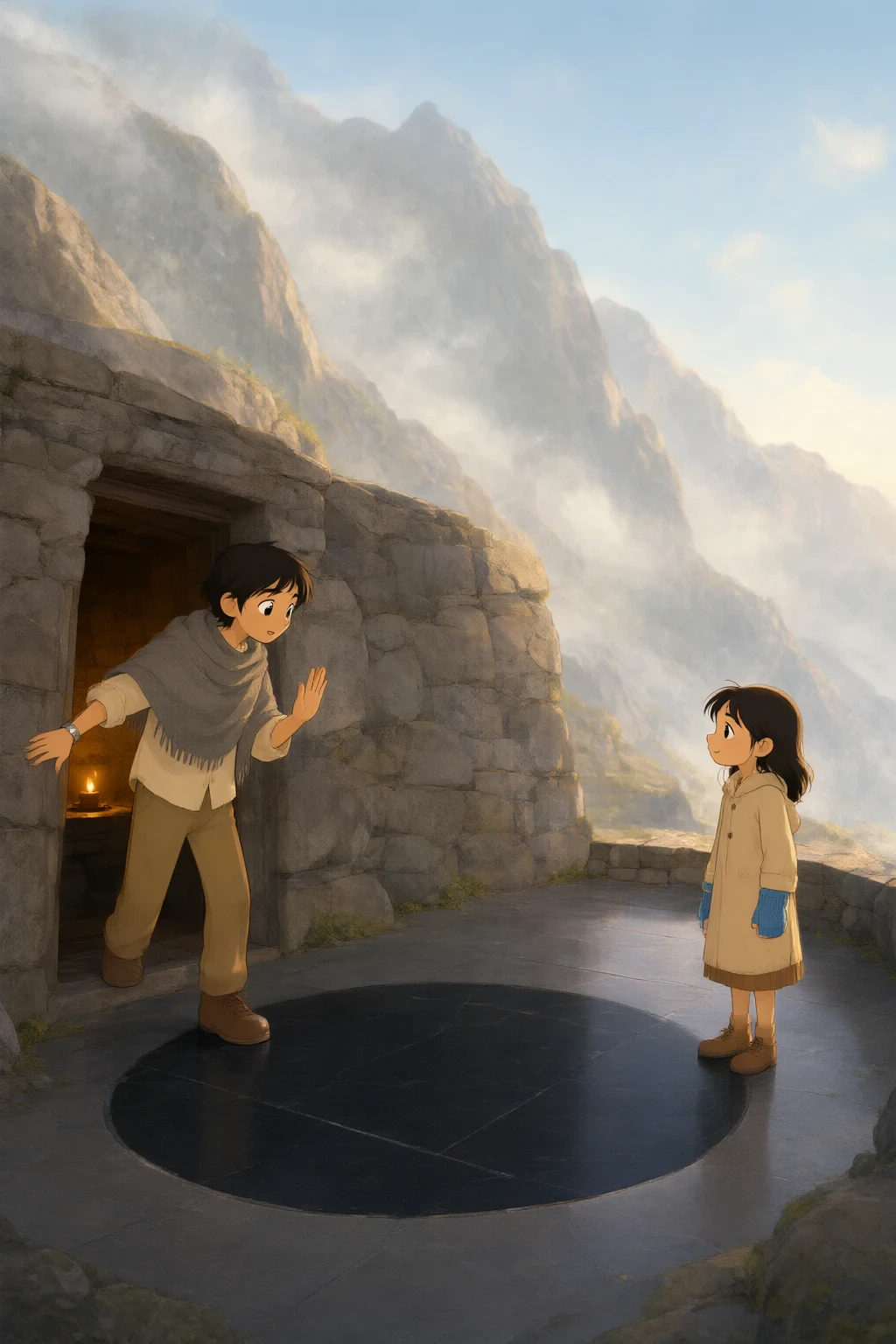
It was the biggest flat piece of stone on the mountain, paved in slabs worn into dishes by six hundred years of standing still. He could see nine of the shrines at once, going up and coming down, each with its own weather. In the middle of it was a black stone, flat, three paces square, polished bright. A wide arc was worn all the way around it, and not on it. In the flat blue light the arc looked exactly like the shape of a person standing aside.
Inside the shrine a woman’s voice was reading, and then a second voice, low and flat, and then the words carrying over the stone. “And for the term of seven years from this day.” Then a silence, a chair, a thank you, and the scrape of a pen. He had never in his life heard a term given a number.
The door banged and a small girl came out with a wooden pail. She had a blue knitted glove on her left hand and no glove at all on her right, and her hair in a plait done the whole length of it by herself. She set the pail down by the door and straightened up. “Het is putting the pail down,” she said. “Het is putting it down by the door. Now Het is waiting for Mother.” Ansel said, “Yes, right, yes. Is she the keeper?”
“Mother is the keeper of the Ninth Step.” She looked at the black square. “You cannot walk on that one.” “Why not?” “That is the Shutter-Stone. Nobody crosses it while a vow is being read. You go around. Everybody goes around.” She tipped her head at the shine. “Mother says the arc is where all the feet are.” So Ansel went around, and stood in the cold bit by the wall. Het came and stood beside him. “Are you going to swear?” “Yes. I am going to swear.” “You have to stand on the Shutter-Stone to be heard in there,” said Het. “Does he have to?” said a voice behind them.
Ilse Merrow came out and turned her whole body to face him, the way a door swings. Her hair was black with one white streak in it. She looked at his boots, and his hands, and the shiny patch on his hip where sheep smoke had burned the wool off the skin.
“I did not say he has to,” she said. “He has to stand in the room. On the stone, nobody crosses while a vow is being read. That is all the stone is. Six hundred years of polite feet. Children say a great many things. You want to swear something.” “I want to swear that I will not leave the herd,” said Ansel. “Not ever. Under this pass. As long as I live.” “As long as I live.” “Yes.” “That has no end in it.” Ansel opened his mouth, and then shut it again.
“A vow needs a term,” said Ilse Merrow. “That is when it stops. Until the first snow. Until you are forty. For always. For seven years, like the woman inside. If there is no term it is not a vow. It is a noise the room makes at you. I write nothing down and your body keeps nothing, and you have climbed eleven thousand steps for a noise.” She turned to go, and Ansel stepped onto the Shutter-Stone.
His feet did it before he thought about it. He was on the black slate in the middle of the wide worn arc, and he took four steps toward the door — four small steps, the size of a boy of fifteen in a hurry — and the fourth put him within an arm’s length of the threshold. Then a hand came up in front of his face, flat, palm out, and it did not touch him. “Stop there, Dun,” said Ilse Merrow. “Stop there.” He stopped.
“That was nearly a vow,” she said. “You were one step off saying it, and it would have been noise.” “I did not know you had to say a term.”
“Nobody knows that. That is what I am for.” She turned back to him. “Now the true thing, once. A vow does not make you good. It does not make you loyal. I cannot do that and neither can the mountain. What it does is put the not-doing into your body. You will not be able to do the one thing you swore not to do. Your legs, or your throat, or your stomach, or your back. It is a wall with no door in it.” “And it costs.”
“It costs. Seven years would take a little of your sleep and a little of your colour, and you would notice it going up a hill. For always would take the ease of your breath, and you would be an old man walking slowly at fifty. The mountain thinks that is a fair swap.” “I would be all right.” “You would be all right. You would just not be able to leave the herd. And the herd would not care. And you would.” A chair went over inside.
“It stops by itself. That is the good part.” She turned to the doorway, and the whole of her turned. “On the day it lifts. Nobody has to forgive you. There is no ceremony. You will hardly feel it. You will just find that a thing you were carrying is not there any more.” “Like a pack.” “Like a pack.”
The little girl came back with a crust of bread and a stoup of cold water, and set them on the windowsill outside the door. “Mother says the water is for whoever is coming down the stairs,” she said. “It is always for whoever is coming down the stairs. Het does not know who. Het puts it there.” Ansel took the bread. He had not eaten since the valley. Then he said, “Do I have to swear anything?” Ilse Merrow turned round again, all of her.
“You have to swear nothing,” she said. “Nobody has made you swear anything. You may go down that stair at first light and go home, and you will not have sworn anything at all, and it will not be held against you anywhere on this mountain, because there is no page for a thing you did not do.” “Then why did I come?”
“Because you wanted the mountain to take you seriously.” She almost smiled, and did not quite. “It will. It is not in a hurry. Come back when you know your term. Come back with a number. I will write it down and I will not lose it.” She went in. The door stayed open a hand’s width, and the lamplight came out across the black stone and lay along the wide worn arc, which looked exactly like the shape of a person standing aside.
He went down in fours, four steps at a time, the way you do when you have counted something and cannot stop counting it. The bowls in the steps were smooth and cold under his boots, and twice the hail came at him sideways. At the first turn he stopped and looked back up. Up there, small as a thumbnail, the black square of the Shutter-Stone lay in the flat light, and there was nobody standing on it at all.
He thought about the vow. He still had all of it. The herd. Never leaving. Under the pass. As long as he lived. It would have made him somebody. Then he understood that the only thing missing from it was a number, and that the number was the only part of it that would ever have been true. His hand went out and found the wall, and the wall was warm, and he went down.