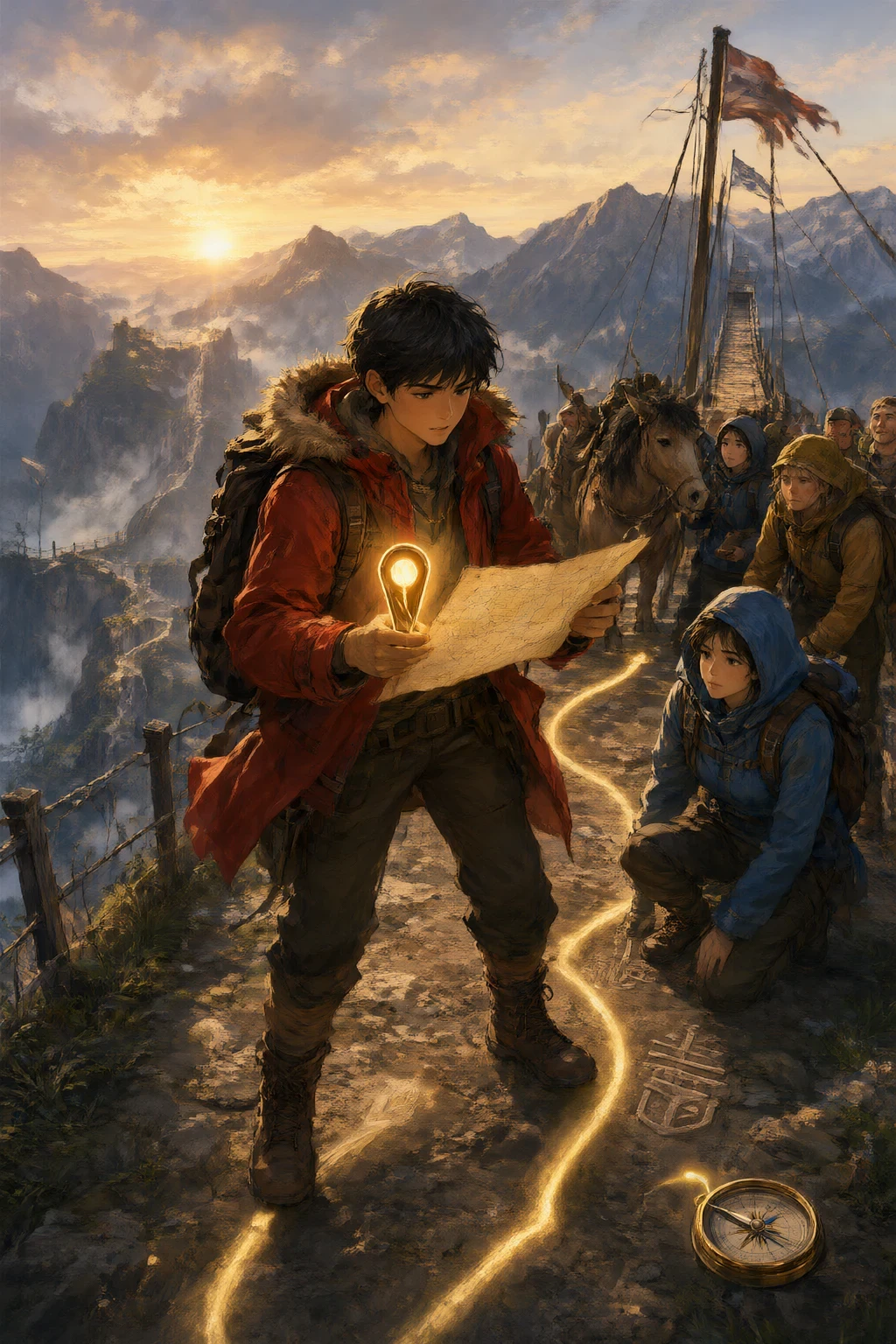
At fourteen, Captain Renn Vale had learned to make a straight line look certain. Her father had shown her how to brace one boot against the other, sight the next ridge, and ignore the cold knot in her stomach. The expedition company wore silver pins shaped like compass roses. Whenever Renn stood before a map table, the brass compass inside her pin ticked toward whichever person was speaking.
This made it useful in council chambers. It was less useful on a mountain.
Her company carried blue lanterns to the Bellweather Crown, where a weathered schoolhouse waited for a new roof. The Crown Roads Council supplied food, rope, and a map thick with official red lines. The red line crossed Merrow Stair, passed a chain of pilgrim inns, and ended at the Crown in six short days. It was the route the council discussed at banquets. Its bridges had banners.
Its inns had names painted on clean boards. Renn’s company had forty-three people: cooks, rope-makers, two map twins who never agreed on north, and twenty-three walkers whose boots were beginning to shine from use.
The quiet route belonged to Oren Vale, a broad-shouldered guide who washed his socks in cold streams and could name edible lichen by the shape of its cups. He was the expedition’s newest member, which meant everyone assumed he knew nothing. That morning he stood beside Renn’s map without touching it. “There is a white line under the eastern ridge.”
“Keepers draw wish-lines,” said Captain Brann, the company owner. “They show where a settlement used to be.” “The route still uses its old marks,” Oren said. Brann placed one finger on the red line. “We use this one. The Crown Roads Council pays half our wages.” Renn stared at the official route. She had trained to. “We could reach the schoolhouse two days sooner.”
“We could also arrive under a ceiling of falling ice,” Oren said. No one laughed. The sound of the glacier came up the valley like cloth tearing.
They packed at dawn. Renn put the council’s map in the waxed case where it belonged and gave Oren the small brass lantern instead. He looked surprised, then tucked it beneath his arm.
By the second afternoon, the red line failed them. Not violently. The first marker stood half buried in gray gravel. The second pointed toward a lake that was not on any map. By the third marker, the pilgrims’ path narrowed to a ledge above a drop no one wanted to measure.
Oren moved ahead with the lantern hooded. He stopped where the path divided. A copper marker—an official Crown Roads marker—stood on the western shelf. Blue lichen, round and pale, covered a line of flat stones on the eastern slope. “Which one?” Renn asked. “The stone remembers feet,” Oren said. “The copper remembers a command.” “That is not an answer.” “It is the only one I trust.”
Renn crouched. The western shelf was broad and bright, easy to see from the valley below. The eastern stones were narrow, lost under snow, and would add a day. Yet the eastern path curved away from the cliff. On the western shelf, a hairline crack ran through the rock. She took out her compass pin. The needle trembled, then swung toward Oren.
Renn felt the company watching her. If she chose the blue stones, the council would say she had delayed the journey because of a guide with no family name. If she chose the red line, she would be obeying a decision that had been made before anyone had felt the mountain.
“All bundles on the eastern side,” she said. “We move in file. Oren leads. I will walk third. Council funds are not worth a broken rope.” Captain Brann looked at the map case. “The contract says red route.” “The contract says deliver the schoolhouse safely.” “And if your guide is wrong?” Renn met his eyes. “Then I wrote the order. Put that in the log too.”
The company crossed in single file. Snow began to fall before the last porter reached the stones. The path was narrow enough that Renn’s pack touched the rock wall. Below them, the western shelf cracked with a sound like a bell struck underground. Nobody cheered. Renn made everyone wait while the tremor faded. Oren touched the lichen, then pointed to a hollow beneath a ledge.
“Camp there,” he said. “The ground is packed. The wind turns above us.” She looked at the sky. A storm was coming, but the hollow would keep them out of the first gust. It would also separate them from the flatter ground where the cook had planned to boil water. They lost the good fire, the dry blankets, and half a day repairing a snapped sledge.
At camp, Brann wrote a message for the council: Captain refused marked road at direction of junior guide. Route uncertain. Supplies damaged. He slid it across the firelight. “I should send this before morning.” “Read it aloud,” Renn said.
He did. The words sounded harsher in other people’s ears. When he finished, Renn took the paper and added a second line: Captain inspected the western crack, heard the guide’s reason, and chose the eastern stones. Order stands under my seal. She sent both letters.
The storm reached them before dawn. The roof of the Crown shed its rotten thatch in sheets, and the schoolhouse yard was knee-deep in mud. The children who lived there had already moved the desks to one side. They watched the company arrive with blue lanterns and red faces, carrying a single patched sledge.
An old teacher named Sava came out to meet them. “We thought the Crown Roads would send a crew.” “They sent a map,” Renn said. “It was wrong.” Sava looked at Oren, who was checking the sledge straps. “You found the old way.” “By following it,” he said.
The repair took nine days. Renn’s company tore up floorboards that smelled of wet earth, cut new beams, and folded the old roof into a retaining wall along the eastern slope. Oren taught the children to read the lichen markers, and Sava made a map that showed both the official road and the narrow stones. The map carried a warning: Weather moves. Ask the mountain twice.
The council sent a stern notice accusing Renn of wasting public funds. A clerk arrived to ask for the compass pin and the original map. Renn surrendered the map but kept the pin. She explained that the expedition needed its instrument.
When she returned, two of the council’s surveyors met her at the lower pass. They had found the western shelf split by forty feet. The new crack smelled of wet iron. “The official route was never safe,” one said. “No,” Renn said. “It was only marked.”
The surveyors looked uncomfortable. The notice stayed in the council’s records. Renn’s name went beside it in a new column, with a small seal: Route amended by field order; evidence attached. At the next expedition meeting, the company argued about what to do with the quiet guide. Some wanted him to receive the captain’s silver. Oren refused.
“I know stones,” he said. “I do not know how to make a camp or mend a roof.” Renn nodded. “Then you will keep your place, and you will teach. That is not a smaller job.”
She pinned a plain brass compass to Oren’s coat. It had no family crest, only a needle. At the first evening gathering, Renn showed the council’s letter to the whole company. Someone read it aloud. No one cheered. That was all right. A choice had been made, and it had cost them.
In spring, a new red line was painted on the eastern stones. It was not bright, and it did not promise safety. Beneath it, the children carved pale circles in the shape of lichen. Travelers stopped to ask the guide before climbing, and the guide listened before answering.
Renn saw that from the Crown’s new roof. The old red path had vanished beneath snow, but the safe route remained visible only to those willing to look closely. She took out her compass. Its needle turned once, then another, and rested between the two paths. This time, she did not pretend it knew the answer.