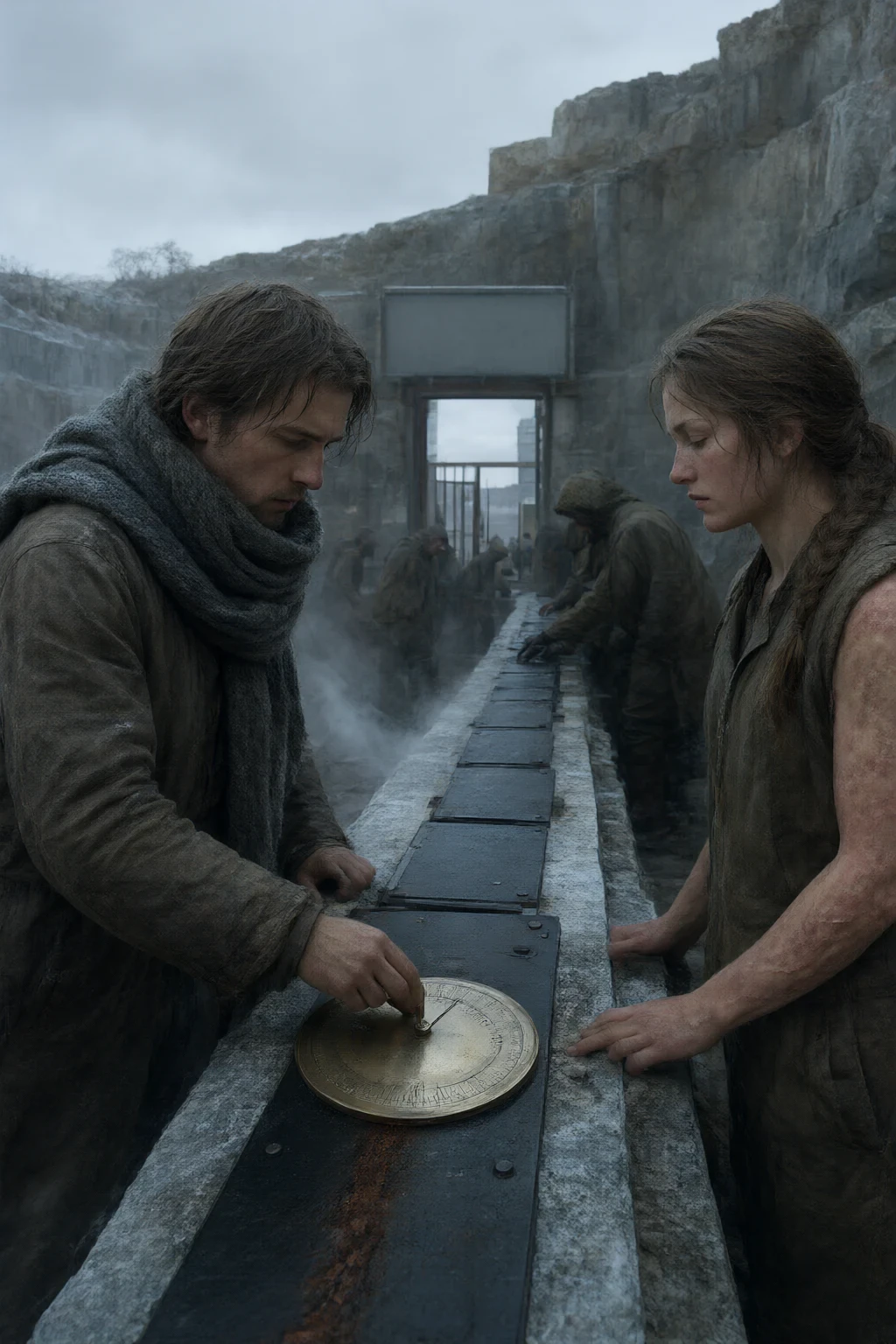
The Assay Office was kept at minus nine from Michaelmas to Candlemas. The way to work in it was not to be warm but to be quick: coat open, work done, coat closed, and then stand at the oak rail while your own breath made a small weather in front of you and went away again. Coen Halloway had been a copy-clerk for eleven days. He was fifteen. It was the first work he had ever been paid for that did not consist of carrying something, and it consisted of being permitted to sit inside the rail and to put his hand on the Assay Book. The rail came to the height of his sternum. The Book lay open on its long frame within it, chained at two points and otherwise free, and it stood open at the season's return, a broad leaf ruled in an ink that had gone the colour of weak tea. Two columns. No heading but the season. Nothing in the margin, no flourish, nothing at all: two hundred years of the Coldmark's whole business fitted into the space between two lines of ink, one of degrees and one of grade.
That arrangement was Halla Rimewright's doing in the way that most things on the hill were her doing, though she had never once said so. She was forty-seven and had sat at that desk twenty-two years, and she wore her fur coat indoors and kept her right forefinger out of the glove, because the thumbnail of it was split down the middle and had been split on purpose for so long that the split had become the shape of the nail. There was a shallow groove across the pad of the same finger, where a pen had been held against the edge of a table for two decades. “Degrees,” she said, “and grade. Degrees are what is. Grade is who gets it first.” Then she did what she always did, which was to put the numbers out before the sentence. “One thousand, six hundred and four. Sixteen. That is a difference.” Coen looked down the page. The plate gauge sat on the table beside her hand, a brass needle swinging inside a graduated arc, a thing rather like a pair of shears with a dial on the hinge. It was the oldest instrument in the Guildhall and the only one nobody was allowed to lend out of the room.
“Eleven lines,” she said. “The Sorne Row, bench four. The Book says forty-one point two on every one of them. The wrights who carry cold up and down that bench say the row is not what the Book says it is.” “Are they wrong?” “They are wrights. They do not read.” “They read gauges.” “They read gauges,” she agreed. “And they tell you it is cold or it is not cold, and that is the whole of what a wright knows about a number.” She set the gauge on the table between them with a care she did not otherwise spend on anything in the building. “You will read it at the cold face of each plate and you will write what it says and nothing else. No good. No bad. If the needle does not lift, you write that it did not lift. There is a room at the back where the returns are filed, and the returns go back a hundred years, and if there is anything in them about a row reading low in a bad season you will find it, because they wrote everything down. The reason we know what the Coldmark did in the year of the long thaw is that four clerks sat in this room for one winter and wrote it down while it was happening.” “And if it is a crack?”
“Then it is a crack, and you write a crack, and I will send for Sorne, and Ilva will tell a crack from a plate with her eyes shut.” “And if it is not a crack?” Halla Rimewright turned her forefinger over on the table so that the split nail lay flat against the wood, and looked at him, and he understood many years later that she had decided in that moment to tell him the truth and had then decided against it. “Then the hill and the Book have been telling different stories for some time,” she said, “and somebody in this building has been picking up the ends of that sentence. It has not been me. I do not leave ends.” She said it in exactly the same voice as the rest of it. Coen, who was fifteen and believed in the numbers the way other people believe in weather, took it for a boast, put it away, and would be embarrassed about it for eleven years.
Ilva Sorne worked the Iron Row at the north end of the Guildhall yard, where the plates were annealed and the new ones lay out on trestles to cool. She was twenty-nine. Her forearms had the colour and the grain of iron that has been worked too many times, and she took the gauge out of Coen's hands and folded it into a square of oiled wool before she would let him hold it again. “You are the copy.” “Coen Halloway.” “I did not ask your name, I asked your trade.” She turned the wool so that the copper shoe of the instrument faced the light. “You are going to lay that against eleven plates and read eleven numbers and write them down.” “Yes.” “Then do not do it with your hand. Hold the wool. It is not that the cold gets in. It is that the cold gets in and stays.”
The climb from the yard to bench four took forty minutes and undid all of that. Voidstone Terrace was cut into the shoulder in eleven steps, and each step was a line of black iron frost-plates let into the granite face, two feet by three, each one under a lintel of split stone with a family name cut deep into it and filled with soot. The soot had been renewed so many times on the oldest of them that the letters stood proud of the granite, and you could read the whole row from the bottom of the hill in any light at all. “Number one is Sundvold,” Ilva said, going up. “Ostmark is the next bench and I have no business up there. I have never had ground in my life. My mother held four and gave it back the winter I turned fifteen, and the guild paid her for it, and the payment was fair, and I have never been able to work out since why I do not think about that every day.” “Because you did not want it.” “Because I did not want it,” she agreed, and went on up, and did not say anything else for a quarter of a mile.
Above bench two the wind came round the shoulder and there was a line of charging going on three benches over: a full rank of plates hissing and steaming in the cold, men in soaked sealskins moving along it with hoses, and the smell of iron so strong in that air that you could taste it in your teeth and it stayed there for an hour. Charging was a business. It was a business because a man stands in front of a live plate for the length of a line and loses the feeling in his face, and the guild paid for that by season and not by hour, and nobody argued about it because the arguing had been done in the founding and had gone badly.
The copper shoe went against the cold face and the needle fell, and swung, and settled. Coen found he had to hold his breath to read it. The hand lamp was steady until he breathed, and the mist of his own breath put a bloom on the copper and on the plate together, and the bloom made the frost on the iron look like sugar on a window, which it was. Number one: thirty-three point six. He checked the Book. Forty-one point two. He wrote thirty-three point six, and the seven and point six went into his head without asking, and he wrote it again under the first to be sure the pen had done what he meant. Number two: thirty-three point six. Number three: thirty-three point six. Number four: thirty-three point six. Number five: thirty-three point six. By the third plate the pad of his thumb had gone to the texture of something behind glass, and the first thing he wrote after that he had to write twice. He thought about the split thumbnail on Halla's forefinger, and the groove across the pad of it, and he did not ask, because it was not the sort of thing you asked about at fifteen, and because by then he had begun to understand that the people in this building were not being dramatic. They were keeping the same accounts he was keeping, in a colder hand.
He did the sum because his head did it, and then he was angry with his head, and then he did it again. Thirty-three point six, five times, is a hundred and sixty-eight point nought. The Book said two hundred and six point nought. There was a difference of thirty-eight point nought in five plates, and he had not been asked for a difference, and he had one. The light was going by the time he reached the sixth, and it went all at once, the way it does in the far north when the sun clears the ridge for four hours and then declines to argue about it. Everything after that was the small gold circle of the hand lamp moving along the row.
Number six was the old one. The iron on it had gone to a bloom on the cold face, a black sweat beading along the top edge and freezing in a fringe, and the iron was thinner there than it was on either side of it, because iron that has been weeping for years is iron that has been going somewhere. Coen knew what it was. A void with any crack in its frost-plate bleeds its charge into the hill, and the loss is written off, and the loss is always put against the last name nearest the plate. He had the brass disc out of his coat to hang on the lintel when Ilva took his arm above the elbow and turned him round to face her, and she was not looking at the plate. “You will not do that here,” she said. “It is weeping.” “It is weeping at the cold face of a plate that is at the end of its life, and if you hang a disc on that lintel the loss is charged to Sundvold, and Sundvold did not make it and cannot mend it.” She let go of his arm. “And I have said for four years that this plate wants replacing, and the answer I get is that the charge is right and a right charge in a bad plate is a plate we keep.” “Does it read right?”
“It reads thirty-six point nine. It has read thirty-six point nine every year since I first came up here at twenty-one.” She looked at the bloom. “It is recharged by hand every season, which is a man’s winter, twice, for nothing but a plate, and the number is fine, Coen, the number is the best number on this bench.” Then a wright coming up behind them stopped and pointed at a hairline he could see on the shoulder of number four, and Ilva did not turn round. “That is not a crack,” she said. “That is a plate.” And Coen, who had by now worked out that the Book was wrong by a very great deal, and that somebody had therefore put the wrong in on purpose, and that the somebody had to be Halla Rimewright because she held the pen and because it was her desk and her Book, said, “The whole Book might be that.” “The whole Book,” said Ilva Sorne, “is a plate. You may put your ear to it and you will find it does not leak. You do not get to call a thing cracked because you dislike what is standing behind it.”
Bram Ostmark was on the bench at noon, taking his own reading of the row, because the wrights had reported the row and the wrights were always asked to take their own reading afterward. He was thirty-four and third generation and had a fur-seam across his right eyebrow healed white, and both his palms were scored with salt-frost like a rope burn, and he was going along the plates with a gauge of his own and not writing anything down. Coen stood in front of him with the Book open on a slate. “Has this row ever read forty-one point two?” “Thirty-three point six.” “That is not what I asked.” “It is the number you asked,” said Bram Ostmark. “It has been that number since my father’s time, and my father never wrote it down, and if he had written it down somebody would have asked him why he had not written it up.” He went on up the bench. At the ninth plate he stopped, and looked back down the row at the boy with the slate, and said, over his shoulder, without any expression at all: “Nine inches of iron between you and the stone. Ask me again when you have it right.”
Number eleven was not on the bench. The bench ended at ten, and after the tenth plate the ground went flat and ridged, and the ridging was a drill field, drilled in rows the width of a furrow, grey earth with frost in the furrow bottoms, and in the middle of it, in the middle of a sown field, there was a walled rectangle about the size of a small house. The wall was knee-high split granite laid without mortar and it had a gate in it, and the gate was latched, and the ground inside the wall was bare. Not thin. Bare. Nothing had ever come up there, not a blade, not a thistle, and the soil was smooth in a way that soil is only smooth when nothing has ever opened it. Coen stood in the ditch path and looked at it. Then he looked back at the bench and back at the wall, and worked out that the wall had to be the edge of the eleventh void, because the wrights drove out to the row from the guildhall side, and the ditch path ran on past the field and up to the quarry instead, and the path across to the gate was not worn at all. “You are not going to ask me,” said a voice behind him.
The old man was standing at the gate with his hands in his sleeves. He had a white beard and the tops of all ten fingers gone blue and shiny, and they caught what little light there was. “My name is Ansel Rime,” he said. “I cut the first void on this hill by hand. It took my father’s father nine weeks and me eleven, and there were three of us and a boy to hold the lamp, and I have told that story so many ways that I no longer know which one of them is the one that happened. This is the only wall on the Coldmark that has never had a name cut over it, and I know that because I cut the others.” “Why has it not?”
“Because there was nothing to cut.” The old man put one blue finger on the gate. “When we cut a void, the lintel goes in with the name on it, the ground’s name, the family that holds it, because a charge that has no name against it is orphan cold and orphan cold is gone inside a season. There has to be a name. There has always had to be a name.” He took his hand off the gate. “Number eleven had no ground behind it. Not that day, not ever. So the founder said we would cut the stone and we would come back for the name, and we did not come back, and the stone is here, and it has been here for two hundred years, and I am the last man alive who was on that bench and I am telling you that nothing has ever been charged into that void in its life.” “Because there is no name.” “Because there is no name,” said Old Ansel Rime. “But the numbers say the other thing, and the numbers are never wrong. The Book has got a beautiful round number against that stone and I have never seen a gauge on it, because you cannot walk to it.”
The room at the back of the assay office held the returns in nailed boxes, one box to a year, and the years went back further than the bench had been cut, and the light in there was one lamp on a nail. Coen found the Sorne Row charge sheet for the year before last by following the Sundvold box, and then he found the one nineteen years back, and it was the only sheet in the box that was not in the same clerk’s hand as the rest of the year. The initials on it were H.R. Ten lines said thirty-three point six. One line, the sixth, said thirty-six point nine. The eleventh line said nothing, and had a blank ruled through it where a figure should have been, and beneath the blank somebody had written, in the same hand, the word unclaimed. And the grade column of that sheet said third. All eleven of them. Third. Coen sat down on the edge of a box with the lamp between his boots and added it up in the failing light. Nine plates at thirty-three point six and one at thirty-six point nine and one that had never held anything at all. Three hundred and thirty-nine point three, against four hundred and fifty-three point two in the Book. A hundred and thirteen point nine.
Then he went and found leaf one, which was not in a box but chained into the frame under the first return, and leaf one said this: Founding season. Void one, Rime line. Assay 41.20. Grade first. Forty-one point two was the first number in the Book. It was written in the founding hand and it had never been altered and it was the charge in the stone of the guild’s own first void, cut by four men, one of whom was a boy with a lamp, and the first void was the finest cut ever made on the Coldmark and there has not been one like it since, because the ones after it were the same cut done faster and in a worse season. Every other void on the hill was less. Every void on the hill had always been less. And forty-one point two sat on leaf one where nobody could see it, and a hundred years of clerks had built the return, the forecast, the sale book, and the pension basis on it, because you cannot sum a column that does not add up and you cannot show a man a number that is smaller than the one he signed. The Sorne Row had been regraded from third to first sometime in the last nineteen years, and the charge had gone up with it, from thirty-three point six to forty-one point two, on the same morning, in the same hand, by the same pen.
He put the old sheet on the table beside the Book and told her to read the initials, and she read them, and did not change colour, and did not put her glove back on. “Thirty-three point six,” she said. “Thirty-three point six. Thirty-three point six. That is one number nine times, and you have known it was one number since the third plate, and you have known since the third plate that it was written down.” “The Book says forty-one point two.” “The Book says forty-one point two,” Halla Rimewright agreed, “and the Book has said forty-one point two on the Sorne Row since the winter of the long thaw, which is nineteen years ago this Candlemas, and I was twenty-eight and I had held the pen for six years.” She turned her forefinger over on the table and looked at the split of the nail.
“Your hill is right. I want that in front of you before anything else, because you are fifteen and it is very easy to spend the rest of your life on the idea that the Book cannot be wrong and therefore somebody has been stealing from you. My needle read thirty-three point six on nine plates on the Sorne Row at two o’clock on the morning of the eleventh of the ninth month, in the year of the long thaw, with a wright holding the lamp, and I wrote it down, and it is on that sheet, and the sheet is nineteen years old and the numbers on it are the numbers on your plates this morning. Nothing has leaked. Nothing has been taken. The hill has not moved in nineteen years. I moved the Book.” She reached over and turned the Book a half turn so that the page lay square to her.
“The thaw took eleven days. Plates that are sealed in a hard frost want sealing again in a thaw, and a plate that wants sealing in a thaw bleeds while it is being sealed, and the men on that bench were sealing from Michaelmas because their fathers had shown them, and the Sorne Row lost most of a season in nine days. Their neighbours lost less. The Sornes lost nearly everything, because the Sornes were the row, and a row does not get to be careful one plate at a time. The guild’s answer to a loss like that was a regrade. Outturn, and the difference against them, and the season closes. That is the whole of the office’s remedy and I have watched it be used four hundred times and it has never once been wrong.” “Your sheet says third.”
“My sheet says third because the row was outturn and outturn is third. And the day after I wrote the loss I sat here with the season’s return open in front of me, and the return is computed at forty-one point two, and every line on it was computed at forty-one point two, because it is the standard and the standard is leaf one, and if I had put thirty-three point six on eleven lines then the return would have been short by a hundred and thirteen yards and the return would have shown a hole in it, and the hole would have been read as a failure of this office, in front of the committee, in the first winter of a bad thaw.” “So you wrote what the return needed.” “I wrote what the return needed,” she said. “That is the job. That is the whole job, and it has been the whole job since leaf one, and I have never once said so out loud in this room before today.” “And the grade.”
“The grade went up.” She said it flatly, and it was the only time in the whole of the afternoon that she said anything that sounded like an argument. “A row that has lost a season badly enough to be forgiven does not also go to the back of the line and wait there for a year. The Sornes were put first. And the first grade is worth what a first grade is worth at the gate, and a first grade is a yard at a price, and the price of a first-grade yard is set by what the yard is, and what the yard is is what the plate says it is. So the row had to carry a number that stood behind the grade. I gave them a number that stood behind it.” “They could not hold it.” “No,” said Halla Rimewright. “No, they could not hold it. Nothing on that bench could hold it. I have known that every day for nineteen years.” “You gave them a grade they had not earned against a charge they could not hold.”
“I gave a family a place in the queue,” she said, “and I paid for the place out of a column of arithmetic that nobody reads except me, and the hill has been quietly paying the difference ever since, out of the whole terrace, one slow yard at a time, and you are the first man in this office to put a gauge on those plates and count it.” She looked at the eleventh line, which was blank, and at the strike through it, and at the word under it. “Number eleven has been on my return at forty-one point two every year I have held the pen,” she said. “Because there is no figure for it, and a figure of nothing in a column of figures is a hole, and a hole in the season’s return is read as a failure of the office. And because no one has ever put a gauge on that stone, because you cannot walk to it, because Ansel Rime is the only man who will tell you what is under it and he tells it nine ways. Is your figure written?” “No.”
“Write it. Write what the needle said and nothing else, and if the needle did not lift then write that it did not lift, and you will be the first man to write that in this Book, and the number will be wrong, and the wrong is nineteen years old and it is mine, and you will not put your name to it.” Coen took out the pen. The Book has no column for a difference. That is not an oversight; it is the design. A figure that has been superseded is struck through with a single line and a single line is not enough, so the superseded figure goes down in the margin in a clerk’s hand, small, where the correction is, and the correction is permitted to be a sentence. He had to make it small. It was a long sentence, and it was going into the degrees column, and there was not one sentence in the degrees column in two hundred years of the Coldmark’s history, because the degrees column was for what was, and what was did not require explaining. He wrote it small.
Then he shut the Book, and wound the chain twice about the frame, and set the brass assay disc into the gutter of the page where it had lain every working day since before his mother was born, because that is where it lived, and it was the only object in the office that had never once been in the wrong place. On the stair he read the figures over to himself, the way he read them in the street, softly, thirty-three point six, thirty-three point six, thirty-three point six, and got annoyed at nobody, for once, and went out into the wind to go and look at a piece of granite with nothing cut into it.