The cloud over Breddal was called Stine, and she was christened on a Thursday in the churchyard with a whole parish present, and the reason she was given that name is that the girl who was asked to say it was five years old and had a cat. She had also, that day, no idea what she was doing, and the whole of the valley had stood about the font in the rain laughing, and the parson had said that a cloud with a name is a cloud you can speak to and a cloud without a name is only weather. And that is true. It is the single most useful thing anybody in Breddal has ever said, and it is the reason a great deal of trouble arrived later.
The contract is under the floor of the church. Two leaves, sealed, one hand, older than the tower. Inger had read it perhaps forty times and could now recite the first line from memory, which is the trouble with reading a thing forty times. The first line says: This cloud, called Stine, and unnamed clouds in her company, shall deliver to this parish, from the sowing to the harvest, nine hundred fundel of water, measured in the funnel of the churchyard. The second line says the parish shall deliver four hundredweight of iron at the harvest. The third line is the trouble. It says: Should the delivery fall short, the name of this cloud is forfeit, and the parish shall hold weather only.
The fifth summer was the dry one. Inger kept the accounts of the parish because nobody else would and because the regent had said, in a tone, that it was a great deal of sitting, and she was sixteen and had been sitting since she was eleven. The register of the parish of Breddal is a book with two hundred and eleven years in it and a great many columns, and Inger's was to keep the third column, which was the weather column, and the fourth, which was iron. This year the third column said: dry.
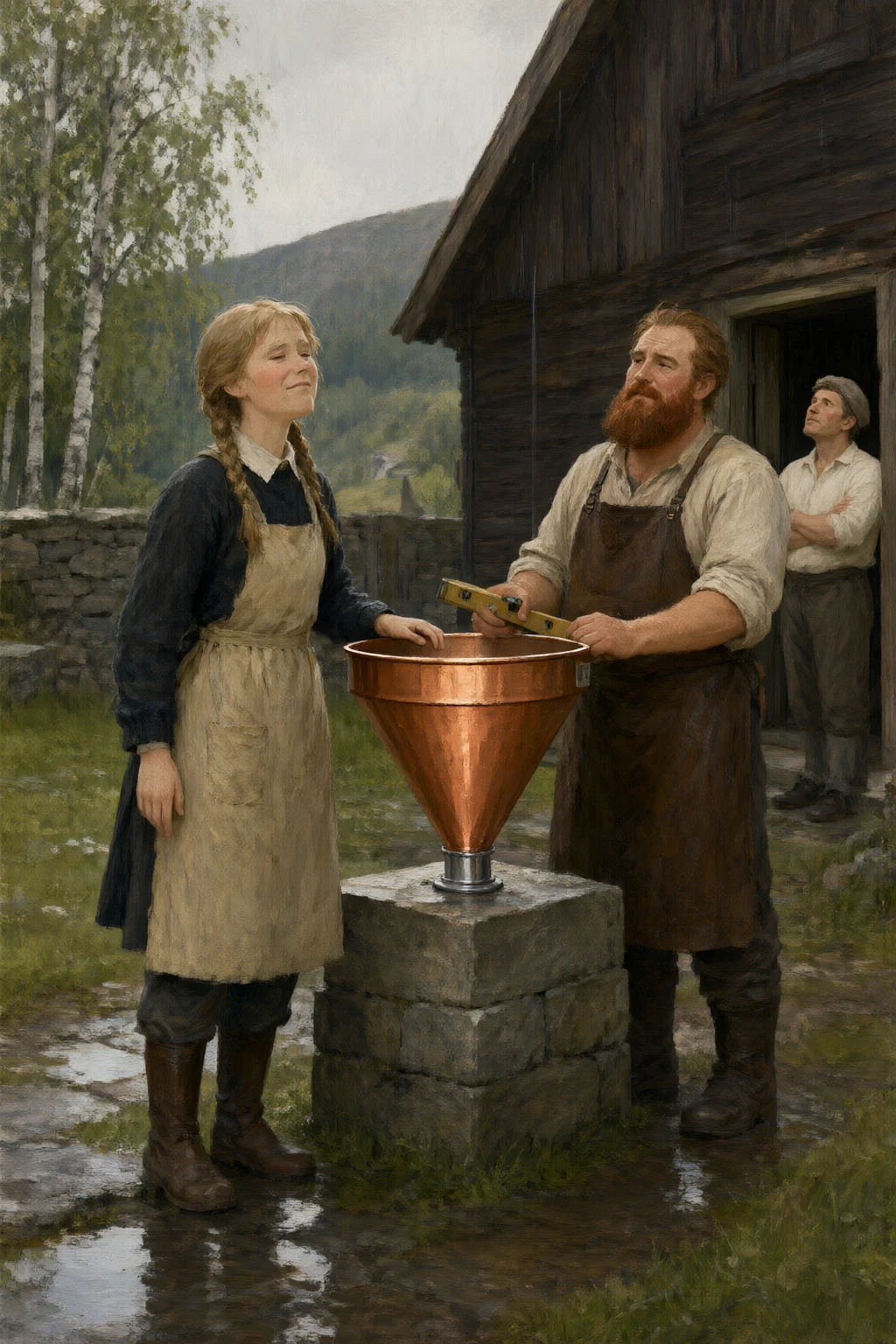
The churchyard funnel is a copper vessel the size of a milk pail set in a block of grey stone, and it is emptied at the parson's discretion and the amount is written down and the amount is the truth. For two hundred and eleven years the third column had been a long argument with a cloud and the argument had been won, more or less, every year. This year the third column said nothing at all from the fourth of May onward.
Under it everything was dry in the way that is only funny later. The millrace at Tjorndal had a stone in it with moss on the top. The smith's trough, which he filled from the stream, was down to a hand's depth of grey water with a leaf in it. The cows came off the mountain to a water hole that had been a water hole in the time of the old regent, and they stood around it, and they were not complaining, because cows never complain, and then in the third week of June the farmer at Breddal's upper farm milked a hundred and forty cows for two days because the cows had nothing to drink and nothing to eat, and then he stopped milking, and that is the part the parish actually felt. The regent called a meeting in the schoolroom. There were eleven things of the parish and only four men in the room and one of them was the parson.
The fifth thing of the parish is the cloud, and the fifth thing of the parish was the reason the meeting went badly. "It is not that Stine has broken," said the parson. "Stine has not broken. Stine is exactly where Stine has always been, over the valley, and there is nothing in the world Stine can do about the fact that there is nothing in the air for her to bring down. She is not withholding. She is empty. Like a cart on a bad road, with nothing on it." "Will she be punished?" said the miller, Soren Vaage. He had been a miller for thirty years and his wheel had not turned in nineteen days and he had said the number out loud every morning in the room, by way of argument.
"That is the question I want answered," said the dairyman, "because I have three hundredweight of butter and no water to wash the churns in, and I have a girl leaving in the autumn and I do not know what I tell her." "There is no punishment," said the parson. "That is what is meant by no punishment. We have no hold on her. We have a name and an account, and if the account is not made good, the name goes, and after that we get weather." "Meaning other clouds," said Inger. "Meaning other clouds," said the parson. "And they are very good, I am told. And they are not christened, and a parish cannot send a letter to weather." Nobody in the room had ever sent a letter to weather. That is the sort of thing that makes a room go quiet. Then the miller said, "Then why is it raining on Stenbaek?"
Stenbaek is nine miles east over the ridge and it has a brewery and four times the people and a market. It also has a churchyard funnel which is not a milk pail. It is a proper great copper bowl, four times the size, with a lip on it, and a man to empty it, and a man to write down what came out of it.
Inger had known about the other funnel since she was eleven. Everybody had known about it. It had been the standing joke of the valley for two generations, and the standing joke had a number in it: Stine could stand over Breddal and do nothing at all, and stand over Stenbaek and fill a vessel four times the size, and be paid in full twice over for the same weather, and the joke was usually told by somebody who then said, we are not being paranoid, it is a different parish. "Take the book," said the parson. "Which book?" "The book. All of it. Bring the cloud book and the iron book and the fifth-summer book and the market book, and put them on this table, and let the room look."
It took her four days and it is the only piece of work Inger has ever done that anybody in Breddal has ever asked to be thanked for twice. What the books said was this. Stine had been delivering to both parishes for one hundred and forty-one years. She had delivered, on average, within a few fundel of the retainer, every year, in both parishes, for one hundred and forty-one years, and everybody believed this, because that is the story that gets told in a valley, and the story is true in the way that a story can be true while the book is doing something else entirely.
The books said that Stenbaek had, in the last five years, been paid by a surplus. Four hundred fundel in the first drought year. Nine hundred in the second. Fifteen hundred in the third, and two thousand two hundred in the fourth, because Stenbaek's bowl is four times ours and a bowl that is four times the size does not merely hold more, it fills up in a heavier shower and holds the overflow. The fifth thing of the contract says that surplus is carried forward. Stenbaek was owed, by Stine, four thousand two hundred fundel of weather that had already fallen in Breddal's parish and gone into somebody else's bucket.
"You cannot take it back," said the parson. "It is carried forward. It is a term. It is the only term in that document anybody has ever enjoyed." "You cannot take it back," said the miller, "but you can stop the carry." "You cannot stop the carry from Breddal. Stenbaek has its own funnel and its own book and its own parson, and the parson at Stenbaek is a decent man who has spent five years being decent about a drought while we have been drinking his surplus, and he has the better of it, and he knows it, and he has never once said so, and I would not put it past him to say so now." "Then what is the amendment," said the dairyman. "What is the paper. Say the paper."
Inger drafted it at the table in the schoolroom on the fourth evening with the books in a heap and no light but the one lamp, and she drafted it eleven times, and the eleventh is the one that was read out. It has four clauses and no poetry in it at all, and Inger has said since, in the plain way she says things, that this was the difficult part, and that she had to write out nine pages of clumsy verse before she understood that nobody in the room was asking her to be impressed.
Clause one: That the measuring vessel is common. That there shall be one funnel, of a size to be agreed between the parishes and sealed by both, and that it shall stand in the churchyard of each parish in rotation, four days here and five there, going and coming as the ferry goes, and that water falling anywhere in either valley while the funnel stands elsewhere shall be credited to both, at the same rate, whether or not anybody has a bucket in it. Clause two: That if the measured return fall below one half of the retainer, the retainer shall be reduced in the same proportion, and the iron shall be returned, and the name of the cloud shall stand, and no party shall lose standing by weather.
Clause three: That no cloud shall deliver the same rain twice into two vessels, and that surplus shall not be carried forward beyond the year in which it fell. Clause four: That the cloud shall also owe the parish, without further payment, fog in the late autumn, frost in the meadow, and the shade of July; and that the parish shall owe the cloud in return the wood for its drift, and iron only in a year when iron is not the difficulty.
Getting it signed took longer than writing it and was the actual work. The regent would not put his name to it, on the ground that a parish could not by resolution amend a document with the sky, and was shown, over two evenings, the section, and the section said the parish could amend the schedule, and the schedule was a domestic matter, and the sky had no standing in a domestic matter, which is a sentence Inger found later in the judgement of another case in another valley and which has been true ever since. The miller wanted the amendment to say the mill comes first. The dairyman wanted it to say the churns come first.
The schoolmaster, who had no vote and came anyway, asked whether it was not simply theft to take four thousand two hundred fundel of rain, and was answered by the parson, who said: it is a bucket with a bigger rim, and the rim was put there by the market, and now we are going to have one rim. The smith, Halvor Bent, said nothing in the meeting. Afterwards he took Inger aside and said, "Clauses I cannot do. I have made a hundred and forty years of funnels and I know what is in one." "What is in it?"
"Silt," he said. "Not from this valley. There is no silt in rain. It is from whatever the copper was standing next to, and it has been standing next to a thing for a hundred and forty years, and it is not clean and I will not seal it, and if I seal it and somebody at Stenbaek throws a bucket of it in the canal, we will have the whole valley looking at a cup that cannot be trusted, and then nobody will ever believe a number again." "Then we do not reuse the old ones," said Inger. "It will be a new one, then," said Halvor Bent, "and it will take me a year, and it will cost the parish what the parish does not have, and if you tell them that I said it, I will deny it."
Stenbaek's parson came over the ridge on the ninth of July to say no. He said it for two hours and then, at the end of the second hour, he asked a question that Inger had hoped he would not ask, which was whether Breddal intended to bring clause three up at the spring conference, and Inger said yes, and he sat back and said, "Then we had better agree to clause one before the conference, or we shall both of us be standing in front of the whole thing with our funnels in our hands."
The new funnel was finished in the autumn of the following year, and it is the same one. It stands in the churchyard of Breddal on a bed of dressed stone with an iron collar round its neck and a mark cut into the collar at the height of the rim, and it is exactly the size that was agreed, and the size is neither Breddal's old size nor Stenbaek's, and the meeting that agreed it took an entire evening and nearly went to pieces over a quarter of an inch. Stine was present. Everyone in the parish understood that she was present, and nobody said it out loud, because the fourth clause says shade, and the day the funnel was set in the stone was hot, and there was shade in the churchyard that had not been forecast and that did not move.
The service was over at two. The new book was ruled at four, and it has four columns, because she ruled four. Date. Measured. Delivered. Carried. And the first line, in her own hand, in the fresh book, reads: 19 June, nine hundred and one fundel, the funnel having stood four days at Breddal and five at Stenbaek, both clerks present, iron not yet delivered, surplus of eleven carried. Inger wrote it, and read it twice, and closed the book, and put the pen in the split at the back where it has always gone. Outside, the wheel of the mill at Tjorndal, which had stood still for nineteen days and had not stood still like that in the summer before, took the first of the water coming down the race and began to turn, and did not stop.