The Corrach came up the meadow on the Thursday and it did not go back. By eight o’clock the Lime Yard was under a foot of the brown water that comes off a river in a spate. The ring of stone setts was gone, and the notice-slate stood in water to the height of the Coal Hole wall. Verity Ash stood on the second step of the Cloth Hall with her waxed notebook on its lanyard, two fingers flat on the door frame, counting.
“Sixteen inches at the setts,” she said. “Give or take the wind. It is coming up at half an inch a minute, and it has not turned.” “It has not turned because it has not finished coming,” said Nan Ilva. She had come up from the foundry with her sleeves pushed down over the white crescents on her arms, and she treated the river the way she treated everything else. “Nine inches an hour, and falling by morning.” Then the hour bell rang eight, and it did not stop.
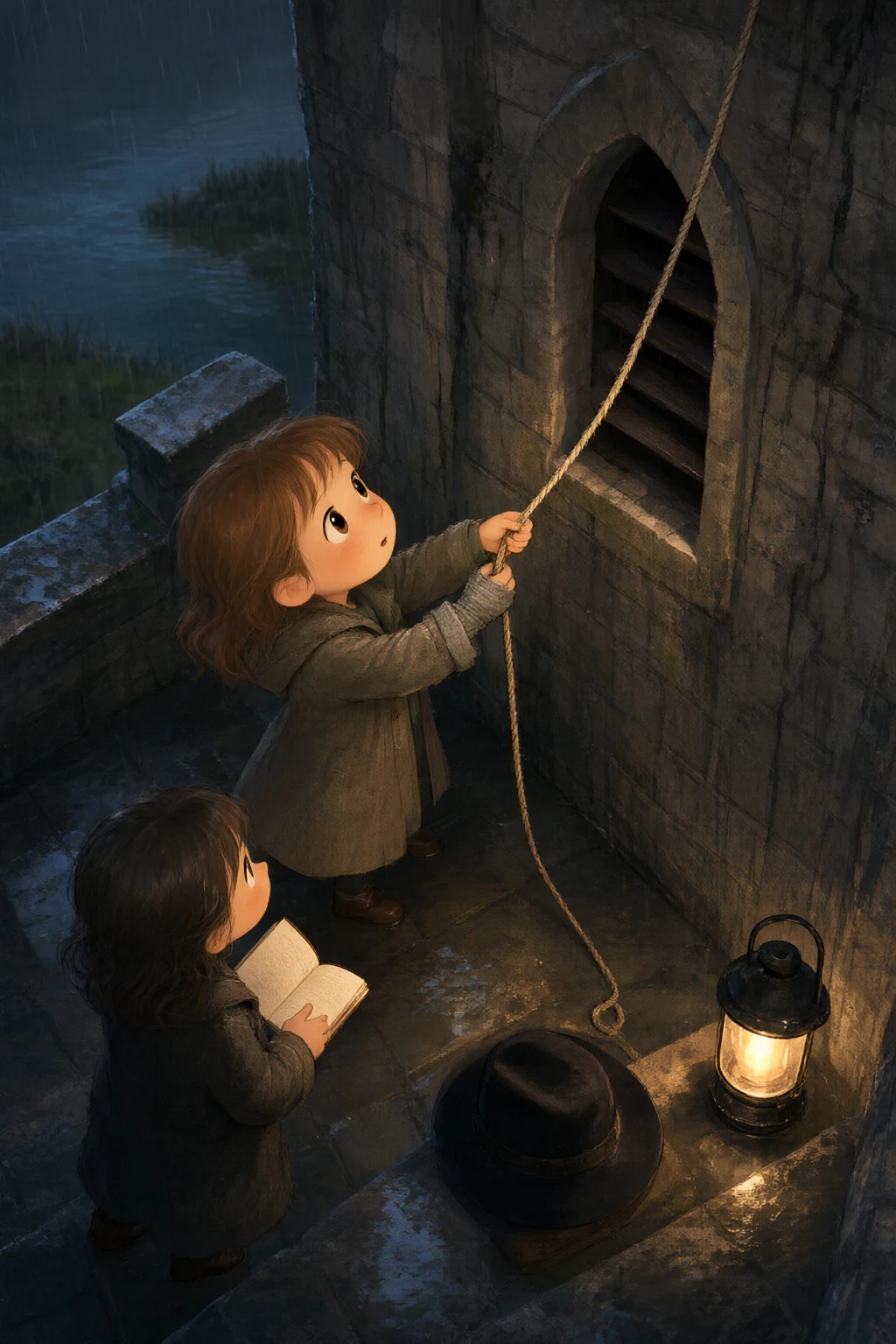
The Cloth Hall tower is square and grey, and the stair inside it is cold in August and colder in November. Ebba Roke was on the second landing with both hands on the hour rope when she understood that the bell was not ringing eight. It was ringing eight, and then it was still ringing.
She pulled. It did not stop. She got her whole weight onto it, up on her toes with the wet wool biting into her right palm, and the sound went out into the Corrach valley and came back up the hill a second later, and every horse in the town turned its head. “That is the fourth,” she said, into the noise of it. “That was the second. That is the fourth, and there has not been a fifth.”
Below her, on the stair, Ferry Nace stood perfectly still with his hat in his hand. He had held the ropes in this tower for thirty-one years, and he had never once had it do this. “Leave it,” he said. “Do not let go of the thread. Whatever you do, do not lose the thread.” The hour bell had one flaw, and it was given to it in the year the tower was new: it holds a note until the holder loses the thread. That was the whole point of it. A bell that counts the hours and does not hold is a bell nobody can trust with a town in it.
And that was the trouble with the town, and it had been the trouble for four hundred years without anybody ever needing to say it out loud. There are four bells on this wheel. One counts the hours and cannot be told to stop. One says the hour and stops. One carries out over the water so that the low cottages know. One screams an hour early to say that something is going to burn. And the river is up.
Ferry Nace came back up the stair with Verity Ash and Aldous Crenn, who had the leather book in a satchel, because a man in his situation does not leave the book in a counting house tonight. Aldous got to the landing and said nothing at all, which frightened Ebba more than the bell did. “The hour bell holds while a hand is on the rope,” said Verity. “That is the flaw, and it is in the book, and the book is right. The question is not what the bell is doing. The question is who is on it.”
“Two hands in this tower tonight,” said Ferry Nace, “and one of them is going down to the Two Wells in a boat, because Mrs. Dall is seventy-one and the water is at their step. So the rope is the girl, or the rope is nobody.” Nobody said anything. Ebba looked down the stair at the cold dark going away and away, and at the handwheel with its four tonnes of iron on it, and put her hands back on the rope. “Then I will hold it,” she said. “I can hold it. I have held it at school singing lessons. Ferry, go and get Mrs. Dall.”
At nine a man called Pyle climbed the tower in the dark and rang the school bell for the curfew. It said ten. It rang the curfew beautifully, and what it said was ten o’clock, into a town where it was nine, with the hour bell still going underneath it like a river under a bridge. “That is not the school bell’s fault,” said Verity Ash, writing as fast as she could write. “The school bell says the hour. The hour has not been let go yet. You cannot have two of them.” “Then what do we do?” said Pyle.
“Do not ring it again. If you ring it again you will say eleven, and by then the town will have been told it is midnight, and there are people down there who will open their doors.” The town had a clock, and it was running, and it could not be wound back, and nobody could tell it anything else. Then Verity came down the stair with her nose white and said there was smoke coming out of the laundry chimney.
The laundry has its iron-bellied stoves, its drying loft, and the only coal store under boilers in Gethin Bell. The water had come up into the stoke hole an hour before and put out the fire, and the coal had sat in the wet all night with a stove pipe running hot through the middle of it. You cannot drown coal. It only has to get warm in the middle.
Nan Ilva was on the laundry roof with a wet bucket, grey smoke going up flat in the wind, and the roof beams over the store already warm to the hand. “If that catches,” she said, “the loft goes at eleven. And there are forty women in that loft, because the low cottages are under water.” The fire bell is in the Cloth Hall tower, and the fire bell has a three-inch seam in its shoulder that screams an hour before the thing that is burning.
And Ebba Roke was on the hour rope, alone, in a cold tower, and the two bells were eleven feet apart on the same iron frame. She had one pair of hands. Odo Marrack came up the tower stair at four minutes past ten, in his black felt hat. “I have held that rope twice since you were born,” he said, “and I have not the arm for it now, and I am too old to be wet in a cold tower for five hours. That is not modesty. That is my knees.” “I am not allowed the fire bell,” said Ebba.
“No. You are not. That is why I climbed up here.” He put the bad hand on the iron frame. “A bell is not a bell in a yard. It is a bell in a frame, with somebody standing in the weather keeping the promise of that frame. Tonight there is one child in this tower, and the child is on the wrong rope.” “Ferry will be back.” “Ferry is a mile and a half off with a boat hook. I have heard the river. Take the wheel, Ebba, and do not think about it. Thinking about it is what makes a hand slow.”
She took her hands off the hour rope. That is all it takes. A bell holding a note does not end because somebody decides it should. It ends because there is nobody on the rope, and the moment the last hand came off the wet wool the thread went out of the bell the way a breath goes out of a man, and the hour bell gave out one long flat noise no bell had ever made.
It was a half sound. It arrived in Ebba’s back teeth before it arrived anywhere else. Then the tower was quiet, and the town was quiet, and for about four seconds the whole valley held perfectly still to work out what it had just heard. They never worked it out. That is what a half sound does. By morning every person between here and the Corrach foot would say they had heard something odd in the night and could not tell you what, only that it was wrong.
And Ebba Roke, who had caused it, put her hands on the four-tonne handwheel and spun it as fast as a girl of fifteen can spin four tonnes of iron, and the biggest bell in the tower went off over her head and screamed. Not a warning. A scream. It came down the stair and into the street and out over the flooded meadow a full hour before there was any fire in the laundry at all, and every dog in the town went off at once. Nan Ilva, on the roof with the wet bucket, looked up at the sky. “Ninety minutes, then,” she said. “Everybody into the Cloth Hall now, and the loft stairs slow, and nobody runs on my roof.”
It took them until twenty past midnight to get forty women out of that loft with their sewing boxes. The fire came in through the stoke hole at eleven twenty-five, exactly ninety minutes after the bell, and the town had that hour because of a three-inch seam of dull red metal a founder had filed visible and refused to hide. And then Ebba Roke went back up and put her hands on the hour rope again, on her own, in the cold, with the water still coming up the meadow.
“I am not going to say this is advice, but,” said a voice from the bottom of the stair, out of a black felt hat that had come back up, “a bell that is counting the hours is the only thing in this town that is telling the truth about the water. It is not being brave. It is counting.”
She held it from half past midnight until four, and the night went in counts, and she counted them out loud. “That is the first. That is the second. That is the third, and the water is at the step of the Two Wells, and it has stopped.” At two she had no feeling in her right hand at all. The grey wool had gone through, and the burn under it had gone through with it, and there was a wet thing on the rope that was not water from the river.
At three the Corrach turned. Verity came up with the notebook and gave the figure the way she gives all of them. “Two inches at the setts and falling since midnight,” she said. “Give or take the wind. It is going to be a hard morning and a wet Tuesday.” At three she thought about the last time she had rung the school bell early, because she had wanted to be near the ringing, and the valley had heard the order come out wrong.
At four o’clock her hand opened. It was not a decision. She had decided nothing at four o’clock. The wool had gone through, and the burn had gone through, and the hand came open on the wet rope the way a hand comes open when it is finished, and the thread went out of the bell, and the hour bell gave its half sound again into the dark of a town that thought it had got through the night. That was the second half sound of the Thursday, and the valley heard both, and by breakfast neither one of them was anything but a mistake in the night that nobody could put right.
The water went down. That is what the Corrach does. It comes up over the meadow in one night and then goes back, the same way, over the same ground, and by ten in the morning the Lime Yard was wet gravel and mud and the setts were a ring of setts again. Mrs. Dall and Joss came down the tower stair at nine in dry clothes, and Mrs. Dall went straight and put her hand on the bronze the way people here put a hand on a bell when they mean it.
The school bell rang at nine. It said nine. The valley could hear the difference from three streets away, because for nine hours the hour had belonged to another bell. Now the hour was finished and the small honest bell had it back. The children heard it and stood up, because that is what it is for, and it had not been wrong once tonight. The last thing that happened was in the counting house, at eleven in the morning, with the rain still going sideways off the moor. Aldous Crenn had the leather book open on its lectern and the green brass reading arm over his shoulder, and the cataract-yellow eye looking out of the window at nothing in particular.
“There has to be a line,” he said. “Not a bell line. A bell line is one bell, one flaw, one word for the purpose. There is no bell in this that did anything last night except be itself.” He put two fingers on the page. “But a bell cannot sound at night without a named human hand on the rope, awake and intending it. That is in the book, and it has never once had a name against it. So the name goes against it.” “We cannot put a child in a casting book,” said Verity.
“She is not in it as a child. She is in it as a hand. Every line in this book has a bell at the end of it, and if I cannot find a word for tonight I shall sit here until one arrives, and it will not, because there is no precedent, and I am not going to invent one at fifty-eight to keep myself company.” He looked round the room at Nan Ilva, at Verity Ash, at Odo Marrack in his hat, and at Ebba Roke, standing in the middle of the floor with a strip of grey wool hanging out of her right hand. “Say what you heard,” he said. “You are the only one here who heard it, and I am not writing it until somebody says it.”
Ebba thought about it a while. Not long, but long enough that the room waited, which is what the counting house is for. “I heard the hour bell from half past eight until it was let go,” she said. “And I heard it again from half past twelve until four, and it was not let go then. It was lost.” “That is the line,” said Aldous Crenn, and put the pen to the paper, and wrote in the small square hand of a man who has written every day for forty-one years and has never had a good word to say about any of it. He read it out, because he read everything out.
“The hour bell of this tower, held from eight of the clock. Let go by the hand of Ebba Roke, who was on the fire bell. Held again from half past twelve until four, and lost by the same hand. Two half sounds. The water being what the water was.” Then he lifted the pen off the paper and stopped, with the sentence standing there unfinished the way his sentences always stand, waiting for the next hand to finish it.
“The book says, in the hand of Ferrow—” he began, out of habit, and then stopped with a sort of embarrassment, because there was no next sentence and there was not going to be one. “Whose hand is this one in?” said Ebba. “Yours will do,” said Aldous Crenn, and looked at it with his good eye. “It is the only name in that book that is not a man over forty.”
She went up the tower afterwards, in the daytime, because there is no better place in Gethin Bell to be on a wet afternoon. The stair was cold. The rain had got in and was tapping on the frames above her, a hundred little noises, and none of them was a bell, and she did not touch the wheel. Down in the meadow the river was going home over the same ground it had come up, slower, taking its time, and the whole town could hear the water in it and the hour in the tower, and after Thursday it was not easy to say which of those was a bell.