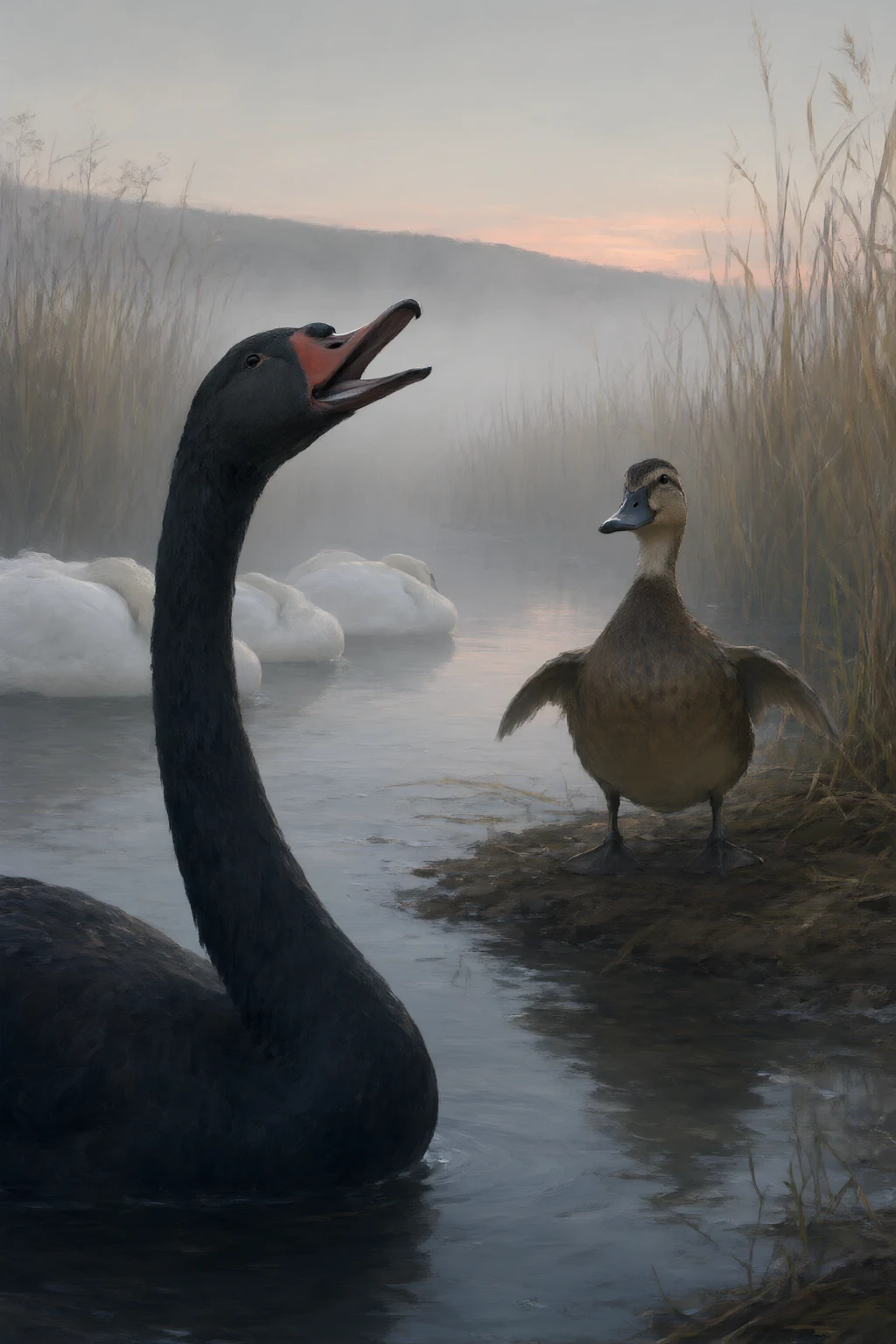
The flock on the Viborg moor had sixty swans in it, and every autumn in the third week they held the ring, and the ring was counted by voice. Understand this about swans first. A swan without a voice is a swan-shaped sack of feathers. The call is the instrument. The note a swan puts out over open water can be heard four hundred paces off, and it carries through fog when nothing else carries at all, and it is not a song. It is a report. It says: I am here. This is where the flock is. If you are not ours, you are now known.
So once a year the sixty came down onto the shallow and formed a ring, and the ring went round once, and every bird called once when it reached the elders. There was no paper and there was no clerk. If you called, you were in the flock. If you did not, you were not a swan there. It was the only registration any of them had ever known, and they kept it perfectly, and for longer than the county had kept anything.
The bird they counted without was called Anders, which is not a swan name at all. He was hatched in a year when the moor was closed and the reeds were a road you could walk, and his brood came down off the shallow in a bad September with their necks not yet blacked. The first winter his voice broke, which is what swans do; the cygnet call is a thin peeping thing and it is meant to be lost, because a lost noise cannot be counted. In the second winter the trumpet should have come. In Anders it did not. What came was a low, cracked, scraping note with a hole in the middle of it, and if you heard it in a still evening you thought somebody had dropped a scythe on a roof tile. "You are not calling," said the flock. "I am calling."
"You are making a noise with your throat. It does not carry. It has no place in the ring." That was fair. Nobody on the Viborg moor was cruel about anything. They were accurate, which is worse, because accuracy never has to be unkind in order to be unkind. In the third week of Anders's fourth year he came round the ring, and what went out over the water went a hundred and fifty paces and died in the reeds. Nobody answered, and there was a rule about that. If the flock answers a call, the bird is in the ring. If it does not, the bird knows before it has finished. The not-answering is the only sentence any of them ever needed, and it is not said with cruelty either. It is said by sixty birds going on with what they were doing. Then the driving-off began, which was also on the agenda and always had been, because a moor has a number, and the number is fixed by the eels.
He was driven off the moor inside forty minutes and he did not fight, because a swan who cannot be heard cannot give an order, and they had all worked that out in the first week. He was pushed out of the circle, and then out of the water, and then found himself on the bank with his feet in the mud and the ring still going behind him. He went east, which is what the swans of that moor do when they are put off. The fjord is shallow and the fjord is nobody's, and there are herons in it, and a heron takes cygnets. He was a grey thing with a black neck and a bad voice and no flock.
He learned, in that first winter, that the things that kill you on a fjord are not eagles. He learned to stand on one foot and sleep on that foot. He learned that a heron will take a cygnet at four in the afternoon in flat light and will not take a grown swan, and that a grown swan standing in six inches of water is a fence post with a head on it. He learned the reeds: bad, because a fox can be in them, and good, because a fox cannot follow you through at speed. And in the second spring of his exile he found the duckling.
The duckling was enormous. That is the first thing anybody would have said about him, and it was the wrong thing to say, and he had heard it enough times to have a whole theory about it. He was the size of a goose and the shape of a barge, brown, with a bill gone yellow at the edges. He was two years old, and had been alone since a flock of greylags drove him off a churchyard for no reason he could ever establish. Every bird he had ever met had told him he was a swan, usually kindly, usually at a distance. "You are the most beautiful bird I have ever seen," said a greylag hen. "I am crying."
"I am not crying. My eyes do this." He was crying. He had been crying on and off for two years, and he cried openly, and the reason he admitted it was that there was nobody to perform for. "You are not a swan," Anders said, because it seemed important to establish the ground. "Oh, I know I am not a swan," said the duckling, and sat down in the mud, heavily, like something being set down. "I've been not a swan since I was the size of your foot. It's just that everybody agrees so confidently."
They were not friends, exactly, for a long time. But a fjord in the second month of the year is a bad place to be two of anything, and by the fourth week they were sharing the one bank that had shelter in it, and by the seventh they were eating the same weed, and by the ninth they had stopped apologising for that. What the duckling knew was this: nobody had ever taught him anything. Swan chicks are taught; the brood is walked out onto the water at one day old and shown how to reach under, how to hold it, how to get off a bank you have landed on too fast. He had worked out how to feed by watching water and getting it wrong.
Anders could do none of it either, because he had been taught all of it in the wrong place, in the good weeks, when there was no need. So they taught each other the way trades get taught, by doing it in front of the other one and saying, "No, like that, you have to keep your foot warm," which turned out to be about forty per cent of everything a swan needs to know. "You're a swan," said the duckling in the first week of the second year. "You know all of this." "I'm a swan." "Then why are you here?" "Because I can't call," said Anders. "And they can't count me."
The duckling cried again, and did not stop for some time, and the reason was not self-pity, though it looked like it from outside. He had just heard the exact sentence he had been trying to say for two years, said properly, by somebody who had been taught nothing. "You don't count," he said at last. "That's not being ugly. I've been ugly for two years and I've been counted in nothing, but I was never in anything to start with. You were in." "Yes." "And then you weren't." "Yes." "That is much worse," said the duckling, "and nobody has ever understood that but me, and I have not got the words for it in my bill."
They kept each other through two more winters. The duckling was raised by nothing and raised himself, and Anders, who had been raised by sixty birds and had never once been hungry, discovered the whole subject of being hungry, and got thin, and got through it. He learned the fjord. He learned the three places a fox will come out of the reeds. He learned that you can stand on a frozen shallow in a wind and stay warm if you keep the web of your foot on moving water at the edge, and that he had to be told, in the fourth month of a night. And each evening the duckling said, "Say something to me. Anything. Just say it." "It's a noise."
"It's a call, and it's yours. No other bird alive can make that noise, and you are the only one who has it. I can't copy it." He was two years old and had spent his life being told what he was, and he did not know at the time that he had just said the thing that saved Anders: "That's not a fault. That's a job."
The gulls had it, because gulls know everything on a moor. The flock was at a number again, a small one, because the moor eels had been poor two years running. Fifty-one birds, and any bird that could not call would be driven off again, and the driving-off was in the third week. "I could try it," said Anders. "You could try it," said the duckling. "That is not the same as being able to do it." "I could try it." They went west in the fourth month, over the fields, eleven days, and the duckling walked most of it because he could not fly well and would not admit it.
He stood in the shallows on the twenty-second day and the flock was there. It was worse than he had built it in his head, and what made it worse was that it was not hostile. The elders sat in the middle with their wings folded, the young ones on the outside, and they looked at the two arrivals coming in off the field the way you look at something you have seen before. Fifty-one birds in a ring, and a clear gap in the circle where he was supposed to be, and nobody had to say so. "Wait for the wind," said the duckling. "It's better with wind off the water." That is a true thing about swans, which is a small comfort, because in this story almost nothing true is a comfort.
He waited. The wind came up off the moor in a long grey push and flattened the water, and that is exactly the condition under which a swan's call will go furthest, because the sound has a surface to run along. Anders opened his throat.
It went out over the moor, and it was a bad sound. It was the note he had made for six years, cracked and low with a hole in the middle of it, and it did not go four hundred paces. It went about two hundred, in a straight line, and where it hit the far reed bank it did not so much die as stop being able to be heard, which is a different thing and a worse one. Fifty-one swans on a moor in the third week of the ninth month, and the sound they made in answer to that was not silence.
It was laughter. It was the fluting, carrying, gorgeous, unhurried sound of fifty-one swans laughing at one bird, which is not a noise you can imagine unless you have stood in a reed bed and heard it happen. It is what a flock makes when it has found the funniest thing on the moor. Anders stood in the water with his head up until the last of it had gone, because the alternative was putting his head under, and he was not going to do that in front of the duckling. Then the old one in the middle came forward. It was a female, four years old, with a number stamped into a ring on her left leg, and she came close enough to say it in the ordinary voice birds use when they are discussing the ring.
"You have learned nothing," she said. "Six years and you have learned nothing. You are not a swan and you were never going to be a swan, because a swan that cannot call is not a bird that calls badly, it is a bird that is not a swan, and the reason is not in your throat. It is in you."
It was the duckling who answered, and what he said is the reason Anders is remembered at all, and it is worth setting down exactly, because it is nine words long and the nine words were true. "I am a swan too," said the duckling. "I was driven off in the autumn I was hatched, for the same reason, and I have been here two years, and neither of us has ever been in a ring. So you are right. Neither of us is a swan. Now what?" The old one looked at him. He was, of course, the most enormous bird on the moor. "He isn't in the ring," she said. "You are not either."
"No," said the duckling. "But you have been trying to drive us both off a moor for six years, and neither of us has gone, and it has cost you the eels twice. Are the eels better this year than last?" That is the whole of what happened. The flock had a number and the number was fixed by the eels, and it had gone down two years running while they spent every third week throwing away a working pair of birds who were eating the same weed. It was not a revolution. It was an accounting error, and the oldest bird in the ring knew it inside four seconds.
The flock took them in on the terms of the winter watch. There is a watch on a moor. Sixty birds will not stay alert through eight hours of darkness, so one bird is awake and calls while the flock sleeps. If a heron comes, or a fox, or a man with a dog, the wake calls, and the flock wakes, and drives it off. It is the only thing a swan does that is difficult, and the flock had to leave it to a cygnet every year because the adults needed the rest. It was left to two birds, on the grounds that neither of them had ever once managed a full night of sleep since they were hatched, and that the duty had been unfilled for two years and the eels knew it.
The swan with the bad voice took the third watch and the duckling took the fourth, in that order, because the duckling insisted and because it was correct: the third watch is the one with the fog coming off the water, and you do not want the bird that cannot be heard alone in the fog with nothing to wake it.
Anders is not a swan. He has never pretended to it and neither has anybody on that moor, and the arrangement works precisely because nobody is pretending. What he is, is the bird on the Viborg moor whose voice goes furthest. The fog comes in off the moor in the last hour before dawn, close and grey, and in it the twenty-three adult swans hear their own flock calling and know where the bank is and do not panic, because under all of that there is the one note, low and cracked with a hole in the middle, going out over the water like a scythe on a roof tile, saying the same four things every night for eleven years.
The county man who rings the swans came out in the third week of the ninth month in the fourteenth year, because the ring still has to be counted. He counted fifty-one in the ring and then the two out of it, and he asked the old one what to write. "Write that the moor is kept," she said, and had a think, being an accurate bird. "Write fifty-three." He wrote fifty-three, which was a lie of one, and it is the only entry in his book he has ever been asked to make, and it is the reason the post of the third watch has never been unfilled.
The duckling goes south every year with eleven of the young ones, and comes back in the third week of the ninth month, and has never once been counted in the ring, and has stopped minding, and says so at length to anybody who tries. He comes back because the third watch has to be taken, and there is a big brown bird on the moor who cannot be heard in fog, and who will be eighty in a couple of years.
And on the night of the fog, which comes most years in the last hour, the duckling wakes out of the first sleep with his bill in Anders's back and the whole moor asleep, and there is a wake to do. So he gets up off the mud, which takes him two goes, and stands with his feet in the freezing shallows, and opens his mouth, and makes the noise that two birds and a whole moor have agreed belongs to him. And the answer comes back across four hundred paces of black water: cracked, low, with a hole in the middle of it, and a long way off, but there.