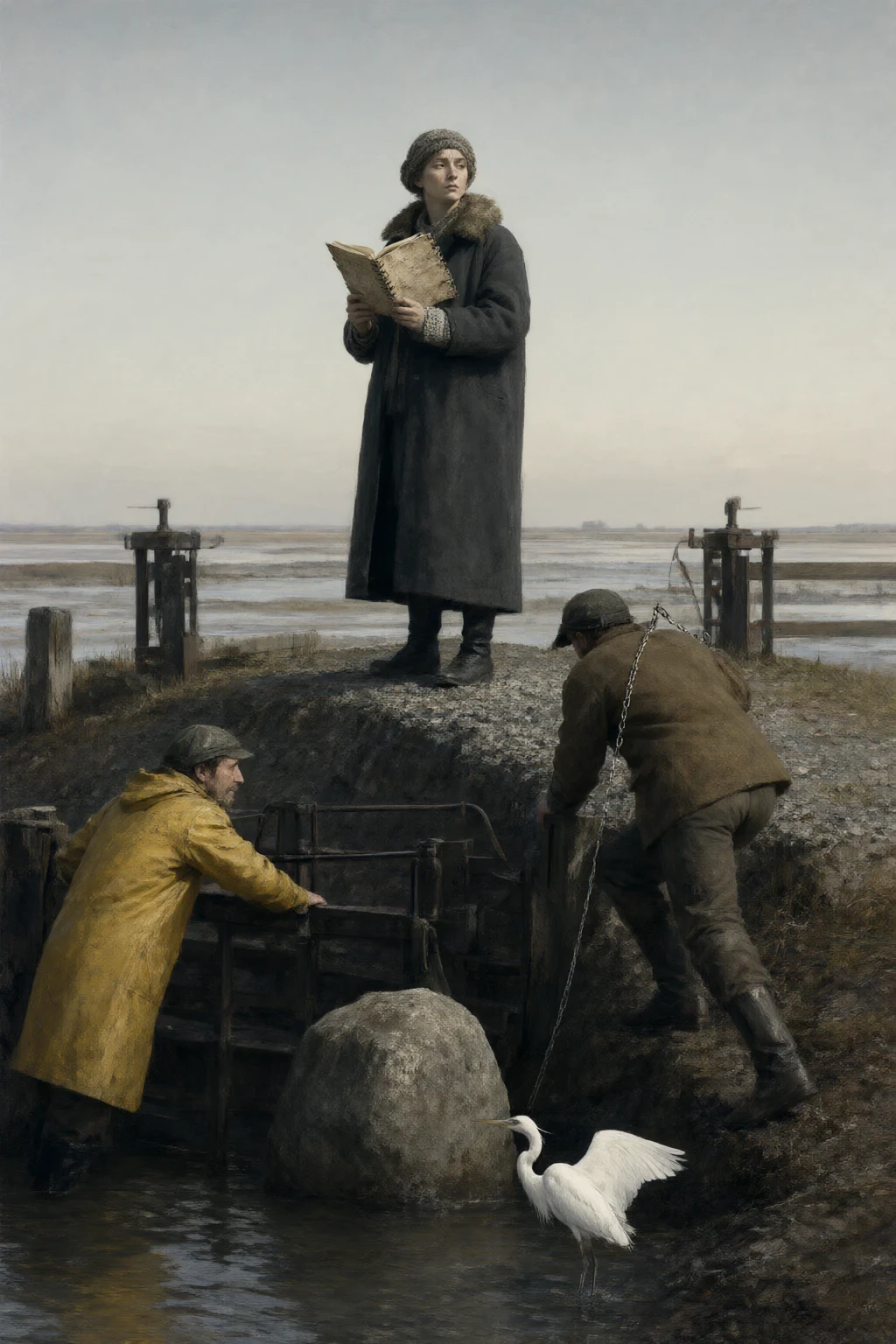
The Salt Marshes had been marshes for four hundred years, and for three of those they had been respected, which is a different and better thing than being drained. Prince Oleg had been married to Princess Ekaterina for two years. In that time he had cut four channels, built three sluices, and moved the whole household of his wife's first parish, where the ground had gone soft as bread, to a village he named, without irony, Novaya Nadezhda. New Hope. What he had drained was reeds and sedge, and the peat underneath, which was the reason the district was called a marsh and not a lake. What he had also drained was a heron rookery the size of forty villages, and the last breeding place in the kingdom of a fish the poor of the capital ate boiled, under another name, for money.
The harvest of 1919 was the best the kingdom had known. Bread held down at three times the old price, and this was considered by everyone the achievement of the century. Nobody had yet said the word impoverish, because the word was about the countryside and nobody in the capital was ever in the countryside.
The tsar had four daughters, which is a number that gets a man into trouble by the fourth. Ekaterina married the marshes. Anna married the Three Oaks. Irina married the black loam of the south-west, the rye that fed two capitals and the Army, bought in nineteen pieces over nineteen years by a Count Sviatoslav whose patience his neighbours found faintly frightening. Vasilisa was the fourth, and she was not beautiful; this had been settled early, with relief, in the family. She was nineteen, thin, and she read. In a court where reading was a phase of childhood, like biting the furniture, she had bitten the furniture, gone on reading, and at fifteen been given a place in the chancery as a copyist.
"You will understand," the Chamber said, "that this is not a punitive measure." They met in a low room with a cast-iron stove and a table never planed on the underside. Two of them were her cousins. The third was her father's cousin, who had looked at floors since she was six and whom she had been mistaking for humility. "It is an audit. The estates are solvent, all three, which should be given weight. When an estate is solvent and the country is not, the difference is going somewhere, and the Chamber would like the somewhere." "I will need a sled that is not a chair," Vasilisa said, "and the right to open the estate books in the presence of the estate." "You will have the sled. There is also a present from your mother. She waited in the corridor for an hour."
The doll was in a box lined with black velvet and it was the size of her thumb. It had a round bald head, a body of lacquered wood, and six hands too small to be any use. Its face was one flat plane without brows or mouth, and where the eyes were there were two discs of paler wood, so that it looked at you without focusing, the way a stove looks at a room. "Your grandmother made these," her mother said, from the doorway. The box was her mother's, the doll was her mother's, and the doll was twelve years old then. "She made them for the border courts, where the figures were large and the men were not good with numbers." "What does it do?" "It adds. It does not advise, and it has never once been asked to."
"That is all. It will not tell you what is right. It will tell you what is there." Her mother said the rest of it to the middle of the floor. "Do not make a friend of it. Be its employer." In the sleigh, on the second night, she asked the doll the weight of the books, and it did, without pretending to be a marvel. "And you? Do you know what is to be done?" "I know the sum. The sum is that you have nine hundred and forty pages of marsh accounts to verify, that they were copied in 1908 by a man who was drunk, and that the number of places where they will not add cannot be known in advance. You must go there and look."
The border village of Babki had been Babki, and it had been moved in the fourth year of the marsh works to the far bank of the river, where the land belonged to somebody. Baba Yaga was Vasilisa's grandmother. She was eighty-one and small, and her hut stood on hen legs, which in that district had stopped being frightening some time in the previous century, because everyone knew the woman who came in and went out of it and the price she charged. The hut turned on its legs when Vasilisa came to the gate, so that the door faced the yard, and a voice inside said, without any question in it, "Two days late. In this district that is a week." "Three roads are gone," said Vasilisa. "The one through the peat." "Then you have learned something already," said Baba Yaga, "and you learned it for free, which means you have not begun."
The stove was lit. On the table lay a slab of birch bark with three things on it: a stone, a knife, and a book in a cover so waxed that it had the look of a shutter. "I am going to ask you for something," said Baba Yaga, "and you will say no, and then I will tell you what it is. So. I want the stone back." "Your boundary stone." "Eleven years ago I gave the parish its boundary for the road. The road came. The stone went. In the new survey the stone is in the middle of Prince Oleg's third sluice." She sat down. "Put it back. Not kindly. In a cart, on the embankment, where the water can see it. Let his men make a fuss, and let the fuss be written in the parish book, because a fuss in a book outlives the men who made it." "And the book?"
"The old accounts. Before 1861 they were kept twice, in the villages and in the Chamber, and when the two disagreed the villages were believed. After 1861 they were kept once, and the villages kept what they liked, which was usually the truth, badly, on birch bark, in a hand nobody could read." "The modern Chamber does not keep the old books." "No," said Baba Yaga, with enormous satisfaction. "In the spring of 1903 the modern Chamber formally established, by order, that the old books are unreliable. Excellent housekeeping. Clerks burn what they are told is bad, and being told is enough." She pushed the birch bark across the table. "Not all of it. I am an old woman in a village that got in the way of something, and no clerk has ever had cause to look at my rafters."
She did not leave the hut until she had read all ninety-one, and on the eleventh day she found the peat. Not the peat generally. The peat: the record of what had been cut from under the ground, kept in the same columns for sixty-one years, because the man who began the first of these books had decided that what you take out from under a place ought to be written down. 1783. Two hundred and forty dessiatinas, to a depth of a man. 1841. Nine hundred and eleven dessiatinas, to a depth of a horse. 1899. Then it stopped. The district needed a loan, the loan was made against the peat, and in 1914 the accounts were closed. "You have it," said the doll. "I have three numbers and a word spelled the way your Chamber spells it."
"Correct. The numbers are identical. The depth in 1841 is in a different unit, because they had not agreed on a unit yet, and that is a difference of spelling and not of kind. Your Chamber has since converted the unit, has since declared the books unreliable, and has since burned every copy but one, and the copy it kept is the conversion." The pale discs turned toward the door, as far as they can. "You have the answer." "No," said Vasilisa. "I have a shape." "It is a number. It is three."
She saw Prince Oleg in the second week, in a house built in 1913 with plate glass and a shortage of everything else, standing on piles on ground that had been marsh. He put three questions about the water table to her before he was told who she was. He had an answer to everything. That was the trouble with him: he was the only one of the three who had done arithmetic he expected to be examined on. "Forty thousand one hundred dessiatinas. Reeds, and nothing in them but herons. Now wheat on the same ground, four times the yield, and the market is thirty verst from my granaries, and the state has not once had to ask me for anything, which I put higher than a medal." "And the peat?"
"Peat was never a resource. Peat was the thing standing in the way of a resource." He was not smiling and he meant it, which was the worst of it. "I have not wronged a person. I have exchanged forty thousand acres of mosquitoes for four hundred thousand acres of bread, inside a generation. There are children in Novaya Nadezhda who will eat." "The rookery," said Vasilisa. "The fish. The people who came for it in August." "Yes. Yes." He poured the tea. "A heron is worth nothing. A kilogram of rye is worth a number that moves, and it is high this winter, and I have sold forward into 1922, and you may admire that or deplore it." "You have sold the next harvest." "I have sold the next harvest twice in three years to three buyers, and I shall do it again in the spring." He looked at her over the cup. "You have found the peat?" "Your third sluice is built on the boundary stone of the parish of Babki." "Ah," said Prince Oleg, and put down the cup, and for the first time that afternoon was not entirely in command of the room. "Ah. That is a different sort of complaint."
Prince Yaroslav of the Three Oaks had built a town, and used the word without irony, because the town had eleven thousand people and a railway and a hotel, and had been four hundred people of whom the fathers cut timber and the sons died in the war of 1914. There was no forest left in the district. There had been none since 1912: sixty-one thousand cubic sazhen in 1915, forty in 1918, three in 1920. "This year I closed the second mill," he said. "I closed it myself, at my own table, with my own pen, and I have been asked since, by the Chamber and by a newspaper in the capital with a public appetite, whether that was a great day or a sad one. Say the true thing. I would be grateful." "The true thing is that you sold the wood."
"I sold it, and the district now has a mill town that a company in the capital can close on a Thursday by moving its accounts into another column. I have four thousand saplets and no land to put them on, because the land is being drained, and on the drained ground they drown in 1926. I have written to the Chamber. The Chamber has answered that the question is not pertinent to my accounts."
Count Sviatoslav was the last, and the last was the worst, and she understood within an hour why. The black loam district was the best land in the country. It had a dairy whose butter was sold in three capitals, six thousand one hundred and forty people, and a book, with tables, that she had read at fifteen and had wanted to live inside. He was fifty-four and enormous, and he showed her everything, and it was good. Then she asked hers. "How many of the six thousand one hundred and forty are bound to you, and by what?" He waved a hand. "Contracts. Everyone has a contract. I did not invent it. A man takes a loan to buy oxen and cannot pay and sells the labour of his children, and the price is fair, and I pay it, and the law permits it, and I did not write the law." "How many of the contracts did you sign yourself?" "None. The steward, Mr Rach, the district court at Cheremsh, the notary, the bank." "And the mortgage?"
Count Sviatoslav stopped. "The mortgage is on the north farm. The north farm is a good farm, the mortgage is nineteen and a half years old, and it is the ordinary arrangement of a man building a large establishment, and I do not discuss it with an auditor, and certainly not in front of my wife." "There are nine hundred and forty pages in your books." He looked at her a moment, and he was not a fool either, and what he saw in her face was a girl of nineteen in a good coat asking a question she had been asked to ask; and the thing she wrote down afterwards, in the fair copy, exactly as it happened, was that he was deciding how much of it she was worth. "The state proposes to apply your improvements generally," she said. "The leases. The advances. The Chamber intends to publish the model." The silence in that room had a shape.
"I did not write it," he said. "Rach writes it. I sign it, and I read the top of the first page in a good year, and after that the pages are the same page." His hands came up and put themselves flat on the table. "It is a form, and the thing I am proudest of is that the man in the field is not a serf, he is a man with a paper, and a paper is better than a fist, and I have believed that my whole life, and now the state intends to make the paper for everyone, and it is my paper, and I have never once read the sixteenth page." "The doll can tell you what is on the sixteenth page," said Vasilisa.
The doll, which could not be frightened or bribed because it had nothing, stood on the bound volume of contracts and added. "Contracts held over persons on this estate: two thousand four hundred and eleven. Contracts of which the estate holds the original: two thousand four hundred and eleven. Contracts bearing the personal signature of the proprietor or his wife: one. The contract so signed is a mortgage on the north farm, and the assignments include the north farm's labourers as collateral, one thousand nine hundred and six of them, signed in 1903, in an office, on a good day, in a hand that appears nowhere else in eleven volumes." Count Sviatoslav sat down. He was a large man and he sat down like a large man whose legs have been taken out from under him by somebody he cannot reach. "Nineteen and a half years," he said. "Four years and eleven months," said the doll.
The fair copy of the audit was one hundred and forty pages and Vasilisa wrote all of it herself, because the protocol forbade a copyist to use a machine, and because a dictated number comes out either softer or harder than it is, and the purpose of a fair copy is that it is neither. The findings took nine pages, in a hand so level that the four clerks who checked them found nothing to query, and two of them found the document difficult to read, which she noted and did not correct, because they were right. The first finding was that the marsh country was never a waste, and that the practice of the district in 1783, in 1841 and in 1899 was the practice now proposed in a different unit, and had failed three times, and that in a house where a thing has happened three times, the fourth time is the failure.
The second was that the three estates were solvent and the credit was due to nobody in particular: ninety-one thousand dessiatinas of forest gone since 1905, six and a half thousand persons under enforceable contract to the black loam estate, and one seed store holding thirty-one months of grain. The third was that the seed store was the only asset in the country worth more than the Army, and was to be neither sold, counted as revenue, nor pledged, and that the fact of it should be written into the instrument in which the Army's own credit is secured, so that any future Minister of the Army who is a fool may at least be a fool who has been told.
And beneath that, without a heading, in the same level hand, because she was twenty years old and had not yet learned that the sentence was not hers to write: of the children born on the black loam in 1907, the great majority of whom stand under contract to that estate, one in nine fails to reach five years old, and of the rest one in three enters school in a state the district inspectors describe, in eleven consecutive volumes, as transient. This is a ratio and not a feeling. The Minister may compare it with the capital's, which is one in twenty-nine, and which he knows, because the capital is reported monthly.
The Chamber took four months on the audit, because an audit is never the thing that takes the time. The thing that takes the time is the discovery that the item at the bottom of a column has a name attached to it. Nothing was killed. That was the part Vasilisa had not been prepared for and never afterward entirely understood. Prince Oleg was sent north with survey chains, a budget, and a commission to establish the line of the coast at the date of a survey to be made in five years, and to move the boundary markers to it. He took the work with the real competence of a man who cannot bear a piece of land to be in the wrong place, and in the third year he sent the Chamber, unprompted, a memorandum on the projected yield of that district as it would stand in 1950. It was excellent. It was read and filed.
Prince Yaroslav was given the restoration fund, which was four thousand two hundred rubles. He laughed for the first time in three years, out loud, in the Chamber, and then apologised, and then observed that the fund would buy nine hundred saplets, and asked whether the Chamber considered the bee-mastiff disease the better purchase. The cousin considered that the bee-mastiff disease, on balance, would cost less.
And Count Sviatoslav was made to read his own contracts aloud to the Chamber. That was his sentence. He did it himself, in his own voice, over five days, in front of a clerk; the first two thousand quickly, and then slower, and the whole room listening to a large rich man become a person in a story he had been in. He was not ruined and he was not a villain and he was the only one of the three who had done honest work, and in the fifth year he began to buy the contracts back, village by village, at his own price, without publicity, and was still at it eleven years later, and had reached nine hundred and forty of the six thousand one hundred and forty, copying each one out in his own hand over his own signature, so that no clerk could lose them. It was the most thorough piece of record-keeping in the history of that district.
There was no wedding at the end of this. In the spring of 1921 the tsar, who had by his own lights solved the business of ruling, by a method nobody has ever discovered, named Vasilisa to the Chamber of the Balance, aged nineteen, without a husband, for five years, renewable; and the renewal in 1926 was the only time in the kingdom that a post was kept on merit after a review. The Chamber's offices left the palace that autumn, because the palace rooms were needed for the seed bank; and Vasilisa's desk, a small table by a window for four years, went down in a cart and was set up at the same height in the same window, which looked in the same direction, which is the road that goes north, which is the coast, and from it you can see nine verst and then a flat grey edge that people who have seen it lately prefer not to describe.
Her mother died in 1920. Baba Yaga was entered in the parish book as gone in 1923, and the clerk who wrote it added, in the margin, that the hut was still there on its legs, the stove cold, and nothing in the rafters, because Vasilisa had taken the books to the capital. The clerk asked her once whether that was theft, and she said: it is a copy, and if you want to say a thing has been taken from a village that has been moved off its boundary twice in its life, then say it in a book, and I will take the book, and the Chamber will keep it too, and then somebody will have to have both. The stone went back on a cart that summer, over his written objection, which is filed, and is four lines long, and is the most furious document in the marsh district's history: I have given the survey. Do not give me the stone.
On the last evening of her first winter in office the sled stopped at the bottom of the Nursery hill, because the thaw had begun to lift the road into a ladder and a sledge cannot climb a ladder, and the driver would not get down in the wet to push, so she walked the last eighty paces in front of a crowd, in a bad coat, carrying a plain clay pot of black loam in which one hazel had survived the winter that killed four hundred and eleven seedlings of the official stock and none of the hazel, the hazel having come up out of a root in the pot rather than out of the ground, nobody having costed it, nobody having ordered it, and so nobody having cut it down. She set the pot on the sill of the seed-bank window at the height where the light was best, and the registrar noticed it in April, and being a careful man opened the inventory at the letter H, and found nothing there, and closed the book again.
The doll was on the desk, as it was every evening of its life, with its small round head tilted at the column. It made the mark it made at the bottom of a sum that was finished, and then it made the other mark, the one it made only when a column refused to come out, and it left the book open there.