The audit began on the first Monday of November and it ended on the last Friday of February, and in between there were one thousand one hundred and forty-two entries to account for and a great deal of walking. Nobody in Nether Combe had ever audited anything. That is not quite true. The mill audited itself every Friday at four o’clock, when the pay board was chalked and the week’s number was called out and checked against the pay books, and that had been done without a break since the mill was rebuilt, and it was the only audit in the valley and it audited money and not names, and Corve Merrick had done it for nineteen years and believed the whole of the town’s prosperity sat on the Friday board and could not be shown to be otherwise by anybody. What he wanted, in the November, was a second opinion. The Bristol house had begun sending a young man up twice a year instead of once, and the young man had begun asking, over a cup, whether the mill’s position could be certified rather than stated, and Corve Merrick is a careful man who does not like being asked a question he cannot answer with a document, and so in the last week of October he wrote four lines to Pell Harrow at the counting-house desk and got back four lines and a date. “An audit of the roll,” Harrow wrote. “Against the pay board, the register, and the hands. Strictly, I should think. For my part I cannot see what the mill gains by it, and I can see a good deal that the Bristol house would gain by it, and I shall want to be in the room.”
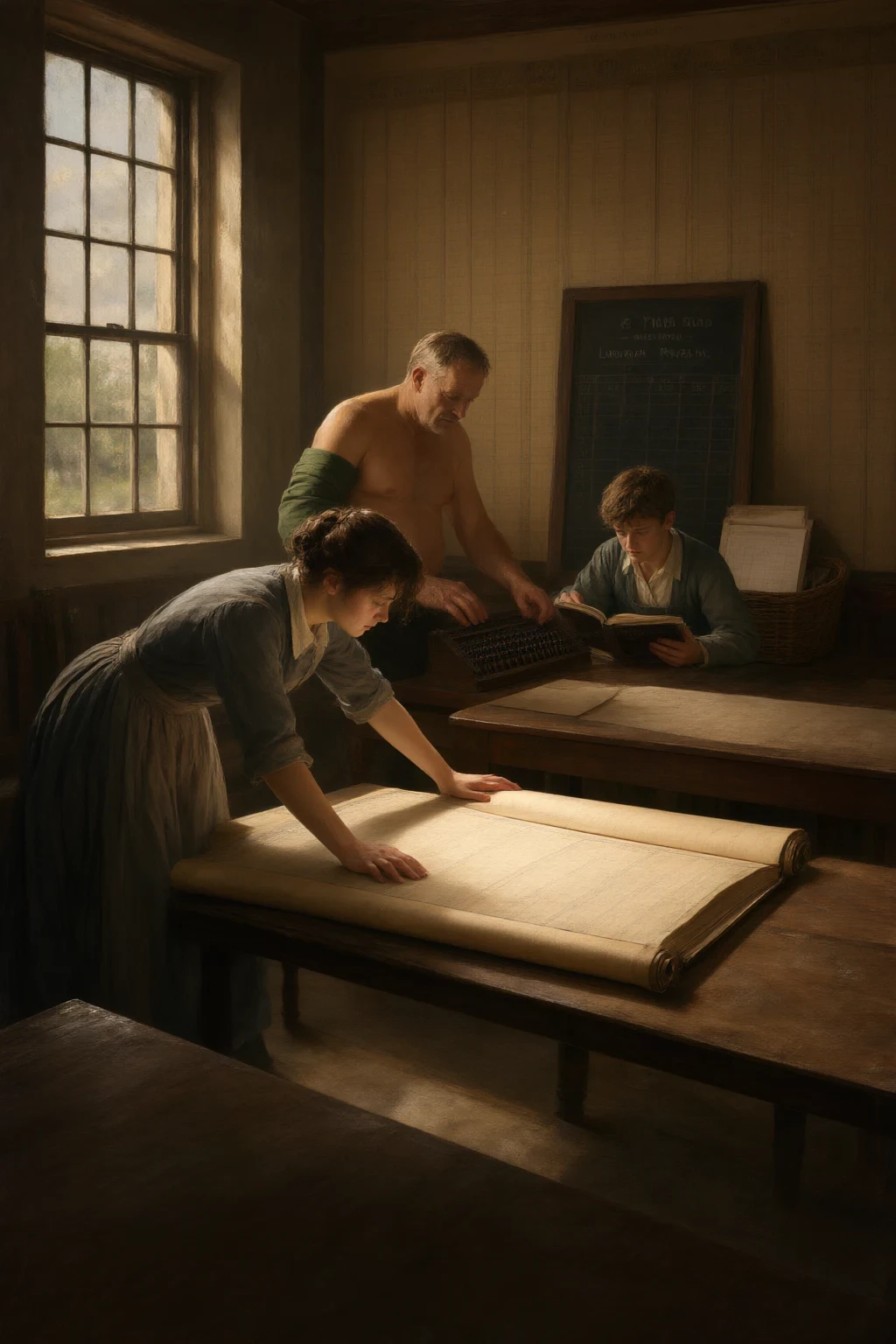
The material was set out in the counting house over the mill office between the seventh and the ninth of November, on three long tables, and it is worth saying what it was, because four fifths of the work of the next four months was finding out what a thing was. The roll came down from the top of the mill in a japanned tin at half past eight on the Monday, in Aldis Prowse’s hands, and it went onto the middle table and it did not go back up for one hundred and nineteen days. It is a bound book of four hundred and sixty-three pages, of which four hundred and twelve are written on, and it opens flat, and it has five hands in it, and the entries are ruled in five columns: the date of the loan, the term, the name, the form of the call as it was spoken, and the outcome.
The pay board came off the wall in its frame, and behind it came the pay books, which are forty-one bound volumes of a year each, in a clerk’s hand and a counter-clerk’s hand, going back to the year the mill was rebuilt, and which are the mill’s only continuous record of who was in the mill and on which day, and which are in a room with a stove in it and are therefore the only records in Nether Combe that have ever been thought about by anybody. The parish register came from the church in a basket, and it is three volumes for the eighteenth century and eleven for the nineteenth and nine for this one, and it records baptisms, marriages and burials, and it records them completely, because a parish clerk is paid by the entry and not by the year. The bindery’s hands came last, downriver, in a handcart, and they are the reason the audit was possible at all.
The mill lost thirty-one years of pay books in the year the counting-house roof went in. It was a fire in a dry March and the counting house burned to the first floor and the pay books for thirty-one years went up with it, and the mill was not insured for them because the mill was not insured for anything except the wheel and the elm, and what came back was a list of the years. The bindery lost nothing, because the bindery does not write its days on paper and keep them in a room with a stove in it. It burns them into the boards. Every press in the Great Bindery has a board, and every board has the date and the number of the press burned into the end of it with a hot iron, and a board is not a thing you throw out, and there are two thousand nine hundred and eleven boards on the rack at the back of the shed and the rack has been full since before the mill was rebuilt and the older ones are in a lean-to and the oldest of those are stacked on their edges in a dry corner with a slate roof over them that a man put on in his own time and nobody paid him for.
“A board does not care,” Merrin Dole said, to the whole of the first morning’s meeting, which was five people. “A board is the only document in this valley that cannot be argued with. You cannot rub out a date burned in iron, and you cannot burn a board, and you cannot borrow it out of the shed, because the shed is locked and the key is on my belt and I sleep with it in my boot.”
The board itself is chalk. A man writes the week’s number in chalk on a slate that hangs in the yard, and on the Friday the pay board is chalked over and wiped, and the chalk is swept up and the floor is swept, and on Saturday the board says the last week of October and nothing else, and so the board is the only record in Nether Combe that is a perfect record and dies every Friday night. The pay books behind it are what the board is copied into, and the copying is done by a clerk and a counter-clerk alternately, which is why forty-one volumes of them disagree with each other in about one line in six hundred, and all six hundred are worth nothing. “That is the difficulty of the whole of it,” Merrin Dole said. “In this valley the things that are kept are kept badly and the things that are kept well are kept for a week. A person may say what they like about the spinner. I have been to the top of that mill four times in thirty years for the board rack and I can tell you the weight of that roll to the quarter of a pound, and I could not tell you one thing that is in it about a person.”
The work was given out on the Tuesday. Merrin Dole took the roll and the register, because the roll and the register are both about people and a person is the only unit that matters. Jory Vasc took the pay books, because the pay books are in figures and Jory Vasc has been keeping a very clean notebook of figures that nobody asked him to keep. Aldis Prowse took the bindery, and was there for two days in every week of the four months, because the bindery is a mile and a half downriver and it is the only one of the three sources that has to be walked to. Corve Merrick kept the counting house and came in at the end of every day and read out of the quarter book whatever was wanted of him, and Pell Harrow came from Bristol on the first of December and the first of February and sat at the end of the table and said nothing for nine days out of the ten.
The method was a three-way match and it was not a subtle one. For every entry on the roll there had to be a person. The person had to be findable. A name goes into a mill valley four ways: it is a name on the pay board, a name in the church register, or a name in the bindery’s books where a piece of cloth carries it, or a name in the roll, which is the fourth way and is the one nobody trusts. So an entry was good when the third column could be set against the other three and the other three did not contradict it. They contradicted it very rarely, and when they did it was almost always in the direction the roll wanted.
“Eleven hundred and forty-two,” Jory Vasc said, on the eleventh of December, and he had it on his left hand, because he wrote on his left hand, and the figure came out of the side of his mouth before the ink was dry. “And you want to know how I know it is eleven forty-two, and not eleven forty-one or eleven forty-three, and it is because the pages are numbered in the fourth hand and the numbering goes to the last written page and the numbering is right, and I checked every number against the count of entries on the page and there are eleven pages where the count and the numbers do not agree, and in nine of them there are two entries on one line, and in two of them somebody has ruled a line through an entry and written no reason.” “Strike a line through an entry,” Corve Merrick said. “In the fourth hand, in 1890-something, and there is no reason, and there is no outcome, and the name is still perfectly legible.” “Then the name is still on the roll.” “The name is still on the roll,” Jory Vasc said, “and there is nothing after it, and the next line is the next loan, and I have never seen that in a book in my life and I have looked at it four times this week.”
The first finding was that the roll is honest. One thousand one hundred and thirty-one of the eleven hundred and forty-two carried across cleanly into the pay books, the register and the bindery, and the eleven that did not were eleven kinds of eleven things and none of them was anybody stealing anything. Eleven names could not be traced to a household in the parish register at all, and all eleven were between 1791 and 1811, when the valley had a different parish boundary and the register of the next valley down was not kept in Nether Combe. Four were women whose marriage had been in Wales. Three were men who had gone to sea. Two were children, and a child of nine lent a name, and the entry says the term was one night, and the audit did not have anything to say about that beyond writing it down. One was a man who appears in the pay books of two mills in the same October, which means the entry is either a duplication or a lie, and the fourth hand has ruled through it, which is the strike Jory Vasc found, and a clerk who rules through an entry in 1890 is a clerk who has decided something. And the thing that mattered, which was not one of the eleven, was six entries in which the pay books had the person at work on the day of the call.
“A lent name is held, not gone,” Aldis said. “Everything the town does under it on a day is the holder’s act, and the holder is accountable for it. So a called name that does not come out of the mill because the person called is in the mill is not a mystery. It is an entry with a good deal behind it.” “Six of them,” Corve Merrick said. “Six of them, and three of the six are in the same decade, and one of the six is on page four hundred and six, and the pay book for the week of the eleventh of February, seventeen seventy-one, has Bess Prowse on the mill floor on the Monday, the Tuesday and the Wednesday, at a shilling and sixpence a day, and the call was on the Tuesday, and the pay book has no mark against the Tuesday at all, and a pay book always has a mark, because a man is paid for a day whether he stands at the end of it or not, and the mark for a day he was called away is a stroke through the day, and there is no stroke on the Tuesday.” “Then she was at the mill and she was answering a call at the same time.” “She was answering it at the mill. Somebody was in this town on the fourteenth of February 1971 using her name, and she was here on the floor doing her own work, and the two facts do not touch, and a clerk who has never read the roll across would say the Tuesday had no mark on it and think nothing of it.”
The tow shed is the one room in the mill where a name is not a form of accounting, and it was in the shed that the audit found the only number anybody in the valley had been keeping wrong on purpose. Innett Sly could spin a hank finer than anybody under fifty and had done it for three years, and she is the person the valley has suspected for three years, and she has never once said a thing without saying how much of it there was, and she counts her own revolutions aloud under her breath because the shed is loud and because a number is a thing you can be alone with. The audit wanted the shed’s list, because the register is a register of households and the shed is a register of women, and forty names came off the shed’s own book in nine minutes: forty, in the order they stand at the frames, with the frames numbered in chalk the way everything in that shed is numbered in chalk. “Forty,” Innett Sly said. “And there are forty-one marks on the floor.” “There are forty-one frames.”
“There are forty-one frames and there are forty of us, and the forty-first mark has been on the floor since the spring before I came, and the girls stand to it, and it is the frame at the top end nearest the door, and I have counted it three hundred times in three years and it is always the one, and I have never found out who it is and I have never said so to anybody, because a girl who says a frame is empty when a frame is not empty is a girl who cannot count, and I can count.” “A frame is not a woman,” Aldis Prowse said. “A frame is a woman on this shed,” said Innett Sly. “Forty frames and forty-one marks means the shed has been carrying one woman it has not got, and it has been carrying her since before I came, and the girls do not talk about it, and I do not either, because a girl who says a frame is empty when a frame is not empty is a girl who cannot count, and I can count.” The second finding was the four households that married.
A household with the roll’s balance on it cannot sell and cannot marry and cannot be buried in the churchyard. That is not a saying. It is a thing that happens, in the sense that a thing happening to one family after another for fifty-five years stops being a thing that happens and becomes a fact about the place, and the register of the parish is where a fact about the place is written down in ink that cannot be argued with. The audit found four marriages inside a term. Four households, between 1794 and 1839, with a name on the roll and a term of three nights or a year or a quarter, and a daughter of the household married inside the term by banns, published three times at the church door, with the register saying the banns were published and the witnesses signing and the fee paid and the banns book kept as well as the register.
In three of the four the outcome column says the call was made and answered, in a hand later than the entry, and the standing for those loans was struck off within the year. In the fourth, the outcome column is empty, and the marriage is in the register in the September of a year in which the term ran out in the December, and the term ran out with no call on it, because the roll has no column that says a call was made unless one was made, and a term that ends is a term that ends. “So that is one hundred and something that were never called,” Corve Merrick said. “Seven hundred and nine,” Merrin Dole said. “I have the number on the board behind you and you may look at it, and it is the largest number in this audit, and it is larger than the number of calls, and it is the number of loans in this valley that simply ran out.”
Nobody had ever put that number anywhere. Seven hundred and nine of the eleven hundred and forty-two entries on the roll were never called. The debts came due, the terms ended, the gold went back into the spinner’s own keeping, and the names came off, and the only record that any of it had ever happened is a ruled line on a page in a book at the top of a mill, and the town has spent two hundred and thirty-five years being frightened of a page that is four fifths blank. “That is the shape of it,” Aldis said, on the fourteenth of January, in the counting house, with the whole of it on the wall in three columns. “Four hundred and thirty-three called, of which four hundred and twenty-nine answered and four did not. Seven hundred and nine never called, and never will be. And every one of the seven hundred and nine is a name that went into that book for nothing, and a person that gave their name for nothing is a person that would give it again.”
The third finding was the tin under the stairs at the mill house, and it was not found by anybody looking for it. It was found because Jory Vasc was sent for a wage book and the stairs creaked. Corve Merrick had a standing against him that nobody in that counting house knew about, and he had had it for twenty-eight years, and it was on page three hundred and ninety-nine of the roll, and it was the eleventh of September 1998, and the name in the third column was his wife’s. He had settled a bad quarter with it. That is the phrase the valley uses and it is the correct phrase: a quarter had gone wrong on the Bristol account, there was a sum the mill could not meet, and a man in a bad quarter in a mill town has three things to sell, and one of them is somebody else’s name, and Corve Merrick had gone up sixty-one stairs with a pay envelope and had put his wife’s name down and had come down again.
It had never been called. The term was three nights and the three nights came and went and no call was made and the balance stood, and every year since, the fifth hand had entered a standing against that name in the outcome column, one line a year, in the same ink, in the same size, in the same place at the right-hand edge of the page where the column is. Twenty-eight lines. The roll’s rate is one part in twenty for every year a balance stands, and that has been the rate in every hand since 1791, and it is entered in the ninety words at the front of the book, and Corve Merrick had read those ninety words in his life perhaps twice. He had looked at the twenty-eight lines and taken them for a fixed charge. A guinea a year, near enough, one line, one year, the same sum. He had gone on putting a guinea into an army tin under the stairs on the same date every September since 1998, in silence, and his wife had been told nothing about any of it, because a man in a mill town does not tell his wife that he has put her name down. The audit did the sum. A guinea a year into a tin for twenty-eight years is twenty-nine pounds eight shillings, and the standing on page three hundred and ninety-nine, at one part in twenty for every year it has stood, is one thousand three hundred and thirty-two pounds sixteen shillings and tenpence.
Corve Merrick put his hand on the iron tally-board before he answered, and the tally-board is a thing the size of a tea tray with the week’s figures cut into a sheet of iron with a chisel, and it has been cut every Friday since the mill was rebuilt, and it is the oldest thing in the counting house. “That was the week before Michaelmas,” he said. “The first of them was the week before Michaelmas in ninety-eight and it has been the same week every year since and I could tell you the day of the week it fell on without looking at a book, and I have not needed to look at a book.” “I am not asking what day of the week it fell on.” “No. I am aware that you are not.” He took his hand off the board. “Twenty-eight guineas.” “Twenty-nine pounds eight shillings.” “That is a guinea a year.” “That is a guinea a year, and the standing is a guinea in twenty a year on the whole, and you have been putting a shilling in nineteen times over a year into a tin, and the tin is under the stairs, and I found the tin because I went for a wage book.” Corve Merrick looked at the tin for a while. Then he said: “Then it is the same in every year. It is not one bad year. It is not a quarter.” “It is not a quarter. It is a sum that is added to and never taken off, and it has been added to since 1974, and there is no line against it that says anything has been given back, because nothing has been given back, because there is nobody to give it back to.”
The fourth finding was in a book in Merrin Dole’s own hands and she had the grace to be embarrassed about it. The bindery’s day book is a ruled book with a column for every working day of the year going back to 1748, and a clerk enters the day, the press, the count, the cart and the odd thing, and the odd thing is where errors go, and errors go in because the only alternative is that the count is wrong, and a count is not allowed to be wrong. On the eleventh of October of this year, against the odd-thing column, in a hand that was not Merrin Dole’s and not the binder’s, and in a hand that was small and very even and pressed hard enough to emboss the leaf beneath, it said: Jory Vasc, lent, three shillings, against the mill, at the request of the mill’s apprentice, and he will collect it when he is sixteen. “He has had it in a great many places since October,” Merrin Dole said. “Six of the girls in the tow shed have seen it. The chandler has seen it. I have had two women in here this winter asking me whether it is true, and I have said that the day book is a book and that what is written in it is what was written in it.” “It is not a loan,” Corve Merrick said. “There is no lender. The boy has lent his own name to himself.” “Then the entry is not on the roll, and the roll is the instrument, and the boy is right that there is an entry and wrong that there is a debt, and the difference between those two things is the whole of what the boy does not know.”
Jory Vasc was sixteen in the spring and wanted, more than anything he had ever wanted, to be on the mill’s own pay board before his sixteenth birthday, and he had worked out, with a completeness that nobody had asked for, that a man who is owed money by the mill is a man the mill must keep, and that the cheapest way to be owed money by the mill is to say that you are. He was not owed money. He was holding his own name. A name given freely to a lender is an instrument, and an instrument is held, and the holder is responsible for everything done in the town under that name. He had given his own name, so the name was given. He was the lender and he was the borrower and there was no instrument in it at all, and there is one protection left in this valley for a person with nothing, which is that a name taken is not a name given and a spindle will not turn for it, and the boy had not had anybody take anything from him. He had walked into the arrangement with the door open.
“It is the same as not being on the pay board,” he said, to Merrin Dole, in the counting shed at the bindery, on a Tuesday, with the whole of it in front of him. “Is it not. Because on the pay board the mill is keeping me and the mill is not keeping me. And a man the mill is not keeping is a man who is not on the pay board. And the six of them that were at work on the day of the call, you said the two facts did not touch, and the mill kept all six of them, and it has never asked them for one hour of the difference, and none of the six has ever been thanked, and two of them are dead. So the question is not whether the debt is real. The question is whether anybody in this valley has ever got a benefit out of a name being lent to them.” He said it in one breath, and he said it as a question, at length, and he was delighted, and Merrin Dole wrote down everything he had said and read it back to him twice and gave it back to him. “You will want to know what to do with it,” she said. “Yes,” said Jory Vasc.
“Do nothing,” said Merrin Dole. “You have three shillings in a book and no lender. That is a line of ink, and a line of ink is the only thing in this valley that is entirely harmless, and if you take it out of the day book and put it in a notebook, then it is in a notebook, and a notebook is a private thing, and a private thing cannot be checked, and what cannot be checked in this valley is the only thing anybody is frightened of.”
The gap came in February and it came on a Thursday, and it was the fourth week of the four months and nobody had been looking for it, because nobody in the counting house had any reason to suppose that a book which had been complete every year from 1791 to 1971 was not complete in 1974. The last entry is the fourth of March 1974. There are one thousand one hundred and forty-two of them, in order, on four hundred and twelve pages, and the last of them is on the last written line of the last written page, and the last written page is the four hundred and twelfth, and the pages after it — fifty-one of them — are ruled and empty. The ruling on them is the same ruling. Same hand, same spacing, same width of column. The pages were ruled when the book was ruled, and the book was ruled at the rebinding in 1841, and a page that is ruled and empty is a page that was left for something. “A book is not finished,” Merrin Dole said. “It is not finished,” said Aldis Prowse.
And there is one line on the fifty-first blank page, and it is at the head of page four hundred and sixty-three, and it is not in any of the five hands. It is in a sixth hand. It is a small hand, and the letters stand two millimetres above the line and no more, and the writing is close and level and goes in a straight run to the right-hand margin, which is the writing of a person who has had a great deal of small writing to do and no occasion to hurry. It says: THE FOURTH OF MARCH, SEVENTEEN SEVENTY-FOUR. THE MILL IS PAID TO THE FIRST OF THE MONTH. ASK THE MILL FOR THE REST. Eleven words, of which the second sentence is a fact about the Bristol house that is in the mill’s own quarter book, and the third sentence is the only instruction in two hundred and thirty-five years of a book that has never instructed anybody to do anything at all.
“We were paid to the first of the month,” Corve Merrick said. “In March of seventy-four. It is in the quarter book, and the quarter book is on the shelf behind you, and I can put my hand on it.” “I know you can. That is not in dispute. The question is the other one.” “There is no other one. I have kept the quarter book for nineteen years and it is on that shelf, and in nineteen years there have been four bad quarters, and I have paid all four of them out of the mill’s own credit with Bristol, and I did not need a name, and the mill was paid on the first of the month in every quarter of every year of the fifty-two years since the last entry, and I would know it if it had not been.” “Then the instruction is true and the book is empty, and both of those are the finding, and they are the same finding, and I do not think anybody in this room wants it in a nicer shape.”
The certificate was drawn on the Monday. It is a sheet with the mill’s name at the head and the Bristol house at the foot and a space between, and the space is what a factor fills in, and Pell Harrow filled in nothing on both of his visits and said, on the second, that he was sorry. “Strictly,” he said, “for my part, I would rather not. Not because of the roll. Because of the eleven hundred and forty-two.” “It is your house’s certificate.” “It is my house’s certificate and there are no two of the three of us who have got to the same place in it.” He had his hand on the leather case the whole time and he did not take it off. “I have a list, for my part, of every name the mill has ever lent. It was made at the rebinding in eighteen forty-one, when your grandfathers thought somebody ought to write the whole thing down outside the book, and it has been in a case in my office for thirty-four years, and I have never used it, and I know what it is worth, and so does the man who sold it to me for a bolt of cloth.” “You have never used it because it is incomplete,” Corve Merrick said, “and an incomplete list is worth nothing, and that is the only sensible thing about it.” “It is worth calling in the valley at once,” Pell Harrow said. “All of it. Every name on it, in one afternoon, in the form you like. For my part I have never been able to think of the afternoon. Strictly, I should think the certificate is a very bad instrument for me to sign and a very good one for you, and I find I am signing neither.”
The certificate went up on the Monday with two names on it, and the two names were Corve Merrick’s and Merrin Dole’s, and Aldis Prowse was not asked to sign it because she is nineteen and not on the mill’s board, and Jory Vasc was not asked because there is a line of ink in a day book with his name in it and the position of a young man in a counting house is not improved by that. The finding went in as eleven lines and the eleventh was the one that the counting house talked about for the rest of the afternoon and that the mill did not talk about at all, which is that a roll of lent names records, in five columns and two hundred and thirty-five years and eleven hundred and forty-two entries, the date, the term, the name, the form of the call and the outcome, and nowhere in it, in any of the five hands, is there a column for the person who held the name.
There is a borrower in every entry. There is a call in four hundred and thirty-three of them. There is a lender in none of them, not once, in a book that has been kept since the year the wheel was made and has been carried downriver twice and mended and re-backed and trimmed at the edge and read down instead of across by every person who has ever opened it. The book cannot name the person it is in the hands of, and it is not an omission. An instrument that names the person who holds it names them to everybody who can read it, and the holder of this one has gone without a name in every entry for two hundred and thirty-five years, and that is either the arrangement or the only thing about the arrangement that a person who has thought about it would keep. “We looked for it,” Merrin Dole said, to the four of them, at four o’clock, with the stove going and the light off the yard window and the winter coming on the window in a bar across the pay board. “Eleven hundred and forty-two entries and two hundred and thirty-five years, and we went looking for one name, and the name is not there and cannot be, and the search is the thing that is finished.”
“Then what is left,” Corve Merrick said, and put his hand out and touched the tally-board, and then took it off again without using it, which was new. “Everything that is not a book,” Merrin Dole said. “A book is finished or it is not. That one is not finished, and it is going to be lying on a shelf in a cold room for a hundred and forty years, and nobody in this valley has ever once asked to see it, and if you want to know a thing that is not written down then you have to stand in front of the person and ask them, and there has never been anybody in two hundred and thirty-five years that anybody in this valley has been willing to stand in front of and ask.” On the last Friday of February she went down to the bindery and chalked the board, because that is what is done with a board, and then she went along the rack and put her hand flat on the iron of the board for the fourth of March 1974, and the date was under the chalk and the date was under forty years of chalk and would be under every year of chalk after this one. It is a bound book of four hundred and sixty-three pages, and fifty-one of them are ruled and empty, and a book that is not finished is a book that is being kept.