In the spring of 1999 the county wanted a road and had no road, which means a great deal more than it sounds like it means. The money was there. The province had released funds for a mountain road connecting eleven villages to the county seat. The county had a surveyor, a foreman, a truck, a grader, and a plan. What it did not have was a line. The villages sat in eleven valleys off a ridge, and between them and the money lay four kilometres of cliff, and the county's engineer looked at the cliff for two days and said the true thing, which is that you do not take a road through there, you take it around, and around is fourteen kilometres and two million, and there is no two million. They sent for Ma Liang.
He was thirty-nine and out of work. He had spent six years in the county propaganda office painting slogans on whitewashed walls, the characters four metres high, the faces two shades pinker on the left than the right, and he had done it well, and in 1986 he had walked out and not gone back. The county kept a file on him that said he possessed certain unusual artistic abilities, which is what such files say when the writer has run out of ways to be rude. The brush is not a brush. It is a brush: wolf hair, a brass ferrule, a bamboo handle, nine yuan in the market at Fenghuang, and it was in his grandfather's hand before it was in his. The magic is not in the brush any more than it is in the well or the lamp. The brush only lets a man with a steady arm finish a job he could not otherwise finish.
Anything that can be built can be drawn. Not a wish: a thing. A road, a culvert, a school, a retaining wall, a dam, a footbridge, a house with the door in the right place. It appears whole the moment the last stroke leaves the hair, and it is correct. Not good. Correct. The camber is the camber. The fall is the fall. And it stays while it is wanted, which is the whole of it and the whole of the trouble, and nobody believes the second half until they have watched a thing they wanted very badly stop being wanted and go. Nobody has ever asked him to draw a man. He tried it once, in 1994, at the end of a hotel lane in Wugong, and a man appeared in a blue jacket who was willing to work, and who on the eleventh day packed a bag and walked off toward the railway, and was not there on the twelfth. Whatever wants a road to exist is not the road. It is the people, and the people go.
He drew the eleven kilometres on the back of a paint tin lid, at the eastern end of the ridge, at four in the afternoon with a bad wind coming off the rock. He drew it in one stroke, from the county boundary stone to the last turn below White Stone Gully, and it took nine minutes. Where he drew the cutting it cut, and where he drew the fill it filled, and the spoil went down the mountain in a slow grey walk that four men from the township watched without saying anything, because there had been a great deal of rock on that mountain since the last ice age and it was entirely uncommitted.
What he had drawn was a road surface. Eleven and a half kilometres of compacted stone with the right cross-fall, a drainage ditch on the uphill side for nine of them, a low stacked parapet through the two hundred metres where the drop was over three, and a turning circle at the top of White Stone Gully, which he put in because his grandfather had told him, in a story about a cart, that a road with no turning circle is a road with one way of dying. What he had not drawn was the eleven culverts. That was not an oversight. He stood on the ridge with the brush and knew that the road crossed eleven small streams and that the crossings had to go under it, and he knew that the thing which kills a mountain road is not the traffic, it is the water getting in behind the fill and not getting out again. He wrote in the notebook where he kept his list, in the words 桥涵以后再说: the bridges and culverts, later.
He wrote it because he did not want to do them. They were underneath. They were not going to be looked at. A man who draws a thing gets the thing he draws, and Ma Liang had never been in the business of drawing things he was not going to look at. The county had a road by the following autumn. The provincial engineers walked it, took a great many photographs, and were extremely polite. One of them, young, went over the whole eleven kilometres with a tape, then went back and measured the fifth kilometre again, then found Ma Liang on a wall painting a slogan and asked how he had known the fall. "I drew it," Ma Liang said.
The bus came first, twice a day, blue with a white roof and a conductor who shouted the stops. Before the bus, the walk from Qingping, the eighth village down, to the county seat was five hours over the ridge in fair weather, and was not a thing anybody did for a market. After the bus it was an hour and a quarter with a basket. The clinic stopped sending a woman with a bag of gauze into the gully villages and started sending out an appointment. A schoolroom in Long'an built for sixty filled to ninety in a year, which is not a triumph but a problem, and the problem was solved four years later by building a second schoolroom, which is the kind of outcome nobody writes up. A girl of thirteen from White Stone Gully got an appendix out at the county hospital, because a bus went past her door and the driver, who was named Cui and is still driving buses, waited an extra four minutes for a girl to be sick in the road.
The apricot orchard above the sixth kilometre, eleven hundred trees that had been selling to a dealer at a tenth of the price, sold to a buyer from the provincial capital at a price that let a family put a new roof on a house. And the graveyards filled, which is the other thing a road does, and nobody put that in the provincial report.
The road lasted eleven years and it did not fail. It stopped being attended, in the way a man stops attending to a thing nobody has yet died of. A road has a class. A class six road is a county road, and the county's road bureau has one grader, one truck, two rollers, and a budget written each December for the roads it thinks it can afford. Everything else is a village road, and a village road is maintained by the village in the sense that the village will, if there is a day. Ma Liang's road was made a class six road by the province in the first flush, for eleven and a half kilometres, in a year when the province had money and an appetite. The allocation came down as a number and was spent in two winters: the grader twice, the shoulders cut back, three culverts cleared, a hundred and forty tonnes of gravel laid in sheets.
Then the province's number came down and the county's did not go up, and the eleven and a half kilometres stayed on the list, and the list is called 列入待养, listed for maintenance, which is Chinese for on a piece of paper in a drawer, and a piece of paper is not a machine and does not stop water. The damage to such a road is never dramatic. It is the drainage first. A ditch not cleared in the fourth month is gone by the sixth, and a road without a ditch is a road being washed from the underneath, and the underneath is where the road actually is. In the third week the bus stopped at Long'an and did not attempt the ridge. Eleven villages lost their road for nineteen days, and the county ran a minibus on the old mule track, which everybody found extremely interesting, because it was the first time in fourteen years that anybody had seen the mule track whole.
Ma Liang was forty-one. He walked up to the fifth kilometre that afternoon and stood on the road he had drawn, and it was, after fourteen winters, exactly the road he had drawn. Not one stone out of place. The surface was polished in the wheel tracks, the ditch at six kilometres had a decade of gravel in it, and the fill under the parapet at four had begun, at the outer edge, to go. He understood, standing there, that the road had not aged at all. It had been neglected, at a rate he could express, and those are not remotely the same thing, and the distance between them is the entire content of his life.
The question came in the ninth month of 2008, in a meeting, from Gao, then deputy director of the county road bureau and now director, who is not a fool. They were letting out the new provincial road, the one with the tunnel, four hundred metres of bore through the ridge at the fourth kilometre. It had cost the province what the old road had cost in the first twenty years of its life. The new line is nine hundred metres shorter, has drainage the design institute drew and a maintenance allocation the province signed for thirty years, and by the standards of the thing it is magnificent. Gao was chairing. Ma Liang was there because the county had paid him a retainer for technical consultation since 1991, and he had never once asked what it was for, because the retainer was the price of not being asked anything. A man from the design institute, who had never met Ma Liang and knew nothing at all, said: "The old alignment is redundant. Close it, plant it, and the obligation ends."
Gao said, "Mm," and then, to the room, in the tone of a man thinking aloud: "We could keep it as a village road. It's a good substandard. It would serve the orchard and the gully." And he stopped, and looked around, and said, "We drew that road in a fortnight. Can't we just draw another?" There are four men in that room over the age of forty, and one of them is a painter. Nobody knew. It had never been in a file, because there is no form, in the entire apparatus of the state, for the truth that a road in this county came out of a tin lid, and everyone who knew had agreed, without ever discussing it, that the agreement was the safest arrangement available.
He drew another. In September, at night, in the courtyard of his mother's house, on a sheet of plywood: a bypass on the west side of the ridge, four kilometres, a good alignment with a passing place, joining at the fifth kilometre of the old road and leaving at the eighth, skipping the hairpin. It took the better part of two hours. The moths came out of the newly warm ground in a circle. In the morning there was a new road on the west side of that ridge, correct, and free, and nobody wanted it.
Because a bypass for lorries is not a thing people want; it is a thing they are required to use. The bus went on the tunnel. The lorries went on the tunnel, being shorter, and there being a weight restriction on the old road for four months of every year because of the frost. The bypass stood there in a county of two hundred and forty thousand people, and Ma Liang went out to it on the back of a lorry in October to see whether anybody had used it, and there was one set of tyre marks, and the marks were his own. Then it started to go.
It went the way things go, which is from the far end, quietly, in the order it was made. The last of the west bypass was a hundred and forty metres of metalled road lying in a field of thistle above the second village, and it went one night in the middle of November, and in the morning the thistles were standing in a place where the ground had been smooth for a fortnight. The county never noticed. A road that nobody has ever used, going back to being a field, is not an event. It is the definition of a field.
This is the road's account of itself, in the form the county's files give it, which is the form in which a road is a list. LENGTH: 11.48 km. CARRIAGEWAY: 5.5 m, unsealed, compacted rubble, 30 cm construction depth. SURFACE: 63,140 m2. DRAINAGE: 9.2 km of open ditch uphill, 4 km of cut-off downhill, 11 culverts of which 11 are culverts and 0 are bridges. ROADSIDE: 620 m of stacked stone parapet. VERTICAL: maximum gradient 41 m, at 8.2 km. HAIRPIN: one, at the Wind Mouth, radius 11 m, sight distance 18 m. ANNUAL MOVEMENTS: 1990, 1,300,000, of which 41 per cent heavy. WINTER TREATMENT: grit, partial, four men and one truck. EXPENDITURE: 1991 to 2001, 612,000 yuan. 2002 to 2008, 96,000 yuan.
CULVERT REGISTER. No. 1, 0.4 km: pipe, 600 mm, concrete, 1979 [sic], replaced 2001, cleared 2004 and 2006. No. 2, 1.1 km: pipe, 600 mm, 1990. No. 3, 2.0 km: box, 1200 by 900, 1990. No. 4, 3.3 km: pipe, 600 mm, 1990. No. 5, 4.0 km: box, 1200 by 900, 1990, replaced 2009. No. 6, 4.0 km, forty metres below the hairpin: box, 1500 by 1200, 1990, cleared 2011 by hand. No. 7, 5.1 km: pipe, 750 mm, 1990. No. 8, 6.4 km: pipe, 600 mm, 1990. No. 9, 7.8 km: box, 1200 by 900, 1990. No. 10, 9.6 km: pipe, 600 mm, 1990, replaced 2013. No. 11, 11.0 km: box, 1500 by 1200, 1990.
The last entry is the one that matters, and the reason is a line in the second file. The maintenance card for 1991 at the fifth kilometre carries a signature in a carpenter's hand: 杜守发, Du Shoufa. Under it, in different ink and a different year, 2011: 清理, cleared, by hand, the same name. And the last signature in the whole file is the eleventh of August 2014, four months before he died, on culvert number six, the worst culvert on the road.
He did not know Du Shoufa. He had driven eleven kilometres of road for twenty-four years on top of that man's masonry and had never been introduced. The reason is not modesty, though Du was modest. A road is made of its surface, the surface is what you see, and what is under the surface is not in the road as far as anybody standing on the road is concerned. Du Shoufa was born in 1946 four kilometres down the mountain. He was a carpenter, then a bridge foreman, then, from 1972, the county's road maintenance man for the western ridge, and he held the post forty-two years, through four directors and two provincial reorganisations, on a grade-eight wage, a bicycle, and in the good years a sidecar.
He had a brush. He did not make a fuss about it and he did not believe in it, and Ma Liang understood, when they finally sat down together in a courtyard in the last year of Du's life, that Du Shoufa had exactly one idea about it, which is that it was a very good tool. He had found it in 1974 in the roof space of a house in Huaihua with a stone inkstone and three characters nobody could read. Du had used it every working day for twenty years, and told four people, of whom three did not believe him and the fourth was his wife, who thought he had lost his mind and then saw a retaining wall come out of a lintel. Here is what he spent forty-two years drawing.
Culverts. About four hundred of them, in every township in the county. Catch basins. Ditch stone. A cattle grid at White Stone Gully still in service. The retaining wall at the hairpin that holds the fill under four hundred metres of road. A footbridge over the Duan River in 1988 that a man from the provincial institute went and looked at twice. Six things a year, every one of them underneath something. He never drew a road. A road is what you get when somebody who is not you pays for the aggregate. What Du Shoufa drew was the reason a road was still a road in the eleventh winter.
Because the rule held for him too, and he had known it since about 1981, and he had never said it aloud. A drawn thing lasts while somebody wants it. A road is wanted by everybody, faintly, for as long as it goes somewhere. A culvert is wanted by nobody. A culvert is not wished for; it is required twice a year by whoever is standing in the ditch with a rod in his hand in the fourth month. It is the wish of exactly one man, and when that man is not there, the thing is not there.
So on the twelfth of August 2014 they cleared culvert number six, and on the eighteenth of September the box culvert forty metres below the hairpin went, and the fill above it went with it, and by the fourth of October there was thirty metres of old road lying in the trees under the Wind Mouth, in a straight line, with a culvert at the end of it like a sentence somebody struck out. Du Shoufa had been dead a month. Ma Liang stood at the hairpin beside the parapet he had not drawn and Du Shoufa had, and looked at the place where his own road was not, and found in himself no grief whatever, and a great deal of shame, and understood that the shame was correct and that it did not help.
The files were still in the bureau. He was shown them, because the retainer made him a person who could be shown files. What they say, in one sentence, is that between 1974 and 2014 a man maintained four hundred things by hand in one county, and that when he stopped, four hundred things stopped, and that nobody noticed any of it happening, including him.
"You have to come when it is raining," he said. "Not after. Not when it is easy. You have to be there at the bad hour, when you would rather be in bed, and then again in April, because April is when the water is coming and there is nothing in it yet, and everything you clear in April you will not have to clear in July. And you have to do it for forty years. Not the road. The coming. If you stop coming, the road does not know you are tired. It only knows that nobody came." And Ma Liang, fifty-four years old, who had drawn a hundred and forty-nine things in his life and had lost a hundred and forty-eight of them, sat in a courtyard and discovered that he had been doing for thirty years exactly one kind of work, and that it was the wrong kind, and that from where he sat the wrong kind had looked exactly like the right kind.
The old alignment was formally closed in the fifth month of 2016. There is a barrier at the county end, a pipe across two posts, red and white, and a board with the county's name on it and a number. Ma Liang walked out. It is four hundred metres to the hairpin and eleven and a half kilometres over, and he did it in two days in May in flat shoes, and slept in a barn at Long'an. Nine kilometres was still there. Nine kilometres was still there because the bus still went there once a day, and because the province, having signed a thirty-year allocation for the new road, had been made by its own auditors to sign a small one for the old, and because a man named Huo, a road gang foreman since the day Du Shoufa retired, had put in a request every year since 2009 and been refused until 2015, and had then been given four thousand yuan and a tractor, and had spent it on the wrong six culverts, badly, and had kept all six.
The two and a half kilometres above the hairpin was not there, and not because of a cliff or a flood or a landslide. It was the part that went nowhere: a road to a viewpoint, and a road to a quarry that closed in 2004. The desire for a road to a closed quarry is a desire a person does not know they are still carrying, and it does not go all the way out. It fades. It goes the way a road goes. He stood where the metalling stopped, and it was a place where the road had become a field four hundred years ago and had now stopped pretending.
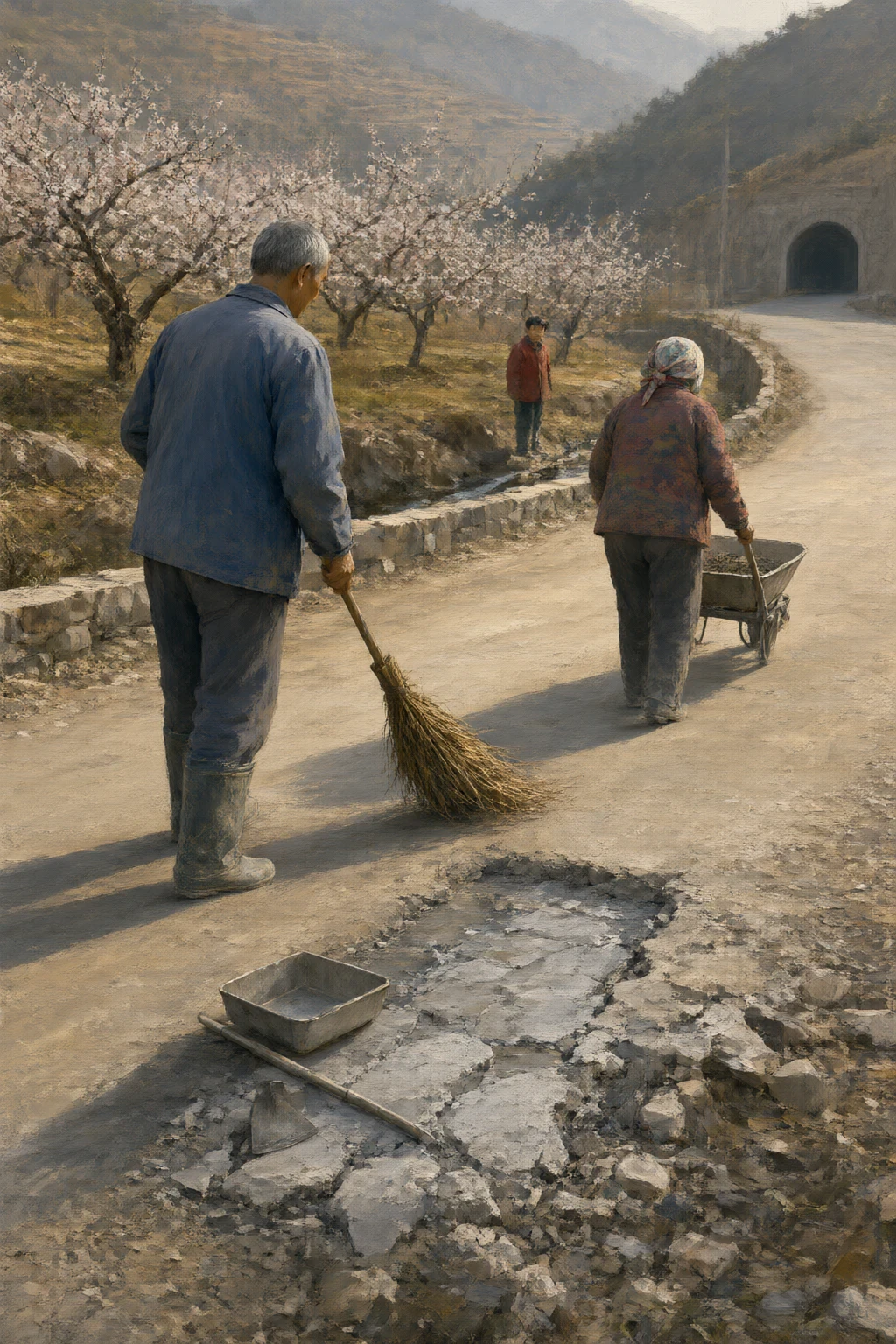
He is sixty-four. The brush is in a tin in a cupboard, and the hair is four millimetres, and there is a place on the handle worn to the shape of a thumb, and it is not going to be replaced. He goes out to Long'an on Tuesdays. There is a stretch of the old road about two hundred metres long below the seventh kilometre where the gully water comes out of a spring under the cut and crosses the carriageway in an unnamed thread, and where there is therefore, in the county's own eventual and embarrassed phrase, a spot. He does three things there. In the fourth month, with a rod, he clears the inlet and the outlet. In the eighth month he cuts the shoulder back and puts the cuttings below the ditch line where they cannot wash across the road. In the eleventh month he repairs the surface, which takes the money, and the money is his own and not small.
He does it with cement and stone and his hands, in the way a man repairs a road in a country where the county has four thousand yuan and a tractor. He mixes it in a tray. He does the bad joint first, because the bad joint is the one that will take the water. He stands back and looks at it, and it is ugly. It is the ugliest thing he has ever made, and he has made a castle in the air for a village in Shaanxi that no longer exists. It is holding in its third winter. The broom is his mother's, and it is forty years old, and it stands against the parapet on the uphill side, where it will not fall into the ditch.