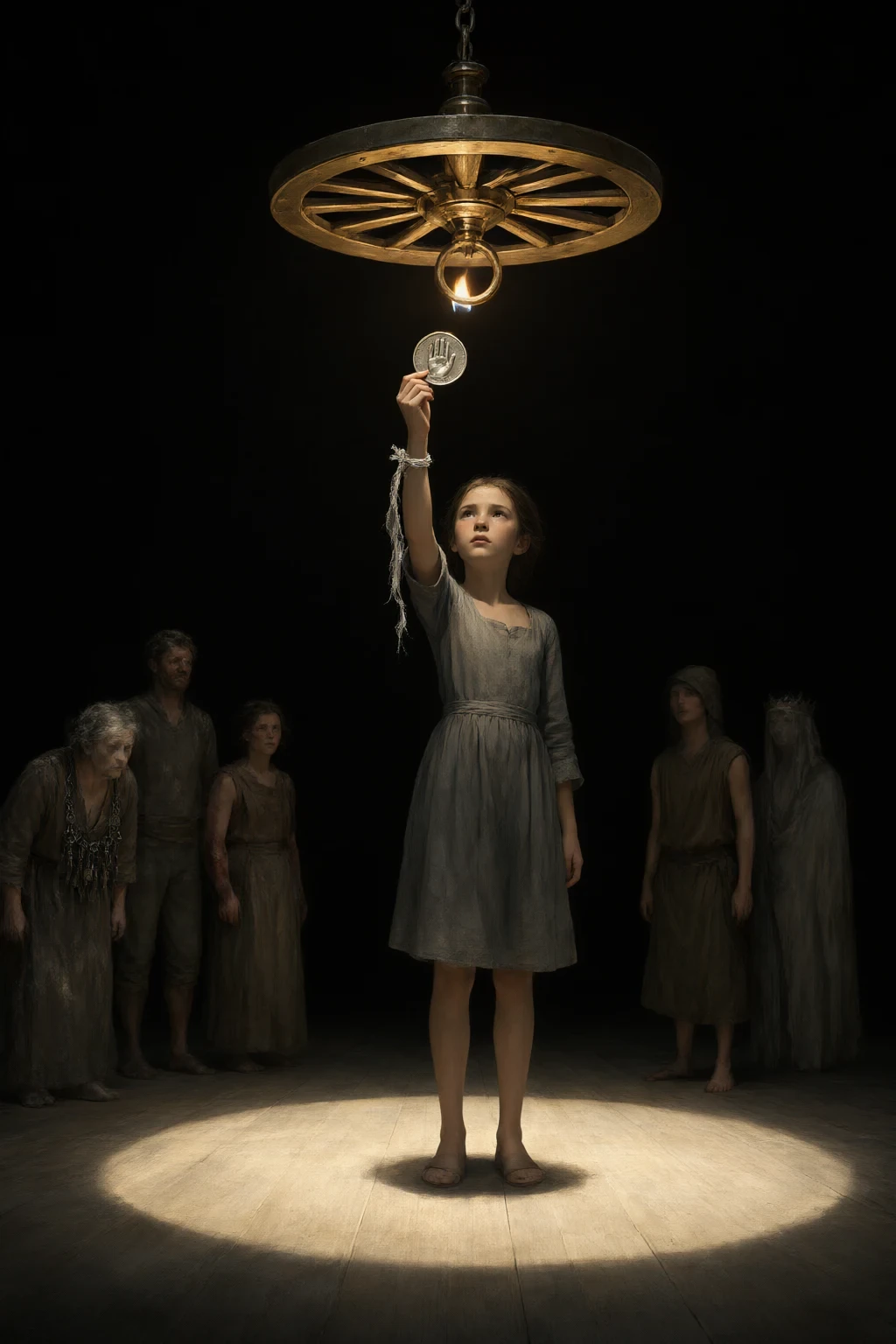
Nim Ollowan had been keeping a private count for three years and she had never told anybody what she was counting, and the number she had reached was two hundred and eleven. She did the count the way the Keeper of the Vault did her trays, from the outside in. The most expensive object in the room was the story, and she did not mean this one, she meant the engine: a person in a disc of lamplight on a plank floor, saying a true thing aloud, while nine people stand at the edge of the light and hold still so as not to spoil it. Two hundred and eleven true things she had said in that room. She had added them up. The total would not buy a heel of bread. There is no figure for that. There is no column. You may not put it in a tray, and you may not put it in a mill, and if you put it in a book the Keeper will read the number and put her thumb on it and say nothing at all. On the afternoon she turned thirteen she decided to say so out loud, in the Hall, to a listener who could contradict her.
The Hall of Telling is stone, so people speak quietly, so a whisper made by nine people at once travels the length of the oval and comes back slightly changed, the way a thing does after it has been round a room. The brass lamp hangs from the silvered pine at the centre of nothing, wagon-wheel wide, and under it the light falls in a hard-edged disc on the floor. The teller stands in the disc, and everybody else stands at the edge of it, at a respectful distance, in the dark. Nim stood in the disc. She had a strip of unspun silver thread tied round her left wrist, frayed at both ends, and she re-knotted it on the way up, and again on the way in, and again after she was already standing in the light, which she was aware made her look nervous, which it was. The Hall was full. She had asked for a hearing and had expected a working Court, and instead the whole establishment was in the dark at the edge of the disc, because word had got round that the apprentice was going to say something about the Salt Bridge, and the Salt Bridge was the finest thing this palace had ever owned. “Mind the disc,” said Cresset Ombre, from the edge, not unkindly. “Cresset cannot afford for it to be trodden.”
The Lampwright’s right forearm was a brass lamp-stand, fused to the bone and the skin at the join gone the brown of a crust, so that her hand was permanently a thing a wick went into. She held it at her side like a woman holding a bucket she had stopped noticing. “You will want to state it plainly,” said Cresset, “because the Court will give you four minutes before it begins to be interested in how you said it.” “Yes, Lampwright. Now state it.” Nim stated it. “I have been counting mints,” she said, “and I have reached two hundred and eleven, and I have added them up, and the total will not buy a heel of bread. That is because two hundred and eleven was a good year for me and a bad year for everybody, and the reason it is a bad year for everybody is that we have told the same things over and over until there is almost nothing in them.” “And I know the usual answer, because Tallow says it and Grist says it and the Queen says it, and the answer is: tell something new. I have tried. There is nothing new in this palace, because we are the palace, and the only things anybody here has ever been inside of are each other.” “Mm,” said Tallow Merrick, in a tone, because it was a count of some kind.
“And I think the answer is wrong,” said Nim. “Not wrong about the thinning. Correct about the thinning. Repeated the same way, the same tale, it comes down to a husk. I have read the rule and I have seen the trays. But a husk is not the story. A husk is the story minus the lies.” “And I do not think anybody in this room believes the lies in our stories are doing any work. I think the lies are load-bearing. I think they are what we are for.” The dark at the edge of the disc did not move. That was how she knew they were all still there. “So I would like to put it to the Court,” said Nim, “that a tale told over and over in exactly the same words is not being worn away. It is being cleaned. That being faithfully remembered is a kind of happening, and that a thing which has survived four hundred tellings with the same words around it has proved, four hundred times, that it can survive the words.” “And what is left standing at the end is the part that will not come off.” She ran out of air at the end of that and had to breathe, standing there, thirteen years old, in a disc of light, in front of nine people.
Marrow started laughing. Not unkindly. He was standing at the back with his bare feet in the cold, in a cloak with two sleeves eaten out of it, and the shadow he threw on the wall had one finger too many on it. “That is a very good child,” he said, “— and that is a coin in somebody else’s pocket.” Tallow Merrick had the good tray out before Nim had finished, and she was going through it with a cloth, which she did with trays the way other people touch a rosary. “Three hundred and ninety-one,” she said. “This one. Dull. Dreadful. Two hundred and six, worse. Nine, and I mean properly nine, worth an inch of lamp oil and a bad mood.” She turned a disc over with her thumbnail. “Two hundred and two. And this, which is the good colour, the clean rim, and which I will not have spoken of badly. Worth eleven.” “This is the Salt Bridge, child, and I have valued it four hundred and eleven times and it has never once been worth more, and I have never once told anybody why.” “Then tell me now.”
“No. Because the reason is that I have tried. Nine seasons ago I had a February with nothing to sort, and I took the Salt Bridge out and told it in the Hall to see what it would do, and it came out at eleven, and I have been angry about it for nine seasons, and there is nothing in the world more tiring than being angry at a number.” She put the tray down. “Also it is the finest thing we own and I will not have it improved by a child of thirteen.” “Grist,” said Nim. “Does it get ground?” Grist Bellweather, who had come up out of the stone and was standing nearest the door because millers always stood nearest the door, put his thumbs in his belt. “Have you eaten?” he said. “No.” “Sit. Sit, there is broth.” “I asked whether it gets ground.” “Everything gets ground,” said Grist Bellweather. “That is the mill. You put it in the hopper and the stones take it down and it comes out as flour and it goes in the bread, and the bread goes on a table forty feet long where there are nine places and four of us, and the bread is grey.” He said all of it to the floor. “That is not a threat. It is a description of a mill.”
“The girl has made a motion,” said Cresset Ombre, “and the motion is contrary to four hundred years of practice, and I would like the Court to hear why before it hears whether it is any good.” “You have two minutes,” said Tallow, “and then I am going back to the tray.” “Cresset will take the two minutes. It is not that she believes it. It is that she has read the same paper twice.” The Lampwright came a step closer to the edge of the disc, which nobody does, and stood with her brass forearm catching the light so that her face was half lit. “Here is the objection. The audience is the instrument. Not the teller, not the words, not the honesty.” “A story told aloud in this Hall to at least one listener who could contradict it, or it is not a story, it is a noise made by a person in a cold room. That is the oldest of the nine and it is the one we do not argue about, because if we stop arguing about it there is nothing here at all.” “I know.”
“Then hear the rest. If the audience is the instrument, a tale is not a thing a teller does to a listener. It is a thing a listener does to a teller. The listener holds the scale. The teller is being weighed.” Cresset turned her head very slightly, which for her was a great deal of emphasis. “Tell me, plainly, what you propose to do to the people standing in this room.” “That for one evening we come here and listen, and listen, and listen, and that because we are so good at listening we will get a better story out of the tale than four hundred years of telling has. That this room, with these people in it, is the thing that is missing.” “Yes,” said Nim. “And you are thirteen.” “Yes, Lampwright.” “Ah,” said Cresset, and did not say anything else, and it turned out later that this was the whole of her objection, and that she had made it in eleven words, and that the Court had spent the next two hours on the other two minutes. They argued about rules for forty minutes, which is what the Court is for, and which is the only indoor amusement in nine hundred years of indoors.
Rule three did not bar the experiment. The Salt Bridge had never been spent. It lay in the recitation tray in a velvet nest, four hundred and eleven minted discs, pale and thin, and nobody had ever carried one to the Table, because the Salt Bridge was not a supper. It was a hymn, and the Court never had its supper on the back of it. Rule seven: when a true story is coined, the true part happens again once in the teller’s body. Small, and always real, and paid at the moment of telling. “Nine minutes,” said Tallow Merrick, not looking up. “If it is a big one. Blisters, and then nine minutes of not being able to breathe. I have had it eleven times. It is not a punishment. It is an invoice.” “Who pays it in this experiment?” “You do,” said Tallow. “You are standing in the light. Nobody else is in a position to pay anything.” “Then it is not an experiment,” said Marrow, from the back. “It is a charge.”
And then the Queen spoke, from the far end of the dark, in a formal beautiful cadence, and the room waited for it, because it had been a long time and everybody wanted it. “My Lords and tellers and lampwrights,” said Queen Ysandre the Long-Waited. “I have heard this tale four hundred times and I have never once been asked whether I remember it, and I would like the record to show that I remember it perfectly and that this is not the same as having been there. I was told it.” “I was nine hundred years old and the Court was new and somebody came to me with the finest thing anybody had ever made up, and I have carried it since like a plate of bread I never eat.” “And I will not be your contradictor, child. You will want one, and everybody in this room will tell you that you cannot do this without a witness, and they are right, and it is not going to be me, because a person who was told cannot contradict, only agree. And if I agree, then whatever comes out of your mouth tonight will have my nine hundred years leaning on it, and it will be the most worthless thing this Hall has ever minted.” “You are thirteen and you will live a long time and you will not forgive me. It was— well. It was something.”
They began at the ninth hour of the evening because the flame is strongest at the ninth hour and the Hall has one lamp and it is not going to be argued with. The Salt Bridge, in the Court’s words, which are the only words it has, is this. On the night of the Great Cold, when the Span was white with frost and the sea came up underneath it like a breath, a woman came out of the dark at the north end. She was barefoot. She carried a lantern in one hand. She walked the two hundred paces to the south end, and behind her the sea closed over the road she had come by. And at the south end a man took the lantern out of her hand and gave her his coat, and neither of them said anything, and that is how the Span was crossed the first time, and that is why it is called the Salt Bridge. That is the tale. Two hundred and forty-one words. Everyone in the Hall could do it. Nim told it, and the coin that came out of the mint was thin, and pale, and warm, and it weighed nothing you could feel through a glove, and Tallow said, “Four hundred and nine, dull,” and put it in the tray.
They told it again. The same words, the same order, the same pause at “like a breath.” The coin was thinner. They told it a third time and a fourth and a fifth, and by the fifth the room had gone into the state a room goes into when it is listening to a thing it knows, and there is no better sound in this palace than that, and every person in the dark was mouthing along. On the sixth, Nim stood in the disc with her wrist turning and understood what she had actually proposed: an evening of nine hundred people’s attention spent on something they already had. On the seventh telling Cresset Ombre said, in the middle of it, “No.” The Hall went the particular quiet that this Hall goes. The Lampwright was where she had been standing for six hours, at the edge of the disc, with her brass forearm up, the wick-holder of it catching the light. “Eleven times I have heard that sentence in this room,” she said, “and it has been the same eleven times, and I have never once said no, because saying no to the Salt Bridge in this Hall is not a correction, it is an event, and I have not had an event since I was thirty.” She lowered her arm. “Say the next part. He gave her his coat.” “He gave her his coat,” said Nim. “No,” said Cresset Ombre. “He did not.”
It went badly for about ninety seconds, and then it went well, and the ninety seconds are the part everybody still has. Half the Hall had stopped listening and started objecting. A man from the linen side said the Coat was the whole point of the tale. Grist said, from the door, that it was a song and not a history, and that he was sorry, and that there was broth. Somebody at the back wanted to know what business a lampwright had correcting a song, and Cresset called it the best question anybody had asked all night, and did not answer it for two hours. The Queen did not stir. She had said she would not be the contradictor, and she was keeping to it with a thoroughness that Nim, watching, understood later to have been a form of grief. And then Nim Ollowan, thirteen years old, said the only useful thing anybody said that night. “No, Lampwright. He did not. And then—” She stopped, the way she always stopped, which was immediately before, and everybody in the Hall had learned over three years not to breathe at that moment.
“And then he did not give her his coat because he did not have one on. He had his coat on and he took it off, and she did not want it, and she would not have it, and he put it on her anyway, and she walked the last forty paces in a man’s coat and did not put her hand on his arm.” “And the reason we have never had this argument out loud in nine hundred years is that the story ends at the lantern, and the story does not know what happens after the lantern, and everything we have added in nine hundred years is what we would like to have happened after the lantern.” “It is a song,” said Grist Bellweather, from the door. “It is now,” said Nim.
The ninth telling is the one the Vault records, and the Vault records it because the ninth is the one that paid. Nim said the tale again, in the Court’s words, and got to the north end, and the coin came into the mint pale and thin, and it weighed nothing, and it went into the tray, and Tallow Merrick said the number, which was three hundred and ninety-eight, and it was the lowest the Salt Bridge had ever gone. “And then—” She took the coin out of the tray again. She was not supposed to. Nobody had ever done it. She held it up and she turned it over, and the raised shape on the face of it, which had been a lantern since the first minting four hundred years ago, was not a lantern any more. It was a hand. Four hundred and eight tellings, and the raised shape had changed, because the shape on a coin is the shape of the true part, and the true part had moved.
“It is not that we got more true,” said Nim, from the top of her head, into a room that had gone completely silent. “It is that we got less false. That is the whole of it. That is what a husk is. It is the story with the lies taken off. Every telling takes one more lie off. It does not add anything. The teller has nothing to add.” “The audience has something to take away, and that is the only direction this has ever moved in, and it has been moving in it for nine hundred years while we sat here thinking we were losing something.” And then the true part happened again in her body, because it was true and it had been told in the Hall to a listener who could contradict her, and rule seven does not care how old you are or how good your reasons are. Her left palm opened across the heel of her hand and came up in a blister the size of a lentil, and then her breath went, not violently, which would have been a relief, but entirely, in the way of a person who has forgotten how, and stood in the disc of light on the plank floor with her mouth open for nine minutes while the finest story in four provinces went on without her. Cresset Ombre put out a hand and did not touch her, and held it in the air a foot above Nim’s shoulder for the whole nine minutes, which is the closest that Court comes to holding a person. When the breath came back Nim sat down on the edge of the disc on the floor, and wiped her mouth with the back of her wrist, and said: “She was not a stranger.”
That is where the second half of the night went, and where the Court learned to be told about itself and mostly did not like it. No one alive had seen the Span, so the proof was not testimony. It was the same proof it always is in this palace, and it is the reason Tallow Merrick exists as an office: the raised shapes on the oldest coins. They went down together, because a first one existed, and it was in the third pigeonhole of the first gallery, in a tray unopened for sixty years, because there is a rule about old trays and Tallow Merrick is the only person who may. The first coin was not thin. It was heavy in the way that only a coin with something true and whole in it is heavy, and it was warm, and the shape on its face was not a lantern and not a hand. It was a door. “It has always been a door,” said Tallow Merrick, in the small dry voice of a woman whose whole profession has just been explained to her. “Four hundred and eight tellings and it has been a door the entire time, and I have had it in my hand eleven times and valued it and put it back.”
Adra Kelm. That was the woman’s name, and the Court had known it for four hundred years, and the Court had no idea it knew it. The Span was a working crossing: two hundred paces of chalk causeway over a tidal race, chained at both ends from the first week of the season to the last, because the tide comes up under it hard enough to take a man off his feet. On the night of the Great Cold the chains were off, because two people had taken them off, and both were fined in the spring. The woman’s fine was heavier, because she had the sense to complain that the man had done it, and the man was her brother. “They were not strangers,” said Tallow Merrick. “They were brother and sister, and they had a quarrel. He unchained the Span and she helped him and then she repented it and turned it in, and it was her doing that put him in the mill for a year, and he never once said so out loud, and she told nobody, and the Court has been telling the rest of it wrong for four hundred years, and the rest of it is a coat.” The lamps in the Vault are low. Nobody spoke for a while. “Then it is not a love story,” said Tallow. “It is not a love story,” said Nim.
“It is two people who owed each other money.” “It is two people who owed each other money,” said Nim Ollowan, “and then she was angry, and then—” And the room waited, because everybody in that Vault had been waiting, for two hours, all night, without knowing it, for this. “And then she was angry, and that is why she went at night. If she had not been angry she would have waited for the tide. The anger is the only reason the Span is called anything at all.” The coin that came out of the mint on the ninth telling weighed eleven ounces, and it was the colour of a wet coin, and the shape on its face was a door. Tallow Merrick did not put it in the small tray and did not put it in the large tray, and wrote on the slip, in her small neat hand, that there was nothing in this Vault for it. “Merrick does not have a tray for this,” she said. “It is the Salt Bridge,” said Nim.
“It is the Salt Bridge with the other four hundred years taken off it,” said Tallow Merrick, and looked at it for a long time. “And I have valued that hymn at eleven once a year for thirty-one years on the strength of a thing that does not improve being a thing that is finished, and I have sorted a great many stories into the right tray on the strength of it.” Nobody wanted it. That is the part that ought to be in the telling, and it is the reason the night is remembered. The first coin had been worth one hundred and forty for as long as anybody could remember, and the whole of the Hall of Telling understood by the next morning, without anybody saying so, that the new coin was worth about forty times what the hymn had ever been worth in its best minute. And they did not want it. “It is better,” said Nim. “It is truer,” said Cresset Ombre. “It is not better. It is a small mean quarrel about a fine with a door on it, and the coat is gone, and the coat was the only reason I have ever put my hand up for nine hundred years.” “It has a shape on it,” said Nim. “A door.”
“Yes. That is what I object to. A shape on a coin is the true part, and the true part of this is a door, and a door is where people go out of a place they have been unhappy in, and this Hall has wanted the coat for four hundred years. The coat is a person in a doorway being kind to somebody.” She put her brass forearm down. “The Court would rather have a husk worth nine than a coin worth forty, and it is not stupidity. A husk costs nothing, and a coin is about us.” Marrow said nothing at all for the whole of the second half, which is the most anybody has ever been able to get out of him, and at three in the morning he was the one person in the Hall who was in a good mood. That is the thing about the Fool, and this was the night it stopped being a joke. Nim found him by the Ash Garden wall with his bare feet in the frost, which he does, and which nobody permits, and which has never once killed him, which the Court has found more irritating than anything else in nine hundred years.
“I am not laughing,” he said. “I have been doing the arithmetic of me all night and I do not like the answer. If repetition takes the false parts off, and the false parts are the only parts I have, then I am already as far gone as I can get. There is no further down.” “I have been telling the same lie since before you were born and it has got larger, and it is the only thing I have ever made, and it does not spend, it does not cross the rim, it does not even mint.” He looked at his own hands, which were grey with cold, and laughed once, and it was not a good laugh. “They will be very pleased with you,” he said. “You have found a way to be told the truth and come away with nothing, which is my condition exactly, and you are thirteen. That is a coin in somebody else’s pocket, Nim, and for once I have looked at it and I have not known whose.”
He came to the Hall at the fourth hour to ask for something, and Nim was still there, sitting on the edge of the disc because her legs were unreliable and she had nowhere to be. “Let me stand where you stood,” he said. “For one telling. Nine minutes, blisters, the whole invoice. Let me do the Salt Bridge. If I tell it exactly right, the only difference in the whole performance is me, and then the coin will tell us what I am.” “Either I am a man telling a story, in which case I am owed everything, and we shall discuss it. Or I am a hole with a memory, in which case it mints nothing, and I will have stood in the light for nothing in front of nine people, and I will have earned it in the currency I have always earned in.” Nim looked at him. He was twenty, or had always been twenty, with two sleeves gone out of a cloak and one finger too many on his shadow, and he was the only person in the building who had never once been fed at the Long Table, in nine hundred years, because a coin has to be minted to buy a meal and he had never minted one.
Everybody had been perfectly comfortable with that, and it had never occurred to anybody, including him, that this was a thing you were allowed to notice. “All right,” she said. “But I don’t know what will happen, and if you want to be honest with me for one second in your life, you could say that.” So Marrow stood in the disc of light on the plank floor with his bare feet on cold boards and told the finest story in four provinces from beginning to end, in the Court’s words, the two hundred and forty-one of them, in the right order, with the pause in the right place at like a breath. It is very nearly perfect. It is one word out of place, in the middle, at the north end, and it is the wrong word, and it is a very small wrong word, and it is the seventh telling, and it does not matter at all. Marrow said: and then she came out of the light. He stopped. The mint made no sound. The tray was empty. There was no coin in it, and none in the air, and no bell, and nothing in the Hall at all except nine people and a Fool standing in the light with his mouth still moving.
Nothing minted. Not a light coin. Not a husk. Nothing, because a thing that is not so, told in the Hall, to listeners who can contradict, does not make a bad coin. It makes no coin. It makes a hole. But the coin for the telling was already in the room, made at the ninth hour and not yet taken up, and Marrow had not broken the rule about his own story, because he had told somebody else’s story, and the breach was at the seventh telling of a story that had already been given away, and the breach is four hundred years old, and it is not his. What the breach made was a silent: a ring of dead air about the width of a coin, hanging where it happened, in the air at the north end of the Hall of Telling, in the middle of the finest story in four provinces. “Pay it,” said Cresset Ombre, from the edge, in a voice nobody had heard from her. “Somebody pay it. It has been made and it is in here and it is swelling and there is no coin in the tray.”
“Nobody can,” said Tallow Merrick. “It is not a story. You cannot put the lie back. There is no telling that would be true, because the true version does not have the word in it, and the false version is not a payment. A silent can only be paid by a true story told here on the spot by a person who consents.” “Then somebody pay it with something true,” said Nim. And because she was thirteen, and because it was three in the morning, and because she had been counting things for three years and could not stop, she said the first true thing that came into her head, which was about herself. “My mother left. That is the true thing I have got tonight. She left when I was ten, down the sea-road with one bag, and she did not say she was coming back and she did not say she was not. I have told this to the Hall every month for three years in the same words, and every time I add one thing.” “And I have checked it, with Tallow, against the ledger of the gate, and the thing I add is always true and it is always the part I had left out.”
The air at the north end of the Hall made a small sound like a cork coming out of a bottle, and a coin fell into the tray, and the coin was warm, and the shape on its face was a bag with a handle. The silent was gone. The Hall had one more name in it than it had a minute ago, which is all a payment is. Cresset Ombre picked the coin up. She did not look at it. She carried it to the sill, where she carries all of them, and set it on the sill, and the flame of the enormous brass lamp leaned over towards it the way a dog leans towards a pocket. She marked a short chalk line on the inside of the lamp ring, at four o’clock, which she has never done in nineteen years, and Nim, who was watching, because she was thirteen, and because she was always watching, did not understand what she had seen and did not ask.
In the morning the mill was running and the recitation tray was being re-sorted by a woman with a hundred small iron keys at her chest. “Three hundred and ninety-eight, dull,” said Tallow Merrick. “Four hundred and nine, dreadful. Nine, very dull.” She put a coin down on the deal table, out of the nest, and did not file it. “And I have a tray slip here that does not correspond to any tray, which is a thing I have not done since I was thirty, and I have not decided what to write on it.” “Write true,” said Nim Ollowan. “True is not the difficulty,” said Tallow Merrick. From the mill came the sound of the stones, which never stops, which is like distant surf, and the smell of flour, and then Grist Bellweather’s voice on the way up, saying that they had all eaten, and that there was broth, and that the Salt Bridge was not going into the hopper, not this year, not on her account. Nim looked at her own left palm, which had a lentil on it, and then at the coin on the deal table, which was warm, and which was hers, and which would not go across the rim of the Long Table and never would, because the best true thing she owns is a thing about her mother and she is the one who told it. “Sit,” said Grist, from the stairs. “There is broth.”