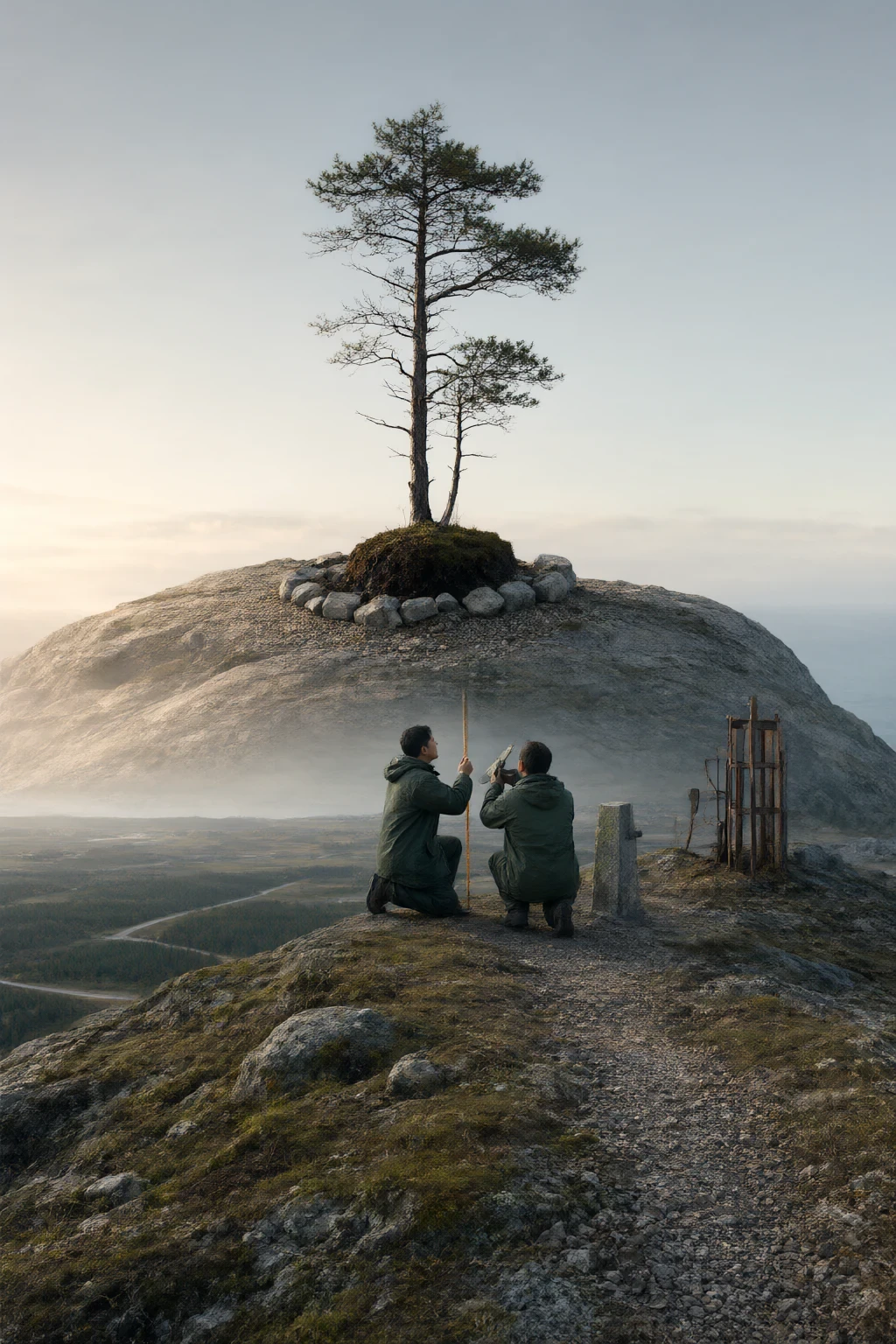
The tree was one of four thousand two hundred and eleven, and it knew its own number without being told, in the way that a thing knows the position of its own foot in a shoe. It had been planted in 1811 in a row, at two feet, in the manner of that time, and the row had been planted because the soil on the west side of the mound was thin and sour and the district had been told by a man with a telescope that the wood would pay. It had been a very small wood and it had been a very long row, and the row ran straight up the slope, and the tree was the last stem in it, which meant that it stood six feet from the edge of the plantation and had been able to see the country since the year it was tall enough to be measured.
The top of the mound was two hundred and forty paces above the level of the road. It was the highest ground in the district, and for a long time it was the highest ground in the country, and there was a stone on it with a plate, and the plate had a number on it, and the number was a height, and the height was smaller than a church tower.
The tree knew what the top was, because the top was the thing it had been for one hundred and eleven years. The men came in 1840 with the first thinning, and they came again in 1861, and in 1889, and every time they measured and every time they took something, and the something was always the biggest, and the biggest was never the top, and that was the arrangement. A stand of trees grows into a crowd, and a crowd has to be thinned or it becomes a thicket, and a thicket is worth nothing, because light is the whole of the business and light comes in from the side. So they came in from the side, and they took the largest stems nearest the rows, and they left the rows themselves, and the top stem was left the way a ruler is left on a map: not out of kindness, but because a measurement wants an edge to measure from, and a top stem is the edge.
That was the thing the tree could not get past, in the long run of the years it had, and did not understand until the winter of the hundred-and-first year. It was kept because it was useful. It was the top stem of compartment seven. Every year in March a man came out from the village with a tape and a board and a sight, and he stood at the base of the tree and he went up it with his eye, and he came down and wrote a figure in a book, and the figure went into a total, and the total went into a district, and the district used the total to say what the wood was worth and when it would be worth it and how fast it was becoming something else. The tree was, in a word, a datum. It was the thing the wood was measured from, and everything the wood knew about itself, it knew by looking at the tree. And the tree had wanted, since it was a young thing in a long row with the wind coming over the mound, to be looked at.
The seedling years came twice and both times they were taken. In 1836 the tree set seed heavily, the way a tree does in the first hundred years, and there was a carpet of it under the row, and the district's rule was that a carpet was a waste of a good stand, and the rule was made in an office by a man who had never knelt on wet ground, and the carpet was grubbed up in April by four men and a boy with a mattock, in two days, and the seedlings went into a bonfire at the edge of compartment seven, and the smoke went straight up, because there was no wind, and for one afternoon there was a smell in that part of the wood that was sweet, and the tree thought about it for the rest of its life, or the equivalent. In 1859 it happened again, and by then it did not think about it at all, which was worse, because the second time it knew exactly what the smell meant and had the use of the knowledge, and had nothing to do with it.
In 1922 the district was reorganised, and the reorganised district had a new plan, and the plan had a paragraph in it about commemoration, which was not sentiment but accounting: a thing that costs nothing and can be written down is worth having. The paragraph said that in the year 2022 the district would mark its highest stem, that the stem would be moved to the top of the mound, and that a brass plate would be fixed to the stone. There were four candidate stems, being the four highest in the district, one in each of four compartments, and they were all, at that date, between thirty-one and thirty-four metres, and stem four in compartment seven was the highest at thirty-four and one tenth, and the difference between it and the others was one and a half metres, which the plan called, in a sentence nobody read aloud, the lead.
The tree was told in March, when the man with the tape came and stood at its foot and did not write anything for a while, and then wrote, and then stood there again, and then said, out loud, to a man standing twenty paces off with a dog, "Well," and did not finish the sentence.
They came for it in the second week of November and they took nine days, and it is worth being exact about the nine days, because nothing in the rest of the account depends on a feeling. On the first day they dug. Not around the root plate: the plate of a hundred-and-one-year-old spruce in thin ground goes out four paces in every direction, and there was no excavator in the district, so they went in with a chain and a bar and a man from the road gang, and they cut, and they dug, and the plate came up whole and with soil still on it, more soil than anybody had expected, and the tree was laid on its side on a sledge of planks that a farm had lent, and the sledge went to the road on two tractors, and it took nine days, and the crew were paid for nine days, and the district's book has nine days in it in a column with a rate against it.
On the ninth day it went up. There is a track most of the way and a footpath for the last hundred and twenty paces, and the sledge could not take the footpath, so it went on a trailer, and the trailer went up in second gear, and the winch on the fire tower's mast took the last lift, which nobody had planned and which the district engineer wrote a memorandum about afterwards, in which he recommended that the memorandum be read, so that the practice might be repeated.
The hole was cut in the rock. There is no soil on the top of that mound; there is forty centimetres of gravel over limestone, and under the limestone there is more limestone, and what grows in the forty centimetres is moss, and heather, and wind, and the surveyor has a line in his notebook against that place which is the highest reading in the country, taken by a man standing on a step ladder he was not supposed to stand on. They cut a hole the size of a barrel, put in the soil that came off the plate, and packed it, and set the tree in at the same angle at which it had stood, which is to say straight up, and which is the only angle it had ever had, because it had grown in a row with the slope behind it and had never had any reason to lean.
Then they put a ring of stone around it and a barrowload of gravel, and the forester said, reasonably, that the frost would heave it in the first winter and that they should come back and look at it in the spring, and they did come back in the spring, and the tree had not moved, and the ring of stone had moved, and they reset the ring.
The loneliness was not what the tree had expected, though it had not known what it had expected. It had expected a height. What it had got was a circle.
From the top of the mound the whole district lay out flat and legible in every direction at once, and for the first three years the tree did nothing but look at it, and it learned the ground the way a person learns a street. It knew where the road came off and where it went under. It knew the compartments: seven was the dark rectangle to the west at four kilometres, and the dark rectangle had a shape it knew to the half pace, because it was its own shape, because a plantation is a grid and the grid does not change. It could see the sawmill's chimney and the vicar's new spire and the sea, which was a thin grey line with a light on it at night, and the light was the lightship, and the lightship was forty-one kilometres away and it was the only thing in the world that was further off than the wood, and the wood was four hundred paces.
What nobody had told it, because nobody had thought of it, was that on the top there was nothing to lean against at all. For a hundred and eleven years it had stood in a crowd, and the crowd had been a kind of weather: it had taken the wind on four sides and had not felt it, and the roots had gone out into a company of other roots that answered back, and the whole of its weight had been shared out sideways among four thousand two hundred and eleven other trees. Now its weight was its own, and its own weight was the wind, and the wind came across that mound at a hundred and thirty kilometres an hour in a westerly and the ground there was not there.
By the fourth year the crown had lost its top third to wind and the topmost leader had died back, and in 1927 a second leader started, on the leeward side, at a hand's breadth above the join, and went up, and the tree grew a new top in the wrong place, the way a man will carry his head to leeward on a coast.
The survey came in March, as it always did, and for four years the man had walked past it without a book, because the district's instructions were to measure the stand, and the stand was compartment seven, and the tree was not in the stand. In 1930 a clerk in the district office found the 1922 plan in a drawer and wrote a query to the forester, and the forester wrote back that stem four was standing on the summit and was living, and the clerk wrote that it was to be included in the returns, and the forester wrote back that it was a hundred metres from the boundary of compartment seven and had been for four years, and the clerk wrote that the boundary of compartment seven was described as a point, and the forester wrote back a number, and the number was thirty-four and one tenth, and the clerk wrote that that was the height it had been given in 1922 and he was very sorry.
So it was measured, and it was entered, and the entry in the district's return for that year reads, in the column for average height, thirty-one metres four, and in the column for stems, one, and in the column for the date of planting, 1811, and the return is a printed sheet and eleven thousand copies of it exist, and this line is the whole of the tree in the world's paperwork.
After that the tree was measured every year. That is the part of it that was strange, and strange in a way that nobody at the district office ever noticed, which is possible because nobody at the district office ever read the returns. Once a stem is in the returns it is a stem, and a stem is measured, and the figure goes in a column, and the column is copied into the summary, and the summary is the district, and the district is the country, and the country is a number that somebody in an office has to be able to produce in an afternoon. So in 1931 the man came up the footpath with the tape and the board and the sight, and he put the base of the tape against the ring of stone, and he went up the tree with his eye, and he came down, and he did the thing he had done in this wood for thirty years, which was to say the height out loud once to nobody.
He did not say it out loud on the summit. He wrote it on the board and put the board in his pocket, and he went down the path, and in 1931 the increment was minus nineteen centimetres and it was the first year in the district's records that a stem had been given a negative figure, and the office queried it, and the forester wrote that it was a correct figure for a tree standing on limestone at the top of the district in the wind, and the office accepted it, because an office accepts a figure that has been explained to it.
In the autumn of 1933 the young man who did the survey that year came up with the increment borer, which is a hollow screw a quarter of an inch across, and which is the reason the district could say what a tree had done in a year, and he took a core from the trunk at four feet, and read the rings on the bench in the yard afterwards, the way you read anything, counting back from the bark. The outer rings of the summit tree were very narrow. The whole of its working life had been written in the last eighteen inches of radius, and the last seven years of them were narrower than a pencil, and they were not all on the same side. Six of the seven were on the side away from the prevailing wind, because that is where a tree puts the wood it can afford to put, and the seventh, the outermost, was on the other side and was black, and he noted that, because it was what he was paid to note.
Below those, and this is the part he would remember, because he was twenty-three and had not yet learned to be careful about what he was feeling, the rings went back a hundred and eleven years in a smooth and even succession, and there was not one of them crowded, and there was not one of them starved, and there was not one year in a hundred and eleven in which that tree had lost a hand's width to anything at all. He took the core out of the man's hand at the end and looked at it for a moment and then went back down the path, and the plate on the stone said the height, and the plate did not say any of this, and the plate was not going to.
From the top, four kilometres off and slightly to the west, compartment seven was a dark rectangle with a pale edge where the road cuts it, and it was the only dark rectangle in that direction, and in the afternoon the shadow of the wood lay across it and took the grid out of it, so that for a few hours a day the place where a tree grew for a hundred and eleven years was one soft shape among the fields. The forester who came up in 1934 was not the same one who had come up in 1930, and he was the last of the district's surveyors, because the district was amalgamated in that year into a larger forestry division, and the return that the larger division required for the year 1934 had no column for a memorial stem, and the clerk in the larger office struck the summit out of the summary with a pen, in a summary that ran to nine pages and was bound in a green book in a town seventy kilometres away.
The tree had five more years. They went the way the fourth year went, and the ninth leader it made was a tuft, and in the last winter the bark came away from the north side in sheets a hand's width across, and the inside of the trunk was grey and dry and full of the tunnels of a beetle that had arrived in 1936 and had found the whole of it. It was not cut down, and it was never cut down afterwards, because the top of the mound belonged to no compartment and no compartment's budget would pay for a tree, and the district was amalgamated, and the memorandum that recommended that the memorandum about the winch be read went into a file that nobody has asked for since.
In the spring the young man with the borer, who was not so young, and who had by then measured, by his own estimate, something over four million trees, came up the footpath once more, because a figure had been asked for by a schoolmaster in the town, who wanted the age of the tree, and who had been told by a man in a bar that there was one on the top of the mound and that it was the first thing planted in the plantation and that it was the highest thing in the country, which was nearly true. He took one last core at four feet. Above that point the trunk was less than a broom handle, and he did not touch it.
The rings at four feet had not closed in eleven years, and the outside of the wood was dead to a depth of two centimetres, and the living bark was a strip on the south side a finger wide, and the tree's whole remaining trade was being conducted through that strip, in the manner of a house that has given up four of its five rooms and keeps the kitchen warm for one. He counted back, as he always did, from the bark, and then he wrote the figure in the book, in the column for date of planting, because that was the figure that had been asked for, and the figure was 1811, and he wrote the height as well, thirty-one metres four, which was four centimetres more than the year before, and the increase was wrong, and he knew it was wrong, and he left it.
Because the book is where the numbers go, and because he was the last man of a kind, and because a man who has spent his life writing down what a wood is doing is not the one who writes down, in a column headed with a word that means increment, that a tree on the top of the district had got taller.