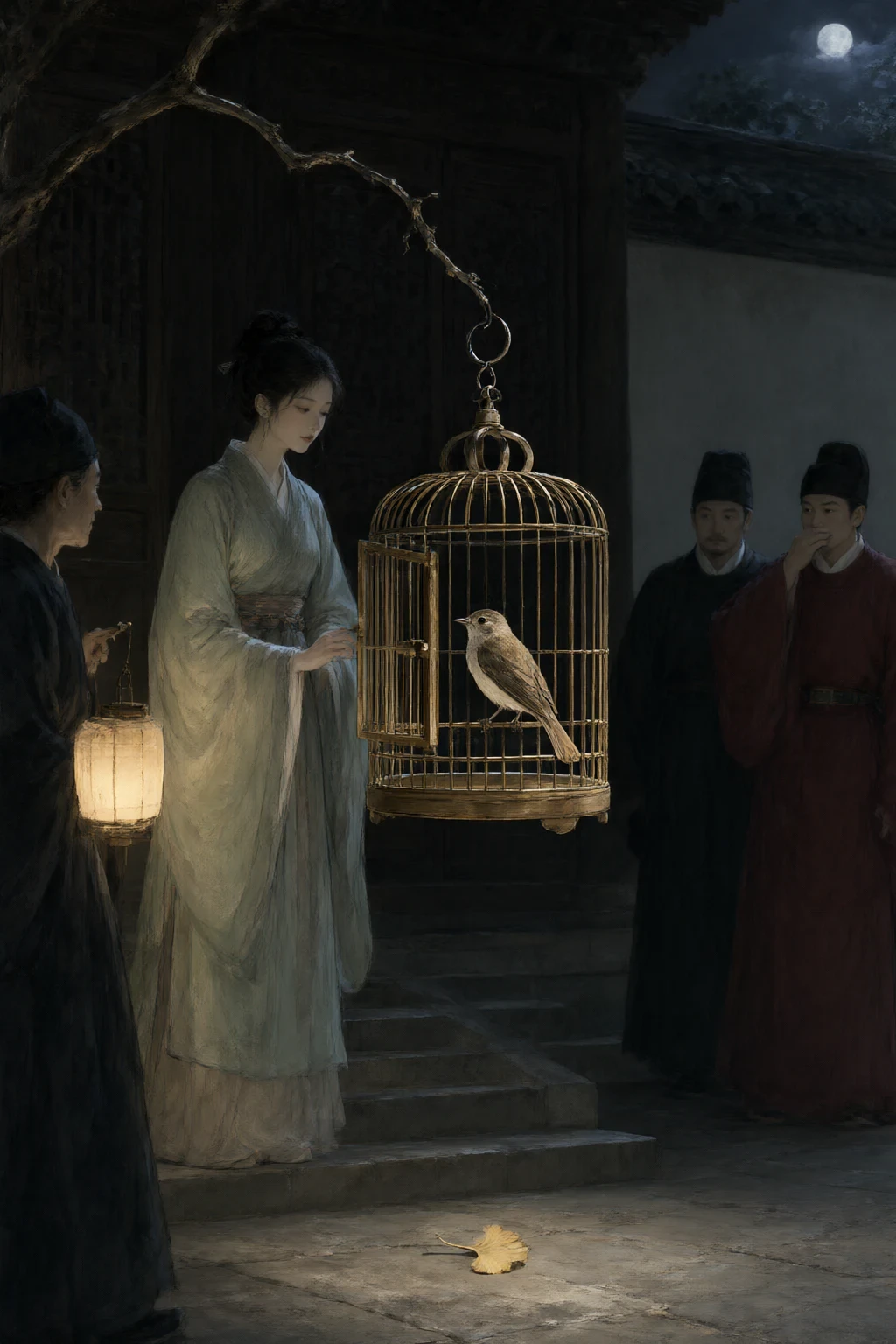
In the eleventh month of the year before, a bird was brought into the summer palace in a cage of yellow bamboo, and within a fortnight the Son of Heaven was sleeping better than he had since he was twenty. The bird was a nightingale. It was not a rare bird, and it was not a beautiful one by the standard of the palace aviary, which held eight kinds of pheasant and a heron with a purple crest. It was a small brown-grey bird that sang. It had been caught in the reed beds north of the city by a boy who sold it for the price of a bowl of fish, and it had been given to the imperial kitchens by a eunuch who thought a bird that sang would be a nice thing for an old man's garden. The nightingale sang at the third watch, in the courtyard of the Hall of the Wooden Phoenix, and the court came out to listen, and the court was very moved.
Mei Lan was nineteen and she had been a copyist in the Bureau of Annals for two years, which meant that she wrote out other people's accounts of things that had happened. The Bureau was the smallest of the six departments and the coldest. It stood north, in three grey buildings with a well between them, and it held the Great Annal, which was one hundred and nine volumes and which every dynasty in the empire's history had continued rather than begun. Nobody thanked the Bureau. When a thing went well it was because the Son of Heaven was wise; when a thing went badly the Bureau had recorded it correctly, which was a different kind of blame.
Mei Lan had a good hand. She was fast, she was exact, and she had the trick of writing in a single size and weight of ink, so that a page of her work looked the same whichever clerk had spoken the words into it. Her master, Comptroller Yuan, said that this was the whole of the profession, and that a copyist who showed her feelings was a copyist who would one day be asked to show them in a document. On the night she first heard the bird, she was at the well with a lamp, waiting for the night-watch to come and sign the water book, and the bird began, and she put the lamp down. "What is it singing?" she asked. The night-watch was an old soldier named Shi Bao, who had stood that post for nineteen years and had been given the bird's song, along with everything else, as a thing that happened to him. "It has words in it." "Has it." "It said a name." Shi Bao was quiet. Then he said, "Then write it in the book, and it will be in the book, and the book goes in the roll, and the roll goes north, and nobody reads it north."
The court went on listening until the fourth month. The nightingale had one song for the assembled ministers and another, longer, quieter one that it sang when the Son of Heaven was alone, and the eunuchs reported that the old man slept through the second song and woke singing it. The bird was clever about repetition. That was what the Minister of Rites, Fang Ru, discovered in the fourth month, and it is the discovery on which everything else in this account depends, and it was made by accident, in a kitchen, by a cook who complained to a eunuch that the bird in the courtyard had called him by name and had named his kitchen.
Fang Ru was forty-four and had come up through the examination system the hard way and believed, with the entire strength of a man who had earned everything he had, that the empire's difficulties were a matter of administration. He sent for the bird's keeper, an old man named Qiao who had raised it since the boy caught it, and he asked Qiao a single question. "Where did it learn words?" > The bird is not gifted. It is a listener. It has been in the reed beds for some months, and the reed beds come up against the north wall of the Hall of the Wooden Phoenix, and the Hall is where the departments are permitted to speak freely after the third bell, on the reasoning that what is said in a garden is not said at all. This reasoning was established by the third Son of Heaven of the Yuan line and has never been questioned, because it is convenient. "Reed beds do not have names in them."
Qiao was an old man and he had been in the palace for fifty years and he had served under four Son of Heavens, and he answered the way people in the palace have always answered a minister who is about to be dangerous. "It learned them from the water," he said. "The water carries sound. Everything that is said near the river is in the river, and the bird drank, and that is all." Fang Ru did not believe him, and he took the bird to a courtyard, alone, at the second watch, and stood in the dark and said things to it. The things he said were test things: the name of the dead eunuch who had served the previous emperor, the year the western canal had failed, the name of his own wife's cousin.
The bird repeated the first two and did not repeat the third, and Fang Ru walked back to his study and sat for a while, and then he wrote a memorandum, which is in the Bureau, in the sealed file, in his own hand, and which begins without any ornament at all.
> Memorandum of the Minister of Rites, fourth month, to the Son of Heaven, most respectfully submitted. > > The bird in the Wooden Phoenix courtyard has learned speech. Not the speech of poetry. Speech of persons. > > I have tested it in the second watch with materials of my own devising. It returned a name given to me in the eleventh month of last year in the western apartments, where I was alone, and which I have told to no one but my wife. It also returned the year of the canal failure, which was announced only in the edict and never spoken aloud in the palace, because the edict was read by a censor and the censor read it to himself. > > The bird is not gifted. It is a listener.
It has been in the reed beds above the palace for some months, and the reed beds are directly above the Hall of the Wooden Phoenix, and the Hall is where the departments are permitted to speak freely after the third bell, on the reasoning that what is said in a garden is not said at all. This reasoning was established by the third Son of Heaven of the Yuan line and has never been questioned, because it is convenient. > > The danger is not the bird. The danger is that a bird can say, at the third watch, in a garden, in the open air, what a minister said in a garden in the open air, and there is then no oath that can be broken, because the bird cannot swear and cannot be cross-examined, and the words it carries are proved by nothing except that another bird of the same kind would carry them too. > > I do not advise that the bird be killed.
I advise that no person in this palace write down what the bird says, and I advise that the practice of repeating to the bird the names of the dead in the presence of others be made to cease, since it is the practice and not the bird that has built the thing we now have to decide about. > > There are names in that courtyard which, if a single one of them is entered in the Great Annal, will be found in the second week by every reader in the empire, and the empire reads its annals more carefully than it reads its taxes. I do not know what follows a number. I have never had to.
The edict was issued in the fifth month and it is four lines long, and it is the shortest edict in the history of the dynasty, and no one in the empire has ever seen a copy of it except the six men it was addressed to. It ordered that the nightingale be cared for as the imperial household's own property; that the keepers of the courtyards report any repetition of words made by the bird to the Minister of Rites and to no other office; that the annals of the year be compiled in the ordinary form; and that the term Concord be used of the year in all documents thereafter. There is no clause forbidding anything. The edict does not say the court will not hear the bird. It says the bird belongs to the household, and that its utterances are reported to one office, and that the year shall be called Concord, and the rest follows from those three sentences the way water follows a crack.
Mei Lan learned what had happened from a copy of the edict that came to the Bureau for the file, and she copied it out in her good hand in the afternoon of the sixth month, and while she was copying it she noticed that the file already contained nine sheets about the bird, and that eight of them were in the Minister's hand and one was in a hand she did not know, an old, careful, slanting hand that wrote with the thumb very open. She put the file back. The Bureau's rule was that a copyist touches a file once. On the seventh night she went up to the Wooden Phoenix courtyard, where she had no business being, with the kitchen cloth over her head, and the bird sang.
It sang for a long time. It sang the third-bell conversations of the western departments, and Mei Lan recognised the Minister's voice saying a number twice. Then it sang a name she knew, the name of a censor who had died in the third month of a fever and had been buried with honours, and then it sang the sentence that censor had said in a garden in the eleventh month of last year, which was a sentence about grain, and the sentence was not true, and the bird sang it as though it were a fact about the weather. The point was not that the bird lied. The bird had no opinion. The point was that a bird will carry a thing that is not true just as readily as a thing that is, and a court that has agreed to write down only true things cannot let a bird into its record at all. She was noticed by a eunuch and she was questioned for two hours and she was not punished. She was simply, from that night, a person who had been in the courtyard, and the Bureau is a place where that kind of fact is useful to more than one department.
The bird sang every night after that, and the court came out and listened, and the court grew quieter each month, which is not the same thing as being silent and is much worse. By the seventh month the Emperor was the only one who came out every night, and he sat on the step in his robe with the singers' cushions brought out for him, and he listened for hours, and twice in that month he was seen to sit down in the dirt of the courtyard with his hands in the sleeves of his robe, and the eunuchs did not report it because they had been ordered to report only repetition of words. The old soldier Shi Bao stood that post every night and heard every word, and on the eleventh night of the seventh month he wrote a line in the watch roll, which is the record of who was awake and what they heard, and which is a real document and is kept in the Bureau and is not the annal and was never copied.
The line reads: Third watch. The bird spoke eleven times. Six men of the western departments present. All heard. The line was struck out in the eighth month by an order that is also in the file, unsigned, and the roll was recopied, and the original is in the sealed file with the eight sheets in the Minister's hand and the one in the strange old hand.
In the ninth month, the Emperor stopped coming out. The court said he was indisposed. The physicians were sent in and reported nothing, which is a category of report that the Bureau files under the ruler's affairs and does not examine. The bird sang in the courtyard anyway, to a courtyard. The eunuchs fed it. The court's appetite for it had gone, and a thing that has stopped being desired is not killed, it is simply mentioned less. Then a thing happened that the annals of the year do not contain, and that the file does, and that I have read. On the nineteenth night of the ninth month the bird was not returned to its cage. In the morning the eunuch who had charge of it reported that it had flown, and that he had been too drunk to close the door, and the Emperor's household accepted the report, because accepting a report was cheaper than looking for a bird.
The bird was found four days later in the court of the western kitchens, sitting in the open on the water butt, where it had been sitting for some time. It was not injured. It had been fed; there was rice in it, and the cook who gave it rice was questioned and had nothing to say. Qiao, the keeper, went and looked at it and said that it had gone out of its feathers, which meant it was old, or sick, or both. In the eleventh month it died. That is in the annals: the nightingale of the Wooden Phoenix courtyard, kept three hundred and some days, died in the eleventh month, and the entry gives the day, and gives nothing else, because there was nothing else that could be entered.
The year was called Concord. Mei Lan copied the name eleven times that winter, in a hand that did not vary, on eleven documents, and the eleventh was the one that went north. The Great Annal entry for the year is one page. It is in the standard form and it is well made. It records the Son of Heaven's hunting in the second month, the opening of the western canal in the fourth, the arrival of the tribute from the southern ports in the sixth, the death of the Empress Dowager in the ninth month, and the naming of the year. Mei Lan knows every one of those things to be true, because she copied the sources for all of them. The page has no errors in it. It is a page on which a reader could find nothing whatever to object to, and a reader in the year nine hundred and something would take it, turn it, and put it down, and never know that the year had a sound in it. She had been three years a copyist when she was given the year, and the Comptroller said, in the ordinary way, that the year was a quiet one, and that quiet years are the hardest to make look full, and that she would find it slow work.
Fang Ru died in his sixty-first year, four years later, and the file of the bird was carried into the sealed store with the rest of the century, and it was not opened again for a long time. It was opened by a copyist in the Bureau who was going through the sealed file for a different reason, looking for a tax return from the year of the western canal, and it fell open at the ninth sheet, which is the one in the old slanting hand with the thumb lying wide, and the hand is the Emperor's own. It is four lines, and it is the draft of the edict, and it is the only place in the empire where the reasons are written down.
> The bird is not dangerous. That is what Minister Fang believes and he is not a fool, and he is wrong for a reason that should be written somewhere, because in a hundred years there will be no one left who remembers it. > > The bird is true. That is all. I have sat in that courtyard in the dark and it has told me the names of the men who signed the granary order and the number of the buried in the fever year, which is not the number in the register, and it has told me the name of a girl in the western kitchens whose death is not in any register at all, and the bird does not know any of this, it only knows what it has been near.
> > I cannot unhear it and I will not stop it, and if I stop it then the last man in the empire who is able to hear it will be me, and I will be dead in five years, and after that no one will hear it at all, because they will all have agreed that there was nothing to hear. > > Therefore let it be Concord. Let there be a year with nothing in it. A country that has one year of perfect quiet in it can be shown that it did not always. Let the quiet one be mine, because mine is the only reason there is one.
Mei Lan was sixty when the historians came, and she was the keeper of the annals by then, and the custom of the Bureau is that a year is not sealed until a keeper has confirmed it, in her own hand, that it is complete. The two men from the academy were very polite. They asked about the composition of the year's record, and about the sources for the canal, and about the Empress Dowager's entry, and Mei Lan answered all of it correctly and at length, and gave them the shelf number of the roll of the night-watch for that year, which is where the file was. When they had gone, she sat for a while with the pen, and then she ruled the page, and she wrote the entry, and she wrote it in the finest hand in the empire. It took her a long time. The good hand is not fast; it is simply never wrong, and it has to be slow, because a stroke that goes in wrong cannot be taken out.
The entry says: the Son of Heaven hunted in the second month. The canal opened in the fourth. The southern tribute came in the sixth. The Empress Dowager died in the ninth. The year was called Concord. And then, in the last line, in the place the form leaves for the keeper's confirmation, she wrote the formula that closes every sealed year in the history of the dynasty, word for word, in a hand that a scholar in a hundred years could not tell from the work of the Son of Heaven's own most disciplined clerk. The record is complete and nothing has been lost. In the eighth month of the next year the cage was still hanging in the courtyard of the Wooden Phoenix, and it was still empty, and the bamboo had gone grey, and no one ever took it down, because taking it down would have been an act, and the palace and the Bureau could not agree on what kind.