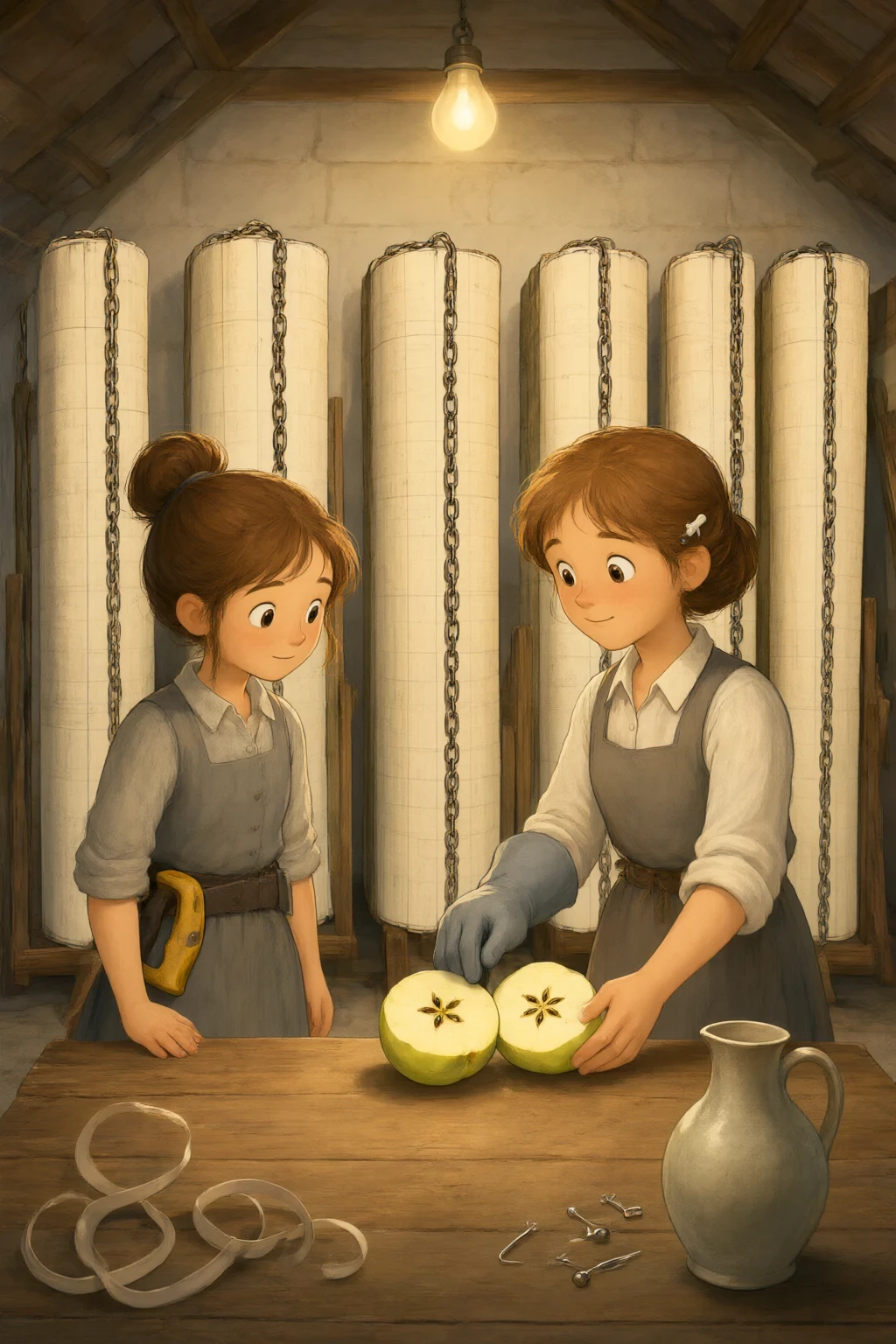
The cellar was cut into the bank behind the schoolroom, and it held three hundred crates of stock fruit and one barrel of pressed juice, and the district agreed on two things about that juice. It tasted wrong, sour and faintly iron, like a nail that has been in the rain. And it was drunk anyway, on Sundays and at funerals and by the register’s clerk on a Friday afternoon, poured cold out of a stone jug.
Nobody had ever found a way of pressing the fruit in it twice. Ottiline Vrey had asked three times. The second pressing came out as water. “You can say a thing once,” said Dellory Fenn, who had been an analyst in this district for forty years and had said it to four different people and never once in writing. “You cannot say it twice in the same tongue.” Hollis Bray was on the cellar step with a waxed cloth strip in his teeth, cutting strips for the bottles, because it was a Tuesday in October and there was nothing else to do. His saw was in the belt-loop at his hip and his palms were barked at the base of the fingers.
The bottles went up the steps two at a time in a crate, and each one had a paper strip round its neck. That was the part nobody had ever thought about. The strips came off a roll, and the roll was three feet long because the man in the town sold three-foot rolls, so the strips hung down the front of the bottle and had to be tied in three places, and when you poured the juice the paper came away in your hand. They were called long vouchers, and there was no other kind.
Each one had writing on it in a cramped hand: the date, the block the fruit was picked off, the number of the barrel, and a docket number copied out of the register by whoever was on the crate that day. Hollis read them all day long, on every bottle, and that was the whole of his job that Tuesday.
The man came at ten past three with rain in his coat and a bag over his shoulder and one shoe unlaced. He was not from the district. He said he was a clerk for a corn factor at Nether Combe, that he had left the cart at the cross and walked in because the road had gone to pieces, and that he had ten minutes before the four o’clock bus or he would be sat in an inn all night.
Hollis had the crate on the counter, the price card at one penny the bottle, the money tin, and a good deal to do. The man put a penny on the counter. “Only one,” he said. “I cannot carry more. I am a clerk and I am not strong and I have missed this bus before.” Hollis looked at the bottles. He looked at the penny. He looked at the door, where the rain was coming across the yard in sheets, and the bus stop was half a mile down the track, and the man had one shoe unlaced and no umbrella. “Take two,” said Hollis. “And run.” “You are not the register.” “No, sir.” “Then you cannot sell me two for a penny. I have been in offices. I know what a boy is.”
“No, sir, but the handcart is mine, and I am not selling you two, I am giving you one, and the other one is a mistake and I will write it in the book as a mistake.” He wrote it in the book as a mistake. The man got a paper bag, and Hollis put two bottles in it, and round the neck of the first he tied a long voucher, cut off the roll with a knife, three feet of wet paper round the most argued-about juice in the district.
“Keep the paper dry,” said Hollis. “It is not for drinking. It is so that if you lose the bottle, the paper says where it came from.” Nobody in the district had ever put it that way before. It was simply what the strips were for, and Hollis had said it out loud to a stranger at ten past three on a wet Tuesday, and a stranger had heard him.
The man’s name was Amos Tranter, and he missed the bus, and slept at the bridge, and came back on the Wednesday cart and asked for the register. He was not a difficult man. That was the worst of it. He stood in the packing shed with his hat in his hands and said thank you three times, and then he said the thing. “I have written to my sister,” he said, “because I wanted somebody else to taste it, and I have read my letter back to her, and she has written to me and said that no wine she ever drank tastes like that, and she has asked me what it is.” “What did you tell her?” said Ottiline Vrey.
“I told her it was like a cellar. Only not a cellar with anything in it.” He was trying hard to get it right, the way people are when they have read their own words too many times. “A cellar with water standing at the bottom, and walls made of something wet for a very long time, and the light coming from a stair that is not lit. And there is iron. I did not know it had a taste.”
Nobody said anything for a moment. The juice was supposed to taste sour and faintly iron, and everybody had said so for forty years, and it had never once occurred to any of them that a man who had never tasted iron would be able to say where it came from, and would say it out loud, in a letter, forty miles away. “There is no stair in the district,” said Marren Ashlock. “There is no stair on either plan,” said Sennet Bray.
“There is no stair in the ground I have walked with a tape on it for twenty years,” said Marren Ashlock, “and I have said the word that means I have not looked for one, and I am not going to argue about it in a shed in front of a stranger.” “Then where is it?” said Tranter. And Dellory Fenn, who had been standing by the cold range with a jug in his hand, said, “It is in the juice. It is in every bottle of it, and the district has drunk it for forty years, and nobody has ever asked it where it is, because we all agreed it was the water that got into the pipe gallery.” He put the jug down. “On the record?” he said. Nobody answered for a second. “Yes,” said Ottiline Vrey.
The register room held eleven tall ledgers on stands, chained by their spines and not by their clasps, and it smelled of glue and foxing and cold stone, and it was the only room in the Rootwork where people lowered their voices. They put the register on the table, and Ottiline Vrey took off her grey archive glove and put it back on again inside out, which she did once a year, and then she said the thing the whole day had been walking towards.
“Ten bottles,” she said. “Eleven, if we count the one you gave away that is not in the tin. And one name, and one date, and three feet of paper each. On the voucher it says Fenrows, barrel four, and a docket number, and the docket number is a real number, and if that man’s sister keeps a letter, then in ten years a person in Nether Combe can write to this district and say, I have a paper that came from you.” “And then what?” said Hollis.
“And then we say yes, and we cannot say no, because the paper says so, and the paper is our own hand.” She turned the volume round. “Look at the columns. Date. Tree. Parent of the scion. Rootstock. Docket. There is no column for what the fruit is like, because a register is a document of descent and not a document of what is down there. So nothing in the register was broken. And a place in this ground went out of the district in a bottle, because a fruit is a place, and you cannot hand a place to a man without him knowing it.” “Then the fruit is the mistake,” said Tranter.
“No,” said Dellory Fenn. “The fruit was a gift, and a gift is a courtesy, and a courtesy does not have your name on it. The paper is what made it a publication. Now there is a docket number, and a docket number is the paper trail of a disclosure, and I did not learn that in an office, I learned it here.” Ottiline Vrey wrote for a while. Then she stopped, and turned the volume round, and showed the page to the whole table.
It was a ruled line, up the wide margin, in pencil, headed in her small cramped hand. “Not findings,” she said. “Findings go nowhere. This is a list of what has gone out of the district, in what quantity, to whom, and what was written on the strip. That is not a secret, that is the register doing the one thing a register is for, which is following a thing from where it was to where it went. And the taste goes on the other sheet.”
She took a second, thinner sheet out of the desk and laid it on the first, the margin sheet, the ruled one, which had four lines on it already in pencil, three of them with a date against them and nothing else. “Who is told,” she said, “is this: everybody in this room, and Marren Ashlock, and the two families, because if the ground is described then it is the families’ ground, whether or not it is on their plan. And the man, because he has already been told, and you do not un-tell a man, you ask him to keep it dry.” She looked at the thin sheet.
“And this does not go to the district record, and it will not be in the register, because a register that holds findings is a register that can be wrong about a descent, and a register that cannot be wrong about a descent is the only reason any of us can sleep. It goes on the paper, in pencil, in the finder’s own hand. And the first name on it is yours, because you have been in that cellar since you were nine.”
There was one more thing, and Hollis did not put it in front of anybody for two days. In March he had made a graft. A scion off a Ward tree, an old one, good fruit, worked onto a Fenrow rootstock because the Fenrow ground was wetter and the scion had been failing on its own roots. He had done it with a grafting knife with one blade edge blunted, because the sharp edge is the one that slips.
It had taken. It was in the register. It had a docket number. It was the first thing he had ever entered anywhere in his life, and he had gone nearly mad with wanting to tell people. On Thursday he took the saw out of the belt-loop and cut a fruit off that tree. It had six in the star instead of five, and a ring of pale flesh around the seed, and it smelled of a cellar after rain.
He tasted it, and it was not the Ward ground, and it was not sweet, and it was not Fenrow either, because he had eaten Fenrow fruit every day of his life and Fenrow was sharp and then sweet, and this was sharp and then iron. He sat down in the grass with the two halves in his barked hands and he went very fast.
“Six in the star, that is not a variety thing, that is a grafting thing, it has taken to a place and it does not know which place, and if it is iron then it is the cellar, and the cellar is the pipe gallery under the Ward block, and the pipe gallery is a water main, and a water main is a street, and I put this tree on a root that is under a street, and my mother signed the docket, and I am the only person who ever noticed because nobody else came to look, and —”
His mother sat down beside him in the wet grass without saying anything at all for about a minute. Then she said, “Give me that.” He gave it to her. She turned the half round, put her thumb on the pale ring, and looked at it the way she looked at a wet wall. “You will find it wet under the north row,” she said. “It is always wet under the north row. And you put your scion on a root that came out of the pipe gallery, and the pipe gallery is under the north row, and that is where it drew from before you ever cut it, and in sixty years it will be the only thing it can tell anybody about.” “Can I undo it?”
“You can cut it off, and you will have a stump and a hole in the map, and the hole will be there when your son puts a tree in it.” She handed the half apple back. “You did nothing wrong, and you did a permanent thing, and those are not the same sentence, and I am not going to help you pretend they are.”
On Saturday they pressed the whole of Bellhouse Cellar. It took two men and a boy and most of the afternoon, and they pressed every crate of the misshapen fruit that had never sold, three hundred crates of it, and the juice came out thin and grey and iron, and they did not tie a strip round one single bottle. Marren Ostley came at four with her coat on and her docket-book in her left hand, and offered, in the second person, to buy the lot.
“No,” said Ottiline Vrey. “Eleven hundred bottles, and no paper on any of them, and you may drink as much of it as you like at the gate, and you will get nothing to send anywhere.” Mirren Ostley looked at the docket-book for a while and then put it in the inside-out pocket. “You are all going to regret having decided that,” she said, “and it will not be me who says so.” And then she took two bottles, because they were free, and went away.
By dark the barrel was empty and scoured, and the second pressing, which cannot be done, was the last pressing, and there would be no more juice in that cellar as long as the district stands, and every family in the Rootwork was given a bottle, and got one. The register went back on its stand and the roll went back in the drawer. And on the thin sheet there were six lines in pencil, in six hands, because by Saturday Dellory Fenn had written one, and Marren Ashlock had written one, and Nell Aveling had come in with a satchel of chalk and had written one.
And the first line said only: this is what it tastes like, and it is not for proving anything, and it is not for selling, and it is here because otherwise we will all drink it for forty years and pretend it is the water in the pipes. The seventh line was Hollis Bray’s. He put it in the way you put a thing down when you have been carrying it up and down the orchard for two days. He cut the fruit from his own tree in the morning and brought it in in a twist of newspaper, and set the two halves on the desk, cut face up, where anybody could see the six in the star and the pale ring.
“Six in the star,” he said, fast, because he could not make it slow. “Iron, and not sweet, and a stair with the light coming down it. March the ninth, docket one hundred and forty-one, scion off the Ward eight, rootstock Fenrow, rootstock came out of the pipe gallery under the north row, and that is my own doing, and I am the finder, and I have written it in pencil, and I have not asked anybody to sign it.”