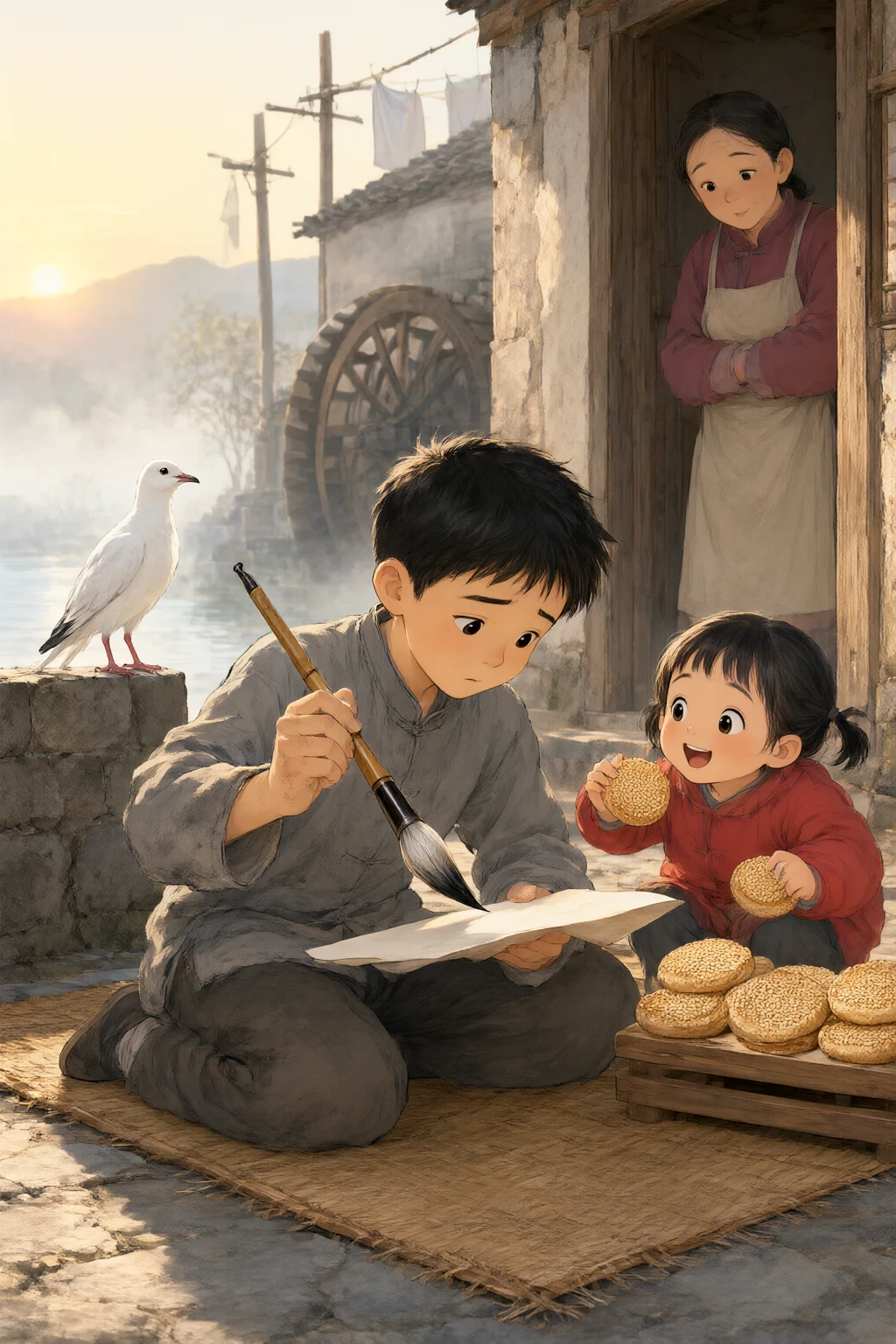
The stone lane behind the mill in Riverbend County had a mill, a well, and a bakehouse, and the smell of wet flour went through it all winter long. Ma Liang was twelve years old. His father cut stone steps. His mother wound thread for a weaver across the river. He was not a painter. He could draw a bowl of rice, and he could draw it better than anybody in the county, and it was still a bowl of rice.
At the temple fair on the last day of the year, an old man in a patched coat was warming himself at the brazier. Ma Liang gave him a spare bun. The old man looked at the boy's hands, which were stained black along the creases, and gave him something in return: a brush with a bamboo handle worn smooth and a head of badger hair gone grey at the tips. "A fine brush," the old man said. "Listen to what it is not. It does not know what you mean. It does not improve your asking. It does exactly what you say, and it does not do it kindly." Ma Liang thought this was a way of being asked for money. He was careful, anyway. He painted a bird.
The bird came off the paper and stood on the sill in the grey morning, and it shook itself, and it was alive, and it was the most beautiful thing anyone in the lane had ever seen. Then it wanted breakfast. Ma Liang gave it rice. It ate the rice. Then it wanted a bath, and then it wanted a mate, and then it wanted to be sold, and after that it wanted to go south, and it sat on the sill and sang until noon and ate a great deal.
A merchant from the county town saw it through the window. His name was Hao, and he was a decent man in a hurry. He paid a thousand cash, which was so much money that Ma Liang's mother dropped the thread she was winding, and the bird went into a bamboo cage in a cart, and Ma Liang was a famous person by the time the cart reached the gate. The bird was not famous. The bird was famous in a cage, in a courtyard, in a house on the far side of town, and it sang there for eleven months for a house that did not want it.
The little girl who lived in the bakehouse was called Mei. She was seven. She counted sesame cakes for her grandmother from dawn to dark, and on the day Ma Liang came home rich she ate four of them and did not say thank you, and then she said thank you. "You should paint food," she told him. "Everybody says you should paint food." "I did paint food. I paint rice better than anyone in this county."
"You painted a bird," said Mei. "A bird is not food, and a painted bun is not a bun." She held up the fourth cake and looked at it. "When I am hungry, a picture of a bun does not fill me up. It just makes me sad that I am hungry, which is worse." So Ma Liang asked her what she did want, and she said she did not know, she was only hungry, and this was the first useful thing anybody had said to him all winter.
Hao came back in the spring with the cage, which was very fine, and the bird, which was not. The bird's feathers had gone thin and it had stopped singing except when somebody was eating in the room. Hao was not a villain. He had bought a song and been sold a hound. They stood together in the lane as witnesses, in front of the ward magistrate, and the magistrate was a small dry woman who asked one question: what was the bird for? Hao said, music. The magistrate said, for whom. Hao said, for the people who pay for it.
"And you are one of the people who pay for it," she said. "So name a use you got." Hao thought a long time. "None," he said at last. "I got a sound." The magistrate said that a thing with no use has no price, and that the thousand cash was therefore a mistake, and that mistakes are divided between the two people who made them. Ma Liang counted out five hundred. He kept five hundred, which was a great deal of money, and which he did not spend, because every time he took it out he thought of the sound with nothing to do.
He painted Mei instead. He painted her with a bowl of cakes in her hands and flour on her cheek, and it was the best thing he had ever made, and the bakehouse put a copy of it over the door, and strangers came in from the next county to look at it and then bought cakes, which was exactly the use.
In the autumn he went south with a merchant caravan, and in Ji Prefecture a clerk told him that the Governor had heard of the brush and would like a picture of a gold ingot. The Governor of Ji Prefecture received him in a plain room with a table, a brazier, and no soldiers in the doorway, which disappointed Ma Liang, who had come all the way from Riverbend expecting soldiers in the doorway. "A gold ingot," the Governor said. "It is not for me. It is for the provincial record, which is very dull, and I am sorry to make you draw something dull. But it must be gold."
Ma Liang asked whether it should be sycee or a minted bar, and how much of it, and the Governor said the sum was large and the form was not important, which Ma Liang later thought was the whole of his character in one afternoon. He painted the ingot. He painted it as well as he could, and the brush did the rest, which is to say it did exactly what he had said. When the picture was dry, the Governor sent his own treasurer to fetch it. The treasurer came back with his hat in his hands.
"It is chaff," he said. "Dried reed mud, mixed with bran, and gold paint over the top so you would not see it at once. There is a great deal of it." The room was extremely quiet. Ma Liang looked at the picture he had made, and the picture was perfectly drawn, and there was no gold anywhere in it. "A gold ingot," he said. "That is what I said." "Yes," said the Governor. "Well. I have been trying to buy gold from this office for two years and I have never received it. I begin to understand why."
He did not punish him. He asked, politely, what a brush was for. "To paint what someone needs," said Ma Liang, "and not what they would like to see." The Governor looked at the picture for a while. "Then the brush is honest, and the fault is that I asked it a dishonest question, and the fault is mine." He asked for the wall of the granary. Rice, the canal, the ferry, the water wheel, the market day, the shape of the hills in every season. No soldiers, no gold, no flattery.
The wall of the granary at Ji Prefecture took two men four months and it can still be seen, though it has been repainted so many times that no one agrees which parts are Ma Liang's. What everyone agrees on is the small figure in the corner market, carrying a bowl.
Mei never learned to paint. She learned to run the bakehouse, and she married a man from the ferry, and she hung a copy of her own portrait over her own doorway, with the real steam from her own oven rising behind it, and she charged a copper to anyone who wanted to look, which she thought was very funny and very sensible.
The old man at the brazier, Ma Liang never saw again. But years later he met an old painter in another town who said that he had heard there was a brush somewhere, that it would paint whatever you asked, and that it had ruined one boy and made another. "It cannot tell the difference between a good question and a bad one," that painter said. "No," Ma Liang said. "But the person asking is right there, and that is enough."