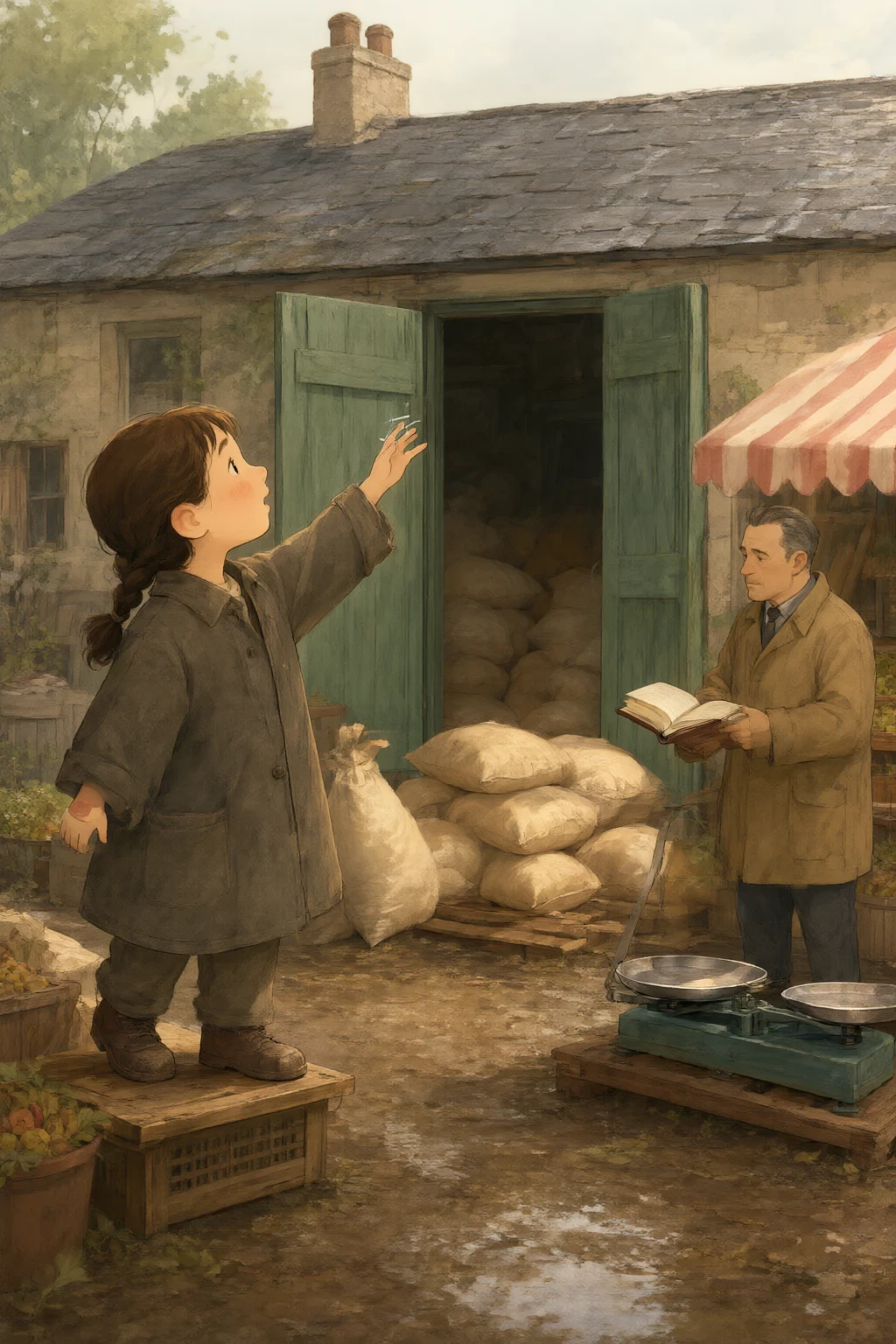
Nell Aveling, eleven, with dark hair in a barley-coloured braid and a burn mark on the inside of her right wrist from the wash-house boiler, stood on the upturned crate in a coat three sizes too big for her and marked the sacks as they came in, one stroke for each full one, because she had been told she was the tally clerk of the Aveling family of Gorse Bridge, which was a title her mother had made up.
Five sacks. That was the day’s work: three weeks of the Fenrows and five sacks of windfalls, every one with the Aveling chalk on the corner. The chalk mark was their own. Jo could do it and Dad could do it, though his looked like a bird. Four strokes and a bar across them, which is five, and then a letter for the row, so that a mark said not only how many trees but which ground they came off. A was the top row by the ditch. B was the second. C was the third.
The doors of the shed stood open all morning. Inside there was the smell of bruised fruit and dry shavings, the scales hung on a frame by the wall, and under the awning the register’s clerk sat on a barrel with the bound volume open on a crate between his knees.
The buyer came at nine. She was nobody’s idea of a buyer, which was why Nell liked her. A canvas trade coat with the pocket mended inside-out and in a different blue, wet boots, and a paper docket-book that stayed in her left hand all morning and never once went into that pocket. She looked at the sacks, and at the fruit heaped in them, and at nothing else at all. “Thursday,” she said. “You and me, we both know what this tree is worth.”
“We have five sacks,” said Dad. “Windfalls. Fenrows, C row mostly, and there is a bit of A.” “Five sacks.” She put her hand in each one, right down to the wrist, and brought up a fistful of wet grass and half a leaf. It was the wet that was worth checking. Everybody knew the wet. Then she looked at the corners. Everybody’s sacks were marked. The register’s clerk used a long cross. The other pickers that morning had a window, a star, three little gates, and a name spelled out in full.
The Aveling sacks had four strokes and a bar, and a letter. That was the thing she would remember. She did not read them. She did not turn a sack, or tilt her head, or scratch at the chalk with her thumbnail the way a person does when a mark is hard to make out. She had all five in front of her and read them without touching one, and she did it in the order C, A, B, B, C, and she did it fast. “Why does the mark say which row?” asked Jo, from under the crate.
“Because a sack of windfalls is not a sack of apples,” said Mirren Ostley. “It is a sack of where they fell, and where they fell is in the taste, and the taste is the only paper anybody has ever written down. So your marks are worth something. Don’t sell them to me cheap.” Dad put his head on one side. “We were asking fourpence a sack.” “I was going to give you a penny.”
“Because she has read them already,” said Nell, on the step of the schoolroom an hour later. “She did not read them. She knew them. That is like knowing a man’s name before he tells you.” Dellory Fenn was sitting on the school steps with a tin of drawing pins in his fist and a folding rule he had never once been seen separate. One lens of his spectacles was wired to his ear with copper thread. “Dellory,” said Nell. “How do I read a tally?” He turned the tin over in his fingers. “On the record?”
“What does that mean?” “It means I am asking whether I may do a thing and write it down, and that if you say yes then it is your fault.” He put the tin on the step. “Nobody has ever said yes to me in about forty years. My answer was always no, and I never asked again, and so I never submitted anything.” Nell thought about it. “Yes,” she said.
“Then a tally is five strokes with a bar, and a letter for the row, and if there is a number after the letter then that number is the tree.” He took the chalk out of her hand, upside down, and drew it on the step. “Your five sacks are C, A, B, B, C. The two B bags are the best ground you have. Under the north row, where the water stands, the fruit takes up the iron out of the pipe gallery, and a buyer can taste that before she has looked at the bag.”
Nell looked at the five sacks in the yard. “So she gave us a penny for everything,” she said, “so we would not know that the two B bags were worth more than the other three put together.” “She gave you one price because one price is easier than four. You and I both know what a sack is worth,” said Dellory Fenn. “Sorry. That is her way of talking and I have caught it.”
Jo had knocked a sack over in the yard while fetching a crate, and the windfalls had gone out of it across the wet stones. That was when Nell found the fifth mark. It was a hook and a stop, and somebody had rubbed at it with a thumb until it was half gone, and Nell knew, in the way you know a thing you cannot prove, that it was not one of theirs. She looked at the other four. C, A, B, B. She looked at the one on the stones.
Then she went and got her father, and she made him look. Dad lifted it. “That is a B mark. That is the same as those two.” “It is not the same,” said Nell. “It is a hook and a stop, and somebody has rubbed half of it off, and the chalk is a different colour.” “It is the same chalk. The shed sells one box.” “It is not the same mark, Dad, I know the shape of ours, I have drawn it a hundred times.”
She got the little knife from her pocket, the one she only ever used for sacks, and cut an apple in half up to the pips, and turned the two halves over, and looked at the cut face, and then gave it back to her father. “That is not ours either,” she said. “Nell.”
“It does not taste like ours. Ours is sharp and then it is sweet. That one is only sharp, and then it is cold, and it tastes like being in a walled place with no window in it.” She put her thumb on the pale ring around the seed. “And it has four in the star, not five.”
The buyer came back for the sacks at eleven, and put her docket-book on the tailboard of her cart, and opened it. “Five sacks,” she said. “Pence each.” “Wait,” said Nell. Everything in the yard stopped. The clerk with his pen, the other pickers at the far end of the table, her father with his hand on a rope, and Dellory Fenn on the step, who had come down without saying anything at all. Nell climbed up on the crate so that they could all see her, which she had never once done in her life.
“My sacks are C, A, B, B, and this one,” she said, lifting the loose corner off the stones, “which is a hook and a stop and not one of ours, and the fruit in it was picked by nobody in this yard this morning.” Mirren Ostley did not move at all. “That is a B bag,” she said, “and you are a child, and your father is standing there.”
“You knew my marks before you touched them,” said Nell. “You went C, A, B, B, C without stopping. And you have paid one price all morning because one price is easier than four. And you have offered a penny for a sack of B fruit that tastes of the iron out of the pipe gallery, and that is the one thing in this orchard a buyer cannot pretend not to know.” Somebody at the far end of the table put down a basket.
“Nell Aveling,” said the clerk, “you may say that again in a moment. First tell us how you know the taste.” She told them how she knew the taste. She told them about the four in the star, and about the walled place with no window, and about the hoop she had to cut in half because it would not cut otherwise. When she had finished, Ottiline Vrey came out of the shed door with the grey archive glove on her right hand and the bone-white boxwood pin in her left ear, and asked the only question she ever asked.
“Five sacks,” she said. “And which of the five is not yours?” “Four are mine. And there is a fifth thing in the yard that is not mine, and it is not anybody’s, and it came off a wall in a place with no sun, and no tree in this district grows out of a wall.” Eleven ledgers said nothing at all, which was how the register answered when it had heard something.
They did not shout at Mirren Ostley, which Nell had expected them to, and which disappointed her for the rest of the day. What they did was sort.
The clerk read the tallies out loud from the end of the table, one sack at a time, and the yard read them back to him, and he wrote a docket number on a paper tag and pushed the tag through the string at the neck. Thirty-one sacks were sorted before the rain came in. Eight belonged to the Ledger family and went back up the west track. Six were marked with three little gates and went to a man from the low meadows who had lost his chalk box in the ditch. Four were the shed’s own.
Two were the Avelings’ B bags, and they went back onto the cart with Dad, and they were the best apples in the yard, and every picker there knew it, and nobody said so. The fifth one went nowhere.
Nobody was allowed to sell it and nobody was allowed to keep it, and in the end Mirren Ostley put it in her own cart herself, in her own hands, while the whole yard watched. It is not the seller who comes away disappointed from the gate of the Cold Graft, and that is the one thing about that walled corner the district will admit to anybody. The register’s clerk wrote out the day’s dockets, and then he stopped, and then he did the thing that made Nell’s mother say afterwards that the whole morning had been worth the walk.
“There is no column for what it tasted like,” he said. “There is a column for the parent, and there is a column for the date, and there is no column for the finding, and there is never going to be one, because a register is a document of descent and not a document of what is down there. So the finding goes in the margin, in pencil, in the finder’s own hand, and I do not initial it.”
Dellory Fenn came off the step and came to the crate and put the tin of drawing pins down on it, and picked up the chalk. “I have been an analyst in this district for forty years,” he said, “and I have had a finding in my coat ever since nineteen hundred and six, and I never submitted it, because I was afraid it was wrong, and because the register cannot be wrong.”
He wrote in the margin of the day’s page, in pencil, that on the twelfth a sack marked with a hook and a stop, not of the Aveling marking, had been found in the yard, and that its fruit was cold, and walled, and none of this ground. Then he ruled a line under it, and put the chalk down. “Delivered,” he said, to nobody, and Nell thought it was the proudest she had ever seen anybody in her life.