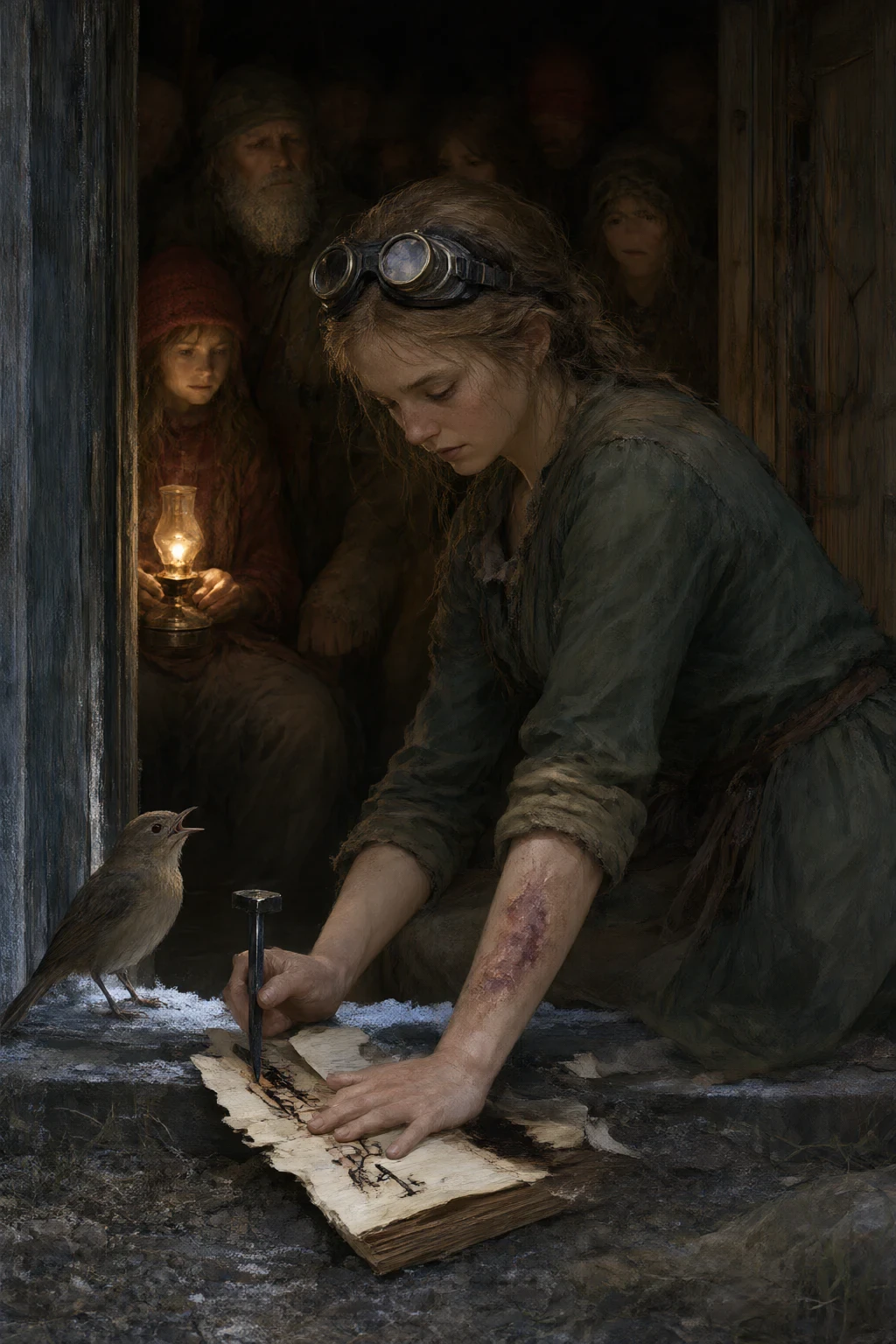
Tace Aldren had been copying the board for a season and a half and had never once read it, and on the twenty-fourth day of the reading week she read it from end to end in a cold room with the door shut, and nobody in the room breathed for any of it. She had a candle in a shell on the sill, because the Scriptorium had a proper lamp in the stand now, and a keeper who has been deprived of a lamp for twenty-five years does not put the hand-lamp down the first night there is one. At the last line she stopped, and put two fingers on the oak behind the bark, where two little empty squares have been cut for four hundred years. “Right,” she said. “That is a signature, and it is not ours, and it is a fortnight old, and I have just read it twice, which means it is read.”
Here is what the new line says, in the hand of the board, four hundred years old, the same sap and the same nib, the letters small and glossy and crawling a little because it was written four days after the sap had gone into the wood. I. The reckoning of the sap is made whole, and is not read again. This begins at the assembly. II. The Company is a party, named, and not described. And the binding of the reading extends to the speaking, from the reading of this line, so that what any party says of the Company is read. III. The Company will answer, once a day, in the Wood, and the answer will not be cut short. IV. The Wards are parties with the Row, and the oil of the Wards is owed, and not given. V. The border is the light, and where the light ends, the Company forgets where it was to stop. And at the end of the strip, in the same hand, in letters larger than any of the others, a single word, and then a bar, and nothing in the bar. “There's a blank,” said Tace.
“There is,” said Elder Sable Ashdown. “And the name is the whole of what has been offered, and it is the only part of the offer that is not already in our hands. Read the second one again, and count the words in it out loud, because I want to hear you count them.” Tace read it again. “The Company is a party, named, and not described. And the binding of the reading extends to the speaking, from the reading of this line, so that what any party says of the Company is read.” “When did I stop being able to see it.” “Eleven years ago.” “When did this stop being a proposal and become a fact?” “When you read it.” Ashdown sat down on the step of the reading stand, which she did not do. “I have been waiting twenty-four days for somebody to say that sentence, and I had a speech ready, and it has gone now that you have said it in eight words.”
“A proposal read aloud binds nothing,” Tace said, “or it is not a proposal, it is a gift with a form on it.” “A proposal binds nothing until it is laid before the assembly, and that is the only true thing anybody will say about this for a month, so I will say it now and get it out of the way.” Ashdown put her hand flat on the oak. “But the second line is not a proposal about what shall be done. It is a statement of what is. That is a fact about the world, stated by a party that is not a person, and you have read it, and it began when you finished it out loud, and I am sitting here under it.” “What does it do?” “It does what I did ten years ago, only the other way round.” Her mouth did the thing that was not quite a smile. “I took away this village's right to speak carelessly about the Wood, to stop a pedlar unmaking the border with a sentence. The Wood has read our line back to us and said: very well. You are bound by everything you say. All of it. Now say what you like about me, and be bound by it.” Merrin Vale was on the floor with her knees up and her red cap over her ears, being the only child permitted, which she is because she asks. “Does that mean I can say it now?” she said. “No,” said Ashdown, without a scrap of doubt. “I said you could ask. You have asked. The answer is no, and the answer is a document, and I am sorry.”
Osmund Rigg came down to the Scriptorium on the second day, uninvited, and stood at the back with his hat in his hands through an hour of argument about a word he had no interest in. “Is the second one past the mark,” he said, when it was done. “The one where the Company is a whole thing and not a place. I park my cart a hundred and forty paces east of the mark and I have done it for thirty-one years, and if the Company is a whole thing then a hundred and forty paces of me is inside it, and a man inside a pact is held to it.” “No,” said Ashdown. “A party is a party only within the light. Nobody past the lamps is a party, because a party the Company cannot answer is not a party. It is an address.” “So I am out. Then I have been out on the right side of it, and did not choose it, and the last thirty-one years of my life have been a man being careful on purpose about a thing I was already outside of.” He put his hat back on. “Does the naming reach my cart.” “No.” “Then I can still sell charcoal.” “No,” said Tace.
“Then I cannot sell charcoal either, because I cannot say the word, and a man cannot sell a thing he is not able to name, and I have said that word every Thursday for thirty-one years.” He laughed once. “So that is the offer. The debt is a hundred and twenty-six years, the name costs me the only trade I ever had, and the answer is that the Wood will talk to us once a day. I am to believe that is a good deal.” “I am to believe it is a fair one,” said Ashdown, “which is not the same, and is not better.” Week one was arithmetic, and it was worse in the one direction nobody had looked in. Five hundred and eighty-nine spoons. Seventy-three pounds and ten ounces of sap, nineteen years of it, owed by an enclave that has no sap and never had any to give, because the only sap in Nettlefold is the sap in a hundred and thirteen lamps' worth of oil, and that belongs to this season. There is no store. There has never been a store. A spoon of sap is not a thing you can put in a bucket, because by morning it is a tree that has been charged for. So the first line forgives a debt that could never have been paid at any price in any year, and the Wood is not being generous. It is clearing a ledger that was never going to balance, in order to be named, which is what creditors do. “The forge is the rest of it,” said Tace that evening in the mill, to Nessa Brack, because the mill was hers. “Not the word. The word I can live with. The forge is this.” She put her hand on the charcoal bin, which was half full of ironwood charcoal and worth more than the shed.
“Bog iron will not go on peat. Everybody tries it and burns the lining out and blames the lining. It wants a fuel that holds four hundred degrees, and the one thing in this valley that does that is the Company's own limbs, and as of yesterday afternoon it is a thing I am not permitted to name.” “Eleven weeks, at the rate we are going. In four months the eight anvils are cold, and this village cannot make a nail, a hinge, a drip-pan or a lamp-frame. Not cannot sell them. Cannot make them. And then Shallowmere, four days' cart, at four times the price, and a lamp-frame that does not know this ground comes loose in a hard frost and goes down, and then it is a dark lamp.” “We never can. The forge is decided, and the forge is the answer, and it is not a good one.” She turned back to the anvil. “Slag luck. Four hundred years of a pact, and the whole of the settlement is that we are not allowed to grow. And I am not a fool. A line that cannot move is not a border, it is a fence, and I have spent nineteen years telling the Scriptorium that fences are for men with a saw.”
Week two was the question of who is a party, and it took four days, and it was won on an arithmetic that Nessa Brack did in her head while somebody else was talking and then had to be talked into reading out loud. “The Wards are not parties,” said Gale Prust, the weaver at the front of the Row. “That is four hundred years, it is in the founding lines, and I have not come here to be taught the document by a foundry apprentice with a burn on her arm.” “The founding lines say the parties are the households of the Row,” said Tace. “The second line says everything any party says about the Company is read. So every word a Ward has ever said about a tree is in the document, and has been since last night, and they are not parties to it. That is not a contract. That is a rule made by one side about the other side.” “The Wards have not complained because they have not had a line to complain with, and a thing with no line has no standing, and a thing with no standing gets its oil taken and is grateful.” Tace put her scarred forearm on the table, on purpose, which she had never done in front of a full room. “Gale, the mill is in the Wards. The charcoal, the lamp-frames, the hinges, your two doors, the brass plate on the lamp at the head of the Row. In four months the mill is a shed, and the mill is not a party. It is a shed that belongs to nobody, in a ward that belongs to nobody, on a border held up by a hundred and thirteen lamps, and not one lamp in this room stands in the Wards.” “Because the Wards could not afford oil. Which is why the Row has lamps and the Wards do not, and which the pact has had a kindness written into it about for forty-two years, and which was not the Row's doing.”
“It was a kindness,” said Elder Ashdown, “and it was mine, in my ninth year of keeping, and it had a handle in it that I put in myself. Every household of the Wards that has an oil it has not begged for shall keep one lamp. Four households, in that year. I could not ask the question without naming somebody's poverty. So the clause that was meant to protect four people became the widest clause in the pact, and the Row went from a hundred and forty-four lamps to a hundred and thirteen, and the thirty-one did not come off because oil was short, and I want this room to hear me say that they came off because of a sentence I wrote.” Nobody said anything. Out of the one north window it had begun to get dark and nobody lit the lamp, because there is a habit about lamps in that room and nobody could remember who had started it. “The tally,” said Nessa.
The tally of lit windows is chalked on a slate at the head of the Row and checked twice nightly. The tally of lamps is on the brass plate of each post, and the plate lists the wick-watchers of that stretch, and it has listed them for four hundred years. It does not list the Wards. There are no posts in the Wards. There are fifty-one households there, and every one of them has been keeping a lamp for forty-two years or has been asking somebody else to, and not one has ever appeared in the whole of the document, because when the columns were made the Wards were not a party, and the oil of the Wards was not an input but a charity, and charity does not go in a ledger. “Forty-two years,” said Nessa. “Fifty-one households, most of them two or three spoons a week, which is a lamp and a half if you are careful. Fifty-one spoons a season and forty-two seasons, which is two thousand one hundred and forty-two spoons, two ounces each, which is four thousand two hundred and eighty-four ounces, which is two hundred and sixty-seven pounds and twelve ounces of oil that Nettlefold has consumed and Nettlefold has never once entered.”
“It is less than anybody thought and it is worse, and I have not finished.” Nessa put her sap-black fingers flat on the slate. “The second column is not a bill. It is a second column. For four hundred years this pact has had one account, and every number in it belongs to a household of the Row. The second column is fifty-one households and everything the Wards have given is in it, and it is not smaller than the first. When it opens, the village is a different size and the sap is a different number, and we do not get to keep the old answer to the debt.” “The debt has been made whole,” said Oren Vall. “That is the first line. Seventy-three pounds and ten ounces, gone, at the assembly.” “Yes. Gone from the nineteen years. The second column starts tomorrow, and from tomorrow the sap is not a debt Nettlefold can ever finish, because the sap is the lamps, and the lamps are the border, and the border is the thing we are trying to keep. That was true before the offer. It is not news. But it used to be true in one column, and the one column had our name on it, and the Wards were not in it, and that was the arrangement everybody was content with, and it was content the way a floor is content.”
The pact does not take a vote. It takes a reading. A thing becomes true when it is said out loud by two parties, and the only way to find out what an enclave wants is to stand in the lane at dusk and make it say so, and then to live in it. Nessa read the tally. Oren read the second column. Then the whole was read back into the lane with the lamps burning: the lamps, the posts, the oil, the sap, the arrears, and the fifty-one Wards households by name, every one, read out at dusk by a girl of fourteen with two fingers stained green-black. And it was a reading, and it bound, and it could not be half-said, and everybody heard the entire number before anybody was permitted to have an opinion about any part of it. What came out of the lane was not an answer to whether the Wards are parties. It was a number. The Wards were parties, and their oil was owed, and the first payment was seventeen lamps taken off the Row and set in the Wards that same week, before the Samstag. Seventeen. Ninety-six after that.
“Two thousand one hundred and forty-two spoons of arrears,” said Oren Vall, doing it on the notice-slate at the Cross in the rain with a crowd round him. “Payable in oil, at the measure the pact uses, and a lamp is the only thing in this valley that oil is actually for. Seventeen the first year, and one a year thereafter, on the day of the assembly, in the Ward that has not got one, named, and the name written on the plate.” “No. Seventeen the first year, because the debt begins now and arrears are arrears and not an instalment. And one a year after, because one is what this village can carry without the border walking in, and because one a year is a lamp and a wick and a watcher's shift once a year on a set day, which is not nothing, for the next ninety-six years.” He chalked it. It took him three goes. “Ninety-six lamps lit. Ninety-six years. And when the ninety-six years are up there will be nothing lit at all, and I am putting that on the slate anyway, because that is what the number is, and this enclave does not get to have a number it is not willing to read.” He clicked his knee twice on the gravel. “Aye,” he said. “Aye, but—” He stopped. The crowd waited, because they had waited eleven years for whatever came after that. “There is no but,” said Oren Vall. “There has not been one for a fortnight. Put it on the slate and go home, all of you, and keep your lamps tonight. I will read the board at dusk, and I will be somebody who is still paying attention.”
Week three was the name, and the name is the only thing in three weeks that nobody could do arithmetic on. “Both parties fill it,” said Ashdown. “The Wood has offered and the village must name. If we write a word and the Wood does not take it, the line does not take, and we are where we were, and the border walks in. If the Wood takes it, the name is the Company's, and the Company is a party, and a party that has been named can be held to what is written about it.” “How do we know if the Wood takes it.” “The birdsong. The birds in the Wood have never finished a phrase in four hundred years, and the forest's birds have always known better than to finish a phrase. If a name is written and the birdsong finishes that night, the name is taken. If it does not finish, it is not, and we write another, and there is no penalty and no shame in that, and I would have thought a great deal better of this month if anybody had said it out loud at the start.”
Twenty-one names were written in sap on strips of bark in twenty-one nights by hands that could not sign and were signing anyway, and the birdsong cut off short every time at the same place. Ash. Cold. Lamp. Sentinel. The Standing. The Warding. The Long Account. The Third Birch. Tace wanted a word for the work: a name that meant the wood came down on request and stood still while it was argued with. Nessa wanted a word for the food, and said so more than once, and thought it the only honest thing anybody had ever done to the Walking Wood in four hundred years, to name a thing after what it does to you. Osmund Rigg wanted a word for a buyer, and nobody would hear him, and he stopped asking on the fourth night. Elder Ashdown wanted a word for the whole, and argued for it for three days: that a company named after one of its own parts was a lie of the first kind, that the first line of the original had said company and meant company, that a thing with limbs is not a limb, and that if the village could not produce a word for the whole then the village had never once looked at the whole and had no standing to be a party to it. She was right. She was also the only person in the enclave who could see the strip, and by the eighteenth night she could not see the strip at all.
On the nineteenth night, at the fourth hour, with the Scriptorium full and the lamp burning in the stand, a tree at the head of the Row lifted its roots and took one step down into the dark. It was the tree the children had called Grannock for four generations, on the east side past the last of the gravel, where the ground turns to bracken and you can see the join like a seam in a coat. Nothing had been done to it at all. But since the seventeenth lamp had come in from the Wards the join at the head of the Row was four hundred paces short of where it had been in the autumn, and Grannock was standing in the dark on the far side of a border that had moved off it, and an ironwood is rooted only while light is on it. It took a step, and put its weight down, and did not go any further, the way they do. Then it took another, and by the time a hundred people had got to the head of the Row it was twenty feet into the bracken making a noise like a cart coming off a bank, and Merrin Vale was the only one of them who said anything. “Grannock,” she said, out loud, in the lane, with sixty adults standing round her.
And nobody said it back to her, because the second line of the new board was four days old and in force, and what any party says of the Company is read, and the Company does not answer in a lane. She said it twice more on the way down to the Mere, in the cold, to nobody, at an hour when there was nobody to hear; and a reading requires two parties, so those two were hers alone, and they were not a reading, and they were a child in the dark saying a name at a wood that was leaving. Down at the Mere of Slow Water there is no ironwood and there never has been, and there the birds were singing the way they had sung for nineteen years, which is to say beautifully, and with the whole phrase, right through, no cuts, and Merrin stood in the reeds with her cap wet through and her mouth open and listened to the entire morning go by, every phrase finished, every one of them, and it was the best thing that had ever happened to her. She did not know she was listening to the reason.
The second nail took nine days. Cold iron, square-headed, never warm. Tace Aldren forged it herself, alone, at night, because a nail is not a signature and a living hand may drive a nail, but a nail is either good or it is not, and there is nobody else in the valley whose judgement about a nail is worth hearing twice. The tally of the seal is on an oak board in the tithe store and goes back four hundred and nineteen years, and it is a list of the hands that forged the nails of the seal. That is not a signature, because a tally is a record of a hand and not a name given to a party. It is the only place in the whole document where a living person is written down at all, and the rule has been kept for four centuries by writing everybody in a ledger and calling it a tally, which nobody in Nettlefold has ever said out loud. Third from the bottom of the last column is an Aldren, because she made the square-headed nail standing in the last line of the first board, which is the nail in the seal-pan, which is why the village has a seal.
“My great-grandmother is on that board because of a nail,” Tace said, on the ninth night, to Oren Vall, in the tithe store. “That is the whole of her. Four hundred years of Aldrens at that fire, and what the document has of her is a nail with her hand on it. I have wanted since I was fourteen to make a nail good enough that her name comes off that board, and I am saying it now because in nine days the tally is going to want a name.” Oren Vall took out the small key on its bootlace and opened the tin in the tithe store, where anybody could see, which he had never done in his life. “I am not going to take hers off.” “She is third from the bottom. In a hundred years the ledger is a new book and nobody alive will know she was anywhere else.” “I am not going to take hers off and I am not going to take yours off, and the reason is that a record is not a tidied thing. A record grows. That is the whole difference between a record and a document, and I have watched one of the two get mistaken for the other for eleven years, and I have been the one mistaking it.” He shut the tin. “Yours goes in above hers. That is all. You will be the hand on the nail the Company signs with, and she will be four lines under you, and a man reading that board in two hundred years will come to your name and go on down, and he will find hers. That is what a person is. Not the one who is remembered. The one somebody carried.”
The thirtieth day came in with a hard blue frost and a light like watered pewter, and nobody in Nettlefold wanted to find out what a village with no border in it looked like, and they all knew, because it looked like the Barren Ring. The room held more people than it had ever held. Every household of the Row, and all of the Wards, which had not been in that room in four hundred years. The ones from the Wards were at the back. The ones from the Row were at the front. Neither group said so, and everybody saw. Tace Aldren read the board. Forty-one lines, and then the new one, which took fifty minutes instead of eleven, and she read in a plain hand voice because she has never had a sing-song in her life, and at the twelfth line she caught herself doing the thing Ashdown does, stopping and saying it again slower, and she stopped, because the second time is for the trees and the trees are not in the room, and there is a clause about the trees.
At the new line she read all five. The room heard the Company offered a signature line, the sap debt made whole, the binding of speech, a promise to answer once a day and not cut the answer short, the Wards made parties with their oil owed, and the border declared to be the light. And then she came to the blank. “Neither party shall speak of the Company in common,” said Nessa, from the floor, not standing, because she had not asked to stand. “The name of the Company shall be that which the parties agree, and where the parties do not agree within thirty days the line does not take, and the board is made whole otherwise, and the pact ends otherwise.” “That is not on the board.” “It is the thirtieth line and the thirty-first. I read both on Tuesday and I have not slept properly since.” “Then read them,” said Elder Ashdown, from the step of the reading stand, “and let the room hear the exit, because the room should know the door is there before the door matters.” She had not read anything in six days and nobody had thought to tell her, and Tace had made the fair copy of the entire thing off the board in one night by a lamp, alone, and had not mentioned it, and never did.
Three names had been written in the dark and rejected by the birdsong, and one name had been spoken alone in the reeds at the Mere on the nineteenth day by a child who is not a party and was in no document, whose saying it was not a reading, because a reading requires two parties and the parties to that name had not been asked. There had never been a clause for it, because four hundred years had never contained a moment in which the right name had to be found. Merrin Vale put her hand up. She did it from the floor, in the middle of a room of two hundred people, and her red knitted cap came off because she had been holding it. “Elder Ashdown,” she said. “Is that allowed?” “What?” “The name. You said both parties fill it, and the parties are the Row and the Wards and the Company, and I am none of those, so I want to ask before I say it.” “You are the only person in this room permitted to ask, child, because you are the only one who has ever asked, and it has cost you nothing, and everybody else in here has been waiting thirty days for a person who would.”
“The one I said in the reeds. I said a name and the birds finished the whole morning, every phrase, all of them, which is the thing I have wanted since I was six, and it is the only good thing anybody has done for me this winter, and I would like to hand it over.” “Hand it to whom.” “To the Company.” She stood up. “It is a tree's name. My grandmother's mother used it, and hers before, and it is four hundred years of children calling a thing by a word they made up, which is the only way anybody in this village has ever said anything true about it. And it is not a name for the whole. It is the name of one tree, one of its arms, and it stood at the head of this lane for four hundred years, and in four weeks it has gone down into the wood, and nobody alive can point at it again, because nobody is allowed to say which one it was.” “So either the Company takes the name of one of its own arms,” said Merrin, “or I am making a sentence up, and everybody in this room is allowed to tell me that, because the second line started on the twelfth day of last month, and I would like to be told, and then I will not say it.”
Elder Ashdown had her hand flat on the oak board, on the oak and not on the sap, which is the difference between a keeper and a woman leaning on a wall, and she said nothing for long enough that people at the back began to shift. Then Tace Aldren took the sap and the nib and wrote one word on the strip of bark, in a founder's hand, and put the strip on the board over the blank. There is a rule that a living hand may not be a signature, and there is no rule at all that a living hand may not hand a party its name, because a name is not a signature, a name is what a signature is for. The strip went on. The sap went into the wood and stood up out of it a little the way sap does, and the letters crawled. A wren, in the black outside the one north window, four feet from the glass and two hundred people behind him, opened his mouth and sang a whole phrase, and finished it. Then a robin, and a chaffinch in the rowan by the tithe store, who had not been audible at all for a week, and who sang a phrase right through with a flourish on the end that no one in that room had ever heard a bird do. And then from out in the dark past the head of the Row, from four thousand trees at once, all the birds in the Walking Wood finished their phrases, and kept finishing them, and it went on for eleven minutes, and there was not one cut in it anywhere, and when it stopped it was morning.
They drove the second nail that afternoon in the Scriptorium, with the door open, in front of everybody. The only living hand that can read the pact aloud sat in the doorway with a fair copy on her knees and did not read, because the nail is not read. Oren Vall read out the order on the notice-slate at the Cross, in the rain, in the order a man does it when he has been putting numbers on a slate for forty years and has run out of small ones. Ninety-six lamps lit. Seventeen posts in at the head of the Wards, the same week, before the Samstag. The Row's oil to the Wards until the arrears are met, at seventeen lamps the first year and one lamp a year thereafter, on the day of the assembly, in the Ward that has not got one, named, and the name written on the plate. “The figure needs a keeper,” said Oren Vall, “and there is one person in this enclave who can read arithmetic out loud, and I am seventy in four years.” “That is not how the ward works,” said Nessa Brack.
“No. Aye. Aye, but it is how the slate works, and the slate is what this village has instead of knowing things, and if the figure is on the slate in my hand then the figure is the Warden's, and if it is in yours then the village can check it, and I would rather be checked.” She took the chalk. In the plate on the first new post in the Wards, the wick-watchers of that stretch are two names, and the first is Nessa Brack, signed off in the Warden's hand on the thirtieth day, in public, at the Cross, and the second is Merrin Vale, who is nine and is permitted because she asks. The first lamp in the Wards was lit at dusk on the Samstag by Nessa Brack, alone. It did not gutter once. She stood on the black-wet gravel with the little hinged door open and the brass plate cold against her knuckles and watched the ground under it, and thought, in the ordinary way, that a light burns as long as there is oil in it and somebody awake who means it. Then she put her hand in her pocket and found the slate, and the slate was for morning, and the morning was thirty years off, and there was one lamp a year in between. “So it goes,” she said, to nobody, and went home.
Oren Vall went out to the Ring on the Sunday, which nobody knew until Monday, because he had been out every night since the autumn and the only reason anybody knew that was that he had stopped writing forty-one on the slate and had started writing the date instead. The Ring is two miles east and it is bare, and his sister's stone is on the north side of it: a low grey slab with nothing on it but weather, because she had asked to be buried under a lampless stone and he had promised her that, and he has kept it eleven years, and there is no lamp out there and there never will be, because the Company does not go past the light, and the Ring is not in the Wood. He took out the last folded sheet of the strip. It was the last year of it, forty-one written down night after night in a hand that had got worse toward the bottom, because writing the same number eight hundred times will do that to a hand at sixty-two. He did not read it. He put it inside his coat against his chest, and he read out loud, in the dark, on the flat ground by a lampless stone, a woman's name that has not been spoken in this valley since the year she was buried.
Nothing answered. He had not expected it to. There is no ironwood at the Ring and no bird there that anybody has ever heard finish a phrase, and he had come two miles in the rain to find out, and it took eleven minutes, and then he said, because he is a man who counts, “Forty-one.” And the number went into the ground there, in a place where there was nothing to hold it and nobody to read it to, which is the only place in this valley where a false reading is safe; and it was a false reading, because the last lamp of the Row is the ninety-sixth and not the forty-first. Then he put his hand flat on the stone for a moment, and walked back up the hill in the dark, two miles, on a knee that clicks, alone, without a lamp, which is not a thing anybody in Nettlefold does.
It is not the same the next morning. That is the part nobody tells you. The birdsong in the Walking Wood finishes now. All of it, every morning, once a day, as promised, and whether you are listening does not matter, because the Company is not listening; the Company is answering. For a fortnight it was something people stood out in the lane for. After that it became weather. What is in the phrases is not given. Nobody knows what the Company says. People in Nettlefold have certainly decided, and no two have decided the same, and Oren Vall has forbidden the subject at the Cross. The word tree is gone. Not forbidden. Gone. It is not on the board and it is not in the lane, and a person who has been here twenty years will open their mouth in the middle of a sentence and find that something else has come out. The mill ran out of charcoal in the fourth week and went over to peat, so the bog iron comes out as a bloom and a hammer, and Tace Aldren has told the Row that she can make a nail and cannot make a lamp-frame, and the lamp count is ninety-six, and no argument in the world will make it ninety-seven. Merrin Vale comes down to the Mere every morning and stands in the reeds and listens to the whole of it go by.
She is the only one who says the name. She says it eleven or twelve times a day. She has tried to stop and cannot, and she has stopped asking why, because the answer she wants is that it is allowed. “Grannock,” she says, in the reeds, to the water. “Is that allowed?” And the birds finish the phrase, every time, at length, right through. And at the head of the Row, on the post at the very end of the gravel, where the join is and everybody in the village can see it now and did not used to, there is a hooded crow four years old with the top third of his left beak gone, so that everything he says comes out with a whistle in it, and he has a name, and he gives it to everybody who comes up the lane. “Grannock,” says Sixpence, and tips his head. “Grannock. Lights, then.” Nobody in Nettlefold can say whether that is the Company answering. Oren Vall has put it in the order that nobody is to ask the question in the Scriptorium, and it is not law, it is one man in a bad coat being careful, and everybody knows that, and everybody obeys it, which is what this valley has been doing for four hundred years and has never once been asked to name. The slate at the head of the Row carries the tally of lit windows, checked twice nightly, and under it, in Nessa Brack's hand, in chalk, ninety-six, and the date, and a second number which is the number of spoons of sap the Wood has been answered in, and which goes up by one on the day of the assembly every year for ninety-six years, and is the first thing anybody in the village looks at in the morning.