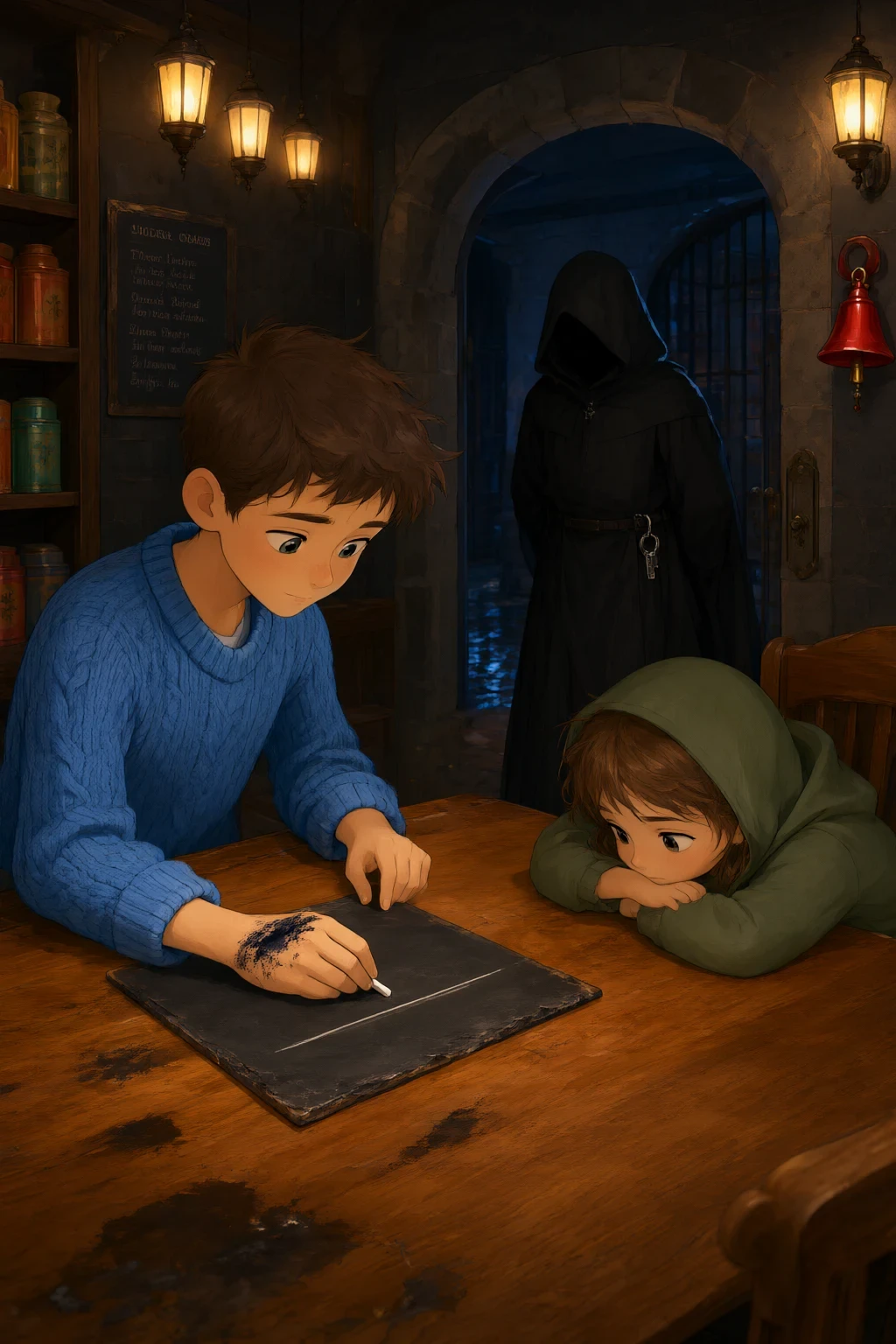
The bell rang on the seventh night with nobody in the roof. Niko was in the Servery with the kettle just off the singing and the red-silk wall bell above his head, and he heard it start, and he went up the stair and out onto the slate to see. The Night Bell sits in an iron cradle up there, above the high-water line, with the lightning vane beside it. The wind was hard and cold off the flat. The whole black Shelf lay out west of him under a moon, white light lying flat on a mirror of water.
The bell was ringing. The cradle was empty. Niko counted eight swings. He looked for somebody on the stair. There was nobody, and the Verandah below was as dark as the inside of a chest, all sixty-one steps of it, and the white railings had gone under again.
“Now then,” said Anja. “You heard it. Come down.” Anja Roe was in the Servery doorway in her stiff black cassock with the hem gone white, and she had the hood still pushed back, and her right hand in the blackened glove. “What does it mean?” said Niko.
“It means the seventh night has turned over. It means the bell has rung for a reader.” She said it the way she said everything that was not an argument, which is to say once, and then not again. “It means somebody is wanted who is not in this building, and cannot be found in it.” “Why can’t it be found in it?” “Because it is not in it,” said Anja. “Now then. Anwen.”
Sister Anwen Tarn came in with her slate under her arm and her short grey cloak streaming water off the hem, and the small steel key ring at her belt went jingling. She had the cold blue-white palm. She always had the cold blue-white palm, and this morning it was whiter. “The Gallery,” she said. “The Gallery is under the water to the second sea chest.”
“It is. That is where she signs.” Anwen put her slate down on the scarred amber table and squared it with both hands. “I walk it, and I ring, and you write what comes up. That is all.” “I write what comes up?” “You write what comes up. Letter by letter. You do not tidy it and you do not guess.”
Ilsa Roke, who was twelve and read the Rules of One out loud twice a day in case they changed, pulled her chair in tight. On the wall above her the slate of the Rules of One hung by two nails, and underneath the last rule somebody had scratched out the whole of the Rule of One with a cold blade, letter by letter, and left the words underneath showing as ghosts in the stone. “Who is missing?” said Niko. “Her name is not written down anywhere,” said Anwen. “That is the trouble. Come.”
Before the lamp was lit they counted the readers, because that is what a seventh night is for besides the bell. Anja counted them twice and Anwen had counted them twice, and Niko made a third count standing in the doorway with the list on the slate.
Twenty-two in the Servery. Nine in the Stacks. Four asleep in the Nests with their boots off, which is against the rules, and four more asleep in the Press, which is worse. Perran Hesk in the Maps Room with one boot re-laced in green twine, and two readers he had never seen before in the Atlas Room, and one small wet shape on the sill of the barred window, sitting, dripping politely into a saucer. “Forty-three,” said Niko. “Forty-two last seventh night,” said Ilsa. “Then the bell is not for one of ours,” said Anja. “Good. Say that to Anwen. She will be pleased for about a second.”
They put a lamp in the Gallery door and Anwen went up alone, because she is the one who walks. Niko and Ilsa stood at the table with the storm lanterns hooked high and the kettle gone cold, and they listened to her go up the far stair, and then they heard the bell. Her first stroke rang out dull and close, the sound a wall makes, not a roof. Anwen counted under her breath where they could not hear it. She was in the corner by the long ledgers.
Niko wrote a stroke on the slate. Ilsa held the lamp over his hand so the point did not slip. “Maker’s marks,” said Ilsa, reading it upside down. “That is the press-mark of the Quire. Nobody sets a bell that near the Quire.” Second stroke. Something nearer, and something with more air in it. “Under the high shelf,” said Ilsa. Third stroke, and Niko’s hand began to shake, because the bell had gone from near to far inside one second, the way a bird does.
“It is in the spillway,” said Niko. “The boards are not good,” said Ilsa. “The boards are not good.” They both looked at the water coming up the gutter of the Spine. It was the wrong colour now, the colour of tea gone cold, and it had a skin on it where things were floating in it. Anja stood behind them with her arms folded in their black sleeves. “Go on,” she said.
Niko wrote the fourth stroke. Then the fifth. Then the sixth, and the sixth was the long one, the one you make at the end of a name that has gone on too long, and by the seventh the slate had most of a word on it, and by the ninth Niko had stopped being able to see straight. The bell rang ten more times, and every time the stroke came, the word came. Then a sound came down the far stair that was not a bell.
Anwen came back with the water to her knees and the lamp still lit, and the slate of the Library, the Night Ledger page, tucked under her arm in two hands like a woman carrying bread. “Out of the Gallery?” said Anja. “All of it?” “All of it. The frame on the high shelf is empty.” “Empty since the spring,” said Ilsa. “Nobody has signed for it.” “Empty since the spring,” said Anwen. She set the ledger page on the amber table. “Now read it out, Niko, and be quick before the water comes to the table.”
Niko looked at what he had written. The letters were his own. He knew his own letters the way you know your own boots. He read it out. “Niko Sarran,” he said. “Of Greyhaven. Seventeen. A borrower of the Servery, entered at the quiet hour, and no term signed, and no book named.” Nobody said anything. The kettle ticked once and stopped. “That is my name,” he said. “That is your name,” said Anja. “I did not write it.”
“You wrote it. On the eleventh of Sleetmonth, at the hour after the bell and before the light. That is the quiet hour, and nobody is meant to be walking in it. You came in out of the mud Shelf with a wet sleeve and you asked Ilsa to hold the lamp while you wrote a word on the back of a slip of paper, and then you put the slip in the Stacks drawer, and you went to bed.” She looked at him. “You did not read it. That is the part you cannot get back.”
“But who decided that?” Niko said. “But who decided I would write my own name down?” “You did,” said Anja. “At two in the morning, with a wet sleeve, for no reason you can get back. Nobody decided it. It was done to you by a room you were in, which is the ordinary way of this building, and the only rare thing about it is that we have never had it happen at the table.” Anwen laid her cold hand flat on the amber wood. She spoke very softly, and she counted before she spoke, which she always did.
“One. Two. Three. It cannot be scraped. That is the rule. A thing taken in is a thing held, and a thing held cannot be crossed out. Not with salt. Not with a blade. Not with fire. It goes to the next volume and it goes on asking after you by name.” “And if I read it?” said Niko.
“You will be in the Library’s book as a reader, for a term, forever, and it will be true, and it will be on the page whether you like it or not.” She stopped. “That is the price of it. It is only a name. It is a small price, and it is the only one on offer, and you may as well have it plain.” “That is not fair,” said Ilsa. “No,” said Anwen. “It is the Library. It is not fair. It is only exact.”
So Niko read it out loud, standing up, with the water coming in under the Servery door and the lamps swinging. He read it twice. The first time his voice went thin at the end. The second time it did not. Anja listened all the way through, and when he had finished she said the thing she says at the end of everything. “Ink dries. Go on.”
Anwen wrote the name into the Night Ledger in her square hand, and dated it, and squared the page with her knuckle. Perran Hesk came in with his spectacles on their green string and his satchel under his arm, and wrote it down a second time in his own book, and said that a thing written down properly is safe, and then he read his own line twice and did not say it again.
The bell stopped somewhere in the small hours. The water went out. The wind dropped, and through the tall window in the Atlas Room the rain stopped sounding, and the floor of the Servery was dry by breakfast. The slate went back on the nail above the Rules of One, and the scratched-out Rule of One stayed scratched out underneath it, and under both of those there was now a name, and it was Niko’s, and he had never once read it before that night.
“Borrower,” said Ilsa, when the others had gone. “You are a borrower now. Properly. You will have to sign for things.” “I signed for a lot of things last week,” said Niko. “Not with a name the Library wrote for you,” said Ilsa. “That one you did not do. Tuesday, you asked me to hold the lamp.”
He went down at noon to look at the tidemark in the Porch, because it is what you do now. The salt line was where Anja said it was: a finger’s width above where it had been the week before, level all the way round, and going quietly up the wall as it went. Niko put his own boot up beside it, and his own boot’s mark was a finger lower, and had been there since he was nine years old.
He took the green book out of his coat and set it on the step beside his boot, and the sun came out and dried the top of it, and the gilt G on the spine went bright and then dim again, and nothing else in the world did that, and the water was already turning out on the flat a mile off, on its way back.