Wim Ostler had been coming to the Halloway Fair since he was six, and in all those years he had never once seen the Great Wheel land on its red wedge, and on the day it did, first turn, no warming up, he came down the row of stalls as fast as he could walk. “Your stall’s crooked,” he told Tilda Grask. “I’m reporting it.”
Tilda was thirteen and ran the token tray with her grandmother, and she had been up since four with three trays, a bag of blue tokens, a bag of white, and a hand-lettered sign. “How crooked?”
“You didn’t even have to try. Red. First turn.” Wim was breathing hard. “There’s four red in twelve on that wheel, isn’t there? So that’s one in three. I spun once and got it, and you still didn’t pay me, so the wheel is a one in three and a lie on top.” “Grandmother,” said Tilda, “the boy says we’re cheating.”
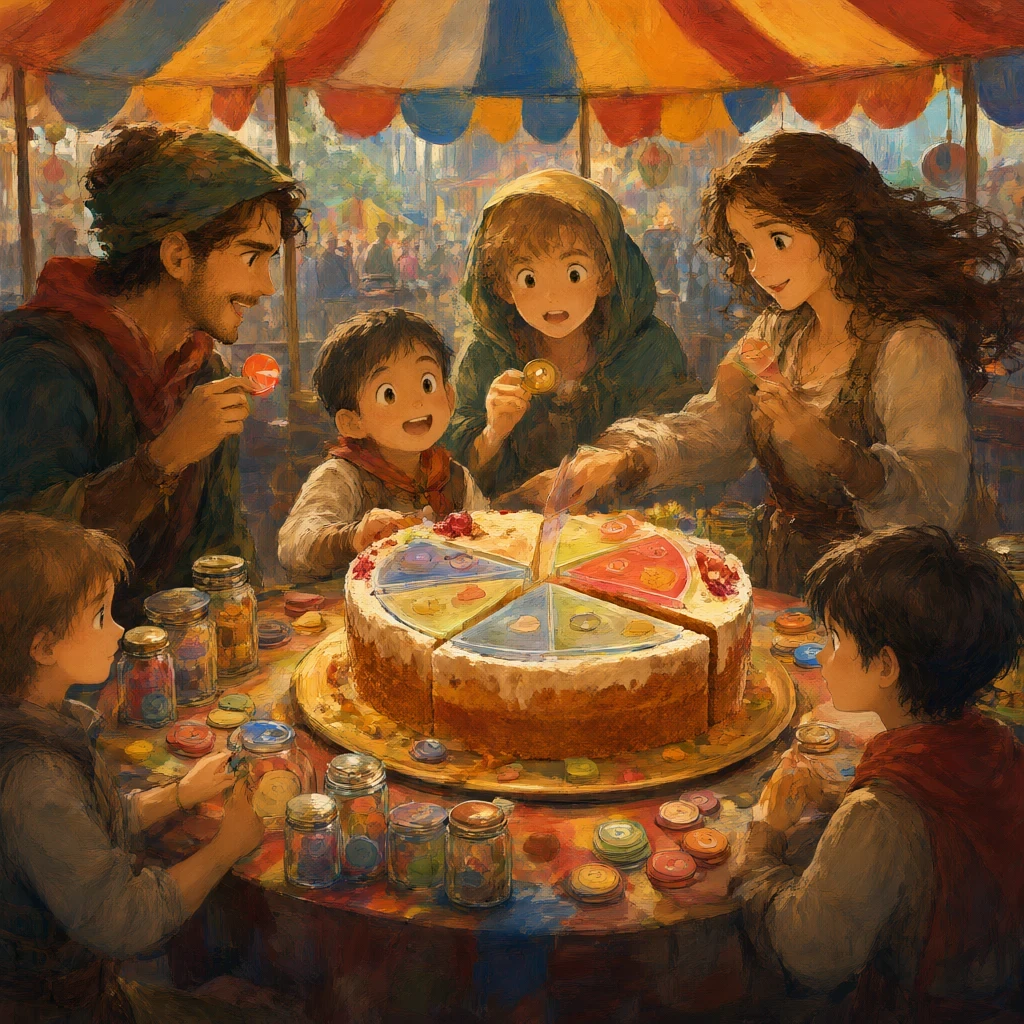
Grandmother Ossa put down the tea caddy and looked at the wheel for a long moment. Then she took a round cake off the stall board, cut it in half, and put one half in front of Wim. She cut that half into two, and then cut one of those quarters in two again, and set the four pieces in a row.
“One half,” she said. “Two quarters. Four eighths. One share of a cake, cut three ways, though you could not fit one on top of another. A share does not get bigger because you cut it into more pieces. And four red in twelve is one in three, the same share as eight in twenty-four. The number on the wheel is not the lie. One spin is not a rate.
To know what the wheel is, turn it a hundred times and count, and that is what we are going to do.” “I am not eating anything. The wheel is crooked.” Wim ate a piece, if only to hear himself say no to the rest of it, and then stood by the tray all morning with his arms folded, watching, which Tilda decided was the same thing with better manners.
The trouble started properly at noon, when the tray filled.
Tilda’s rule was on the board in her grandmother’s letters. The bag held twenty tokens, five of them blue, so any one token drawn was blue one time in four. A round was eight tokens drawn one at a time, each put back before the next, and a round won a prize if three of the eight came up blue. The board said THREE IN EIGHT PAYS A PRIZE.
That had been right for years, when the bag held eight tokens with three blue in it. This year the trader had brought a new bag. But at noon a man named Brindle came to the front of the stall and claimed that eight blue tokens earned eight prizes, because eight blue tokens looked like the whole tray.
“Those are not eight prizes,” said Tilda. “A round pays one prize, and you have not played a round from my bag. Hold on. Nobody draws until I count this.” She looked into the bag. She spread the bag out and counted the twenty tokens twice, and started again, because the second time she got a different answer. “Five blue out of twenty,” she said. “Grandmother, the bag is not the bag I wrote the sign for.”
Grandmother looked at the sign a long moment. Five blue in twenty is one token in four. The old rule was written for a bag of eight with three blue, more than one in three, so a round of eight now turns up three blue less often than the sign promises. The sign was promising a bag that no longer existed.
“Twenty tokens, five blue,” Grandmother said. “So we say that, out loud, to the crowd, before the next man starts the same argument from the other end.” “It is not cheating,” Tilda said. “The bag has five blue in twenty, the sign was written for three in eight, and the trader changed the bag and nobody changed the sign.” “So how do I know what it is now?”
“You read the number on the sign, and you count the tokens in the tray, and if the two don’t go together, you ask before you eat.” She pushed the tray forward. “One token. Pick one. Do not look.”
Wim played a round of eight tokens and won nothing at all, and enjoyed it enormously. That was the day he learned the other half of it, and Tilda let him learn it in public. She drew twenty slots on the board, filled in five blue, and set it where the crowd could see.
“Five of twenty,” she said, “so any one token is blue one time in four. Over the whole morning everyone in this row has drawn at least two hundred tokens, and the blue ones came up about one time in four as well. The bag and the long run agree, and the fair can check the arithmetic or check me.”
“That is two hundred and nine draws,” Wim said. “I only did eight.” “So your eight is a scrap of a long run, and a scrap is not a rate.” She wiped the board. “We will run the tray for an hour with the count written up where everyone can watch.”
It took an hour and twenty minutes. Wim counted every token. The board read at the end: two hundred draws, fifty blue, one hundred and fifty white. “Fifty out of two hundred,” Tilda said. “One in four. Same as five in twenty, same as twenty-five in a hundred. Wim drew eight in a row with nothing, because eight draws is not long enough to say anything.”
“Eight draws could have gone any way.” “It could. Two hundred could still go strange if somebody hid something under the cloth, but nobody did, and we wrote every one down. If you want to catch me, you do it with two hundred, not with the one that annoyed you.”
Wim went to the Great Wheel after that, because he still had not finished with it. He worked it out on the back of a raffle ticket and came and found Tilda at the tray.
“Twelve wedges,” he said. “Four red. So a turn has one chance in three of being red. I got one on my first turn and you paid out nothing, so I am owed a prize for having used up my one in three.”
“Then we run it.” Tilda got the wheelkeeper’s boy to turn the handle, Wim tallied it on the raffle ticket, and they ran thirty-six turns. Eleven were red and twenty-five blank. Tilda took the ticket and wrote out the thing that had actually happened to him, in a line he could not argue with.
“You had one chance in three on any one turn,” she said. “In twelve turns you should expect about four red, and you would not expect one. You spun once and got a red, and you have kept that one turn for a year. Thirty-six turns gave eleven red, close to the one in three the wheel promises. One red on one turn is a very good story. It is a useless rate.”
The wheel was crooked. Grandmother proved it with a spanner and a set of weights. She had noticed on the third day that the red wedge kept coming up in the same corner, and on the seventh she took the back off and showed Wim a lump of lead the size of a fist, bolted under the red slot. “Now,” she said. “Say what you see.” “It is weighted.”
“Now say what it does.” Grandmother spun the wheel and they counted thirty more turns in public. Fourteen red out of thirty. One in three should have given about ten. “Heavier under the red, so the ball drops through it more often than it should,” Wim said. “It is not luck on your side. It is the wheel not giving every wedge the same chance.”
“The wedges are the same size,” Tilda said. “Measure every one with a ruler and you find them identical, and the wheel would still not be fair. Fair is about every turn having the same chance, and the only way anybody can tell is to count.” Wim looked at the lead for a long time.
“I reported the tray first,” he said. “And it was not crooked. You told me to ask and I did not ask, I just watched, and I still reported it.” “You reported a thing you had not counted,” Grandmother said. “That is not villainy. That is what happens to a person who likes being right.”
The lead came out. The wheelkeeper repainted the four red wedges four different shades and hung a slate beside the frame with the count from that day on it: thirty turns, ten red, when the wheel was straight. On the last night the three of them sat on the tailboard with the tally board between them and the last of the tea. “Two hundred and nine this morning,” Wim said. “Fifty-one blue.”
“Two hundred and sixteen now,” Tilda said. “You were asleep for the last seven and I did them myself, and they are all in the book where you can check me tomorrow. Fifty-four blue out of two hundred and sixteen is a quarter exactly.” Wim turned the tally board over. Five in twenty, and fifty-four in two hundred and sixteen. “Same,” he said.
“It looks different written down, though. Five in twenty looks like a small fact. Fifty-four in two hundred and sixteen looks like a fact about the world.” “Neither one is a fact about the world by itself,” Tilda said. “They are about four tokens in a hundred, if the bag has not been tampered with. The only reason one is worth believing is that somebody counted the other one too, in front of witnesses.”
The bells went at midnight and the fair began to come down, and the Great Wheel stood dark with twelve repainted wedges and a slate of numbers hanging on the frame, and in the sack on the counter sat tokens that had passed through eight hundred hands, one in four of them blue.