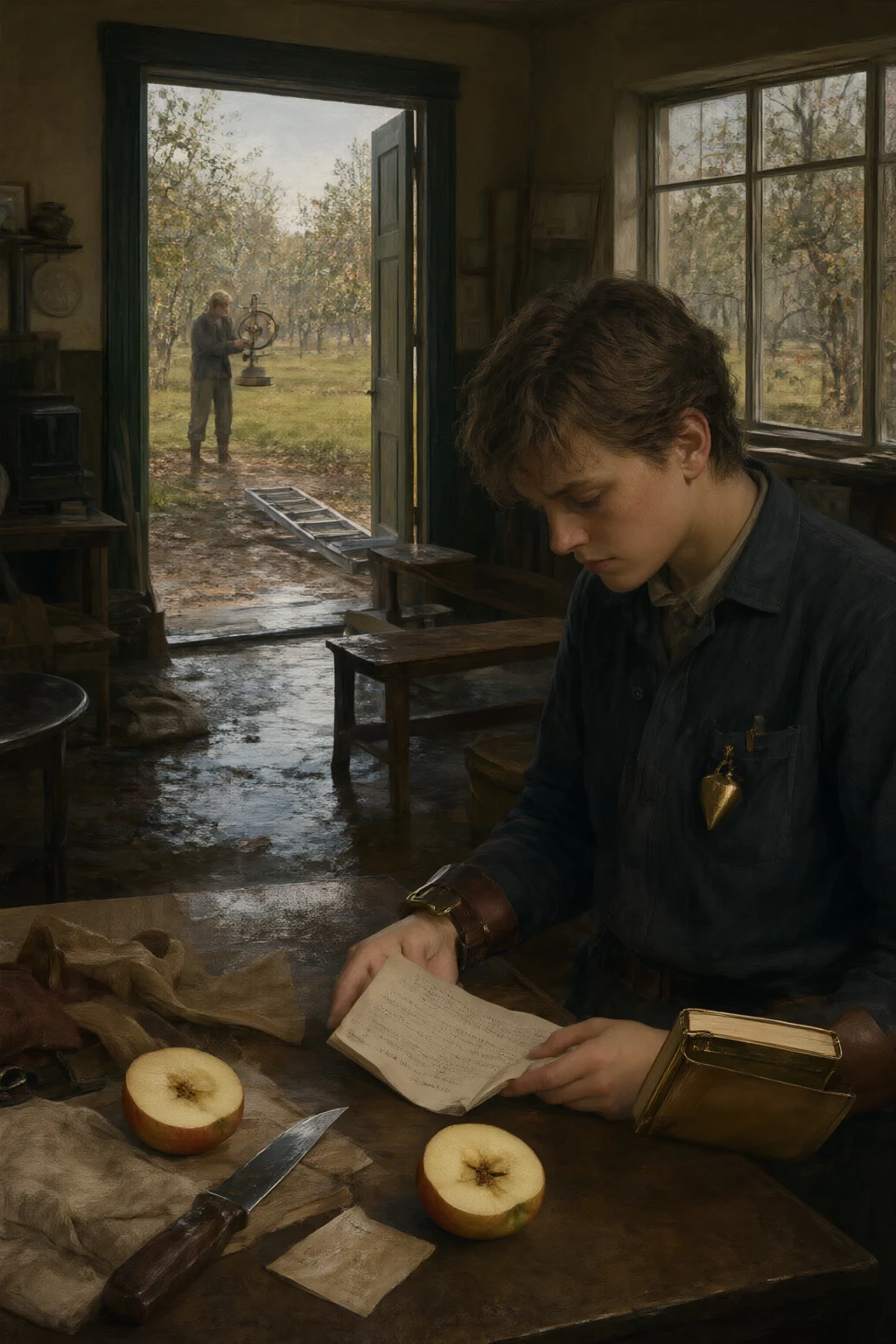
On the eleventh of February, in flat grey light with no shadows in it whatsoever, Marren Ashlock and Ede Salter stood in the same field at four hundred paces from the drainage ditch and each of them put a stake in the same ground. They had done this four times before that year, always in the same order, always with the same result, and the fifth time they did it they had brought a theodolite up from the town by two men who would not speak to each other and would not speak to anybody else either, and the two men set it up in a field drain and went and sat on the wall by the schoolroom and were there when it was finished. The instrument was excellent. The instrument was the best the county had. It was a level of precision that would have been absurd to point at nine old apple trees in a wet orchard at the end of a wet February, and Marren Ashlock sighted along it, and read, and wrote the figure in the notebook lashed to his left wrist, and closed the brass-buckled strap over it. Ede Salter wrote hers in a small brass-bound book in an oilskin sleeve at her belt, and her right index finger is blue-white from forty years of the Fenrow wet and does not bend, and she writes with the other three and has never once mentioned it.
“There,” Marren Ashlock said. “Nine rows. And the ninth is there.” “It is,” Ede Salter said. “Give me the date.” “What?” “Give me the date. I will not give you a figure until I have the date, because a figure without a date is an opinion and I have four hundred acres of your opinions in a box at home and I do not want another one.” “It is the eleventh of February,” Marren Ashlock said, “of this year.” Ede Salter wrote it down. Then she sighted her own chain back along the ditch by the method she has used since 1861, which is to lay the tape from the schoolroom wall corner and not from any stone, and read, and wrote, and the two figures stood on the same flat wet field eleven yards apart and differed by two hundred feet and one inch.
It had differed by two hundred feet for a hundred years. The Ward Survey and the Fenrow Survey were begun at opposite ends of the same hundred and eleven acres in 1791 and corrected against each other every year since, and neither family has ever once admitted that either of them was wrong, and neither of them is wrong, and this is not a paradox, it is a property of the ground, and it can be stated in one sentence by anybody who has bothered to think about it, and it has been stated, in print, four times in a hundred years, and every time it was stated by a man who was not a surveyor and was not believed. The two of them began within a fortnight of each other in the spring of 1791, and neither would begin at the other’s end. Ashlock’s great-grandfather took the top of the block, because the top is dry and can be walked after rain. Bray’s great-grandfather took the bottom, because the bottom is where his father’s sheep were. They met in the middle in the summer and compared nothing. It was not a courtesy. The district’s only standing instruction on the subject is one sentence, drawn up that August: each survey to be kept entire, and neither to be corrected by the other, save by the correction of errors.
That clause is the whole of the century, and the century has never once complied with it. What happens instead is that both men walk both ends, every year, alone, and each comes back with a figure for the other’s end, and the figure is written into the other family’s book with a note, and the note is never a correction, it is a remark. There are eleven hundred and forty of these remarks in the district at present. Eleven hundred and forty dated, careful, correct remarks, no two of which agree with any other, and not one of which has ever been withdrawn. The clause says neither is to be corrected by the other. It does not say the other may not be corrected by the ground, and the ground has corrected both families every year for a hundred years, in the same direction, by different amounts, and neither family has ever admitted to the other that the ground was in it.
The sentence is that a survey is not a position. A survey is a position expressed as a distance and a bearing from something. The Ward Survey expresses every tree in the orchard as a distance and a bearing from the Ward row-head, which is a dressed stone in the ditch at the top of the block. The Fenrow Survey expresses every tree as a distance and a bearing from the Fenrow row-head, which is the north-east corner of the schoolroom. Both row-heads are good. Both sets of figures are good. They are not two descriptions of one thing. They are two descriptions from two ends, each of which is honest, and the distance between the two ends is not the same distance in either description, because the ground between the schoolroom and the ditch is not one hundred and forty yards. It is a flagged floor over a flooded quarter, and a corner of a building, and a great deal of brick, and water moving the way water moved when the city above it was not a rumour, and it does not measure the same twice. So the ninth row of the Fenrows stands where Marren Ashlock’s theodolite put it, two hundred feet and one inch from where Ede Salter’s tape put it, and both of them are right, and the difference is not a mistake in either book. The difference is the ground.
“What you are describing,” Ede Salter said, that February, “is the tree.” “The tree is the thing on the ground.” “The tree is the thing in the air on the end of a thing that goes down into the ground, and I have been in that ninth row with a spade and I have found the root of the third of that row at eleven feet of offset and four feet of depth under the third of yours, which is a different field, Marren, that is a different field with a different crop in it, and the crop in it is not yours.” “Show me.” “Not this year,” Ede Salter said. “This year you are going to be examined, and I am going to be examined, and neither of us is going to be believed, and in the meantime the main drain goes in by the top and takes the Ward orchard’s best eleven rows out of production for two seasons, which is what the county wants, and which is what I have always said would happen.”
The drain was the whole of the reason and the reason had nothing to do with magic. The district had wanted a main drain since 1868. In 1871 the county had offered to lay it, free, out of a fund for which the district had to produce an agreed line. In 1872 the agreement failed, over one row. In 1876 it failed again. In 1881 and 1886 and 1889 and 1890 the two surveys exchanged letters, and the letters always ended in the same three sentences, and the three sentences were always a statement that the other party’s figures were not to be relied upon. In the autumn of 1890 the offer was renewed for the last time, with the condition that the line be agreed by the coming spring. In the winter of the same year, Mirren Ostley began buying options on the disputed strip.
She did it openly, which was the worst of it. She did it in the yard of the packing shed on Thursdays, with her docket-book in her left hand and her trade coat on, the pocket mended inside-out in a different blue, and she offered the Ward holders and the Fenrow holders each the same figure, and the figure was good, and no holder ever said no, because the strip bears nine trees and has borne nine trees for a hundred years and neither family has ever cropped it or grazed it or claimed a crop off it. “You and me,” she said to Sennet Bray, over the scales, in the second week of January. “You and me, we both know what this tree is worth, and what it is worth is nothing, and what I am offering you is a great deal of nothing, and you should take it before the county sends a man with a spade and finds out what it is actually worth.” Sennet Bray, who has a mitten with no thumb on her left hand and a mouthful of iron keys on a bootlace at her throat, looked at the docket-book and did not touch it.
“You will find it wet under the ninth row,” she said. “It is always wet under the ninth row. And that is not a thing I am telling you about the ground, madam, that is a thing I am telling you about the weather, and the weather in this district has never once been wrong, and neither have I, and I will not sign anything, and you may say that I said I would not sign anything, and I will say it again next Thursday and it will be true both times.”
Amos Trewin came out from the county town on the fourth of February and sat in the front of the schoolroom with his hat on the desk, and he was sixty-nine and had chaired the Standing of the Rootwork Surveyors for twenty-two years, and the reason the district had a Standing at all was that the district had two surveys and one ditch and could not agree where the ditch was, and the reason Amos Trewin chaired it was that the county wanted a drain and the two families wanted a ditch and everybody wanted the other two to go first. He called the Sitting for the eighteenth. It sat from nine in the morning until the light went off the top windows, which was three, because it is that kind of room and that kind of February. The stove was not lit. The benches were the school benches, and the children had been sent out to the yard with a half-day, and forty people sat on them, and the ones at the back sat on their hands. Amos Trewin laid down the order of business, which was four sheets, and read it out. “First, the Ward Survey will be examined on his own notebook. Second, the Fenrow Survey will be examined on her own notebook. Third, any person may be called who has a thing to say about the ground and not about the other family. Fourth,” he said, looking up, “nobody is to be asked to produce anything they have not already offered, and nobody is to be asked to agree to anything.”
Marren Ashlock took his chair sideways at the table with his back to the wall, which is what a man does who expects to be examined. He had his notebook open on the desk before he was asked the first question, and he had the years in his head in order, and he answered everything from the book and not once from memory, and Amos Trewin, who had done this for twenty-two years, read the figures out of the book afterwards and found that every one of them was right, and it took forty minutes, and it was the only forty minutes of the Sitting at which a sound of any kind was made by anybody at the back. “Your own figure for the ninth row of the Fenrows,” said Amos Trewin, “is how many feet from the Ward row-head.” “Two hundred and eleven and four, by the chain, in 1876. Two hundred and eleven and one and a half by the level this year. The difference is a settling and I have allowed for the settling and I stand by the allowance.” “And Mrs Salter’s figure for the same row, measured from the schoolroom.” “Is hers,” said Marren Ashlock. “Will you say that again, with a reason.”
“I will say that the figure is hers, and I will say that it is not my figure, and I will say that a figure that is not my figure is one that I am not here to defend, and I will say that I have asked her, twice, in writing, for the row-head she uses, and she has given it to me both times, and it is the north-east corner of the schoolroom, and that corner is a soft corner, Mr Trewin, that corner is a lime mortar corner in a building that has been leeping since 1848, and I have said so in writing.” “Have you.” “Three times. Once in 1886 and twice in 1889. I have the letters in the chest and I can read you the dates.” “I believe you can,” said Amos Trewin. Ede Salter, at the back, on a bench, with her hands in her lap, said, without raising her voice: “I will take him at his word on the letters, because they are the letters I wrote, and I wrote them, and I am not going to sit here and deny writing them, and I will read the dates after him if the Standing wants them read.” Nobody had asked her to speak. Marren Ashlock turned his head. “You said the corner is soft.” “I said nothing about the corner. He said the corner is soft. I have not been in that corner since 1871 and I have no opinion about it and I will not take an opinion about it into this room, because if I take his opinion into this room then this room is a room where two people are discussing one corner instead of eleven hundred acres.”
She was examined from half past eleven, and she brought the oilskin sleeve onto the desk and set the brass book on it, and she gave the date before she gave every figure in the book, which was not a trick and was the thing that made her the only person in the district anybody had ever been afraid of. “By the tape, from the schoolroom north-east corner, the ninth row of the Fenrows is at four hundred and eleven paces and a half, taken in eleven lengths, and the eleventh length was taken twice because the ground under the fourth length is over brick and the tape has a great opinion of brick.” “Four hundred and eleven paces and a half,” said Amos Trewin, “in what season.” “September 1889, and again in the September, and again in the March, and the March is the one in the book because the March is the one where the man holding the far end was his own man and my man was his own man and the two of them did not speak and the two of them are the reason I trust it, because a man holding a tape who is talking to the man holding the other end will shorten it, and they had nothing to say to each other.” “And the difference between your figure and Mr Ashlock’s is a hundred and ninety-nine feet and something.”
“It is a hundred and ninety-nine feet, two inches and a quarter, at the ninth tree, and it is not a constant, and that is what I want the Standing to take first, because it is the only part of this that has never been argued about. In 1876 the difference at the ninth tree was a hundred and forty-one feet. In 1884 it was a hundred and seventy. In 1889 it was a hundred and ninety-nine. It is growing.” “Growing at what rate.” “Eleven feet a year since 1884, and it is not steady, and it is not parallel to anything, and I have not published that because I could not make it mean anything, and I am not a person who publishes a thing that does not mean anything.” Marren Ashlock put his pen down. “That is not a survey,” he said. “That is an observation about a survey.”
“It is a survey,” Ede Salter said. “It is the only one of the two that has predicted itself twice. Yours has a fixed row-head and a moving ground and it tells you where the stems are this year. Mine has a fixed ground and a moving stem, and it has told me for seven years that by this time the ninth row would be where I say it is, and it has been right every year, and if the Standing would like me to produce the prediction I will produce it and it is in a book in a box at my house and it is dated the eleventh of August 1884 and it gives a hundred and ninety-two feet, and I have been understating my own case all morning because I did not think anybody would sit still long enough.” Nobody said anything for some seconds. A child’s coat was wet on the end bench. “Ninety-two,” said Marren Ashlock. “Ninety-two feet two inches, and I would not put a farthing on the inches, and I have not put a farthing on the inches for seven years, and I would like it minuted that I offered the inches and was refused them.”
It was Mirren Ostley who was called at two, because she had a thing to say about the ground and not about the other family, and she came up with the docket-book in her left hand and did not put it on the table, and stood. Amos Trewin asked her what she wanted the strip for. “You and me,” she said, “we both know what this tree is worth, and it is worth more to the person who has never seen it, and I have never seen it, Mr Trewin, I have been in that field twice and I did not go down, and I have sold fruit out of it for two seasons and I cannot tell you where it is, and I do not need to tell you where it is, because the buyer I have has the fruit and the fruit is the address, and the address is the only thing in this district that is worth money that is not money.” “Is it a fruit, then. Are you saying the strip is a fruit.”
“I am saying the strip is a place,” Mirren Ostley said, “and a place is worth what a person will pay to be told about it, and I have been trying for two seasons to sell it, and I have not been able to sell it, because you cannot sell a place in this district without a docket number, and a docket number means the register, and the register will not give me one, and the register is not permitted to give me one, because the register has no column for what is in a place, and if the register had a column for what is in a place I would have had a number in 1889 and we would not be sitting in a schoolroom in February.” Nobody had said it in that form before. At the back of the room somebody said, quietly, that it was the only true thing anybody had said all day. “Madam,” said Amos Trewin, “have you any paper to do with that claim.” “I have four thousand one hundred and eighteen dockets,” Mirren Ostley said, “in my left hand, and I will not put them down, and you are welcome to look at every one of them, and they will tell you what my grafts are made from, and they will tell you nothing whatever about what my grafts are made out of, and that is not a flaw in my paper, Mr Trewin, that is the entire design of yours.”
Dellory Fenn was not called, because nobody thought to call him. Marren Ashlock thought to call him at four o’clock, in the yard, with the light going off the top windows, and found him instead standing by the gate to the Cold Graft with his rule shut in his hand, looking at a tree in leaf that bore nothing, which is what that tree has done since before anybody in this district was born. “Forty years,” Dellory Fenn said, before he was asked. “You want to know about the witness.” “I want to know about the witness.” “There is no witness.” “There is a practice,” Marren Ashlock said. “It is in the 1794 Standing minute, and it is in the 1802 minute, and it is written twice in the district handbook, and it is called a witness graft, and it has not been used since 1859, and the last man in this district who used one is standing in front of me holding a folding rule he has never opened, and I have had four inches of ink off my own hands in nine days, and I would like to use the practice.”
Dellory Fenn looked at him for a long moment. He is sixty-three and he has never submitted a finding in his life, on the grounds that the finding might be wrong and the register cannot be wrong, and there is a tin of drawing pins in his coat and the spectacles on his face have one lens wired to his ear with copper thread. “On the record?” he said. “Of course not on the record,” said Marren Ashlock. “Not yet. On the file. In your coat. In a haybarn. I do not care. Tell me the shape of it.” So Dellory Fenn told him the shape of it, on the gate of the Cold Graft, in the dark, in about four hundred words, and it was this.
You cannot measure a root. A chain measures a stem, and a level measures a stem, and every instrument in the county measures a stem, and a stem is the least interesting fact about a tree in this district. So the district grew another instrument. You take a scion of a tree whose site is known beyond argument — a rootstock you have dug up, a block you have already agreed, a row both families have signed — and you work it onto a root that is in dispute. You wax it. You enter it in the register, in the ordinary columns, in the ordinary words. And then you wait, and you do not move it, and you do not ask anybody to look at it, and in the third year or the fifth it comes into bearing, and the fruit is the finding, and every person in the district can hold it and know where it grew, and there is no column in this district for what the fruit says, and the man who made the witness knew that when he started, and made it anyway, because the finding does not have to be entered to be made, and a man who has found out where a place is has found it, and the register is not the world. “How long does the fruit take?”
“A scion of a young stock, on a root that is already running, four years. I did it in four.” “And the stock?” “The stock drifts. That is the whole of the cost and it was the whole of the cost in 1794 as well. Every witness ever set in this district cost somebody a tree. The instrument is a tree that stops describing itself so that it can describe somewhere else, and you cannot get that out of a tree by asking.” “Whose stock.” “The nine rows of the Fenrows are already a root and the row leans, and if you want a witness that will answer in four years you use a Fenrow scion on a disputed root, and the Fenrow row you take it from will be a different tree in five years’ time from the one it is now, and it will go on being a different one until somebody puts a scion back onto it from its own variety, which nobody has done since 1861 because it does not pay.”
The Standing rose at three and sat again at four, and the county’s line was withdrawn, and the drain was deferred again, and there was one thing left on the paper and it was a paragraph that Amos Trewin had written himself in 1868 and had never once had occasion to read out. “The witness is not a survey,” he said. “It is a graft. It takes four years, it costs a tree, it produces a finding that nobody in the district is permitted to write down in the district’s own book, and if the two families do it together it is not one man’s fruit but a row of them, and the row will be a witness to a strip nine trees long, and a strip nine trees long is not a line, it is an acre and a half, and an acre and a half of the hundred and eleven is not a boundary settlement, it is a settlement of the difference, and the difference is a hundred and ninety-nine feet and two inches and a quarter at the ninth tree, growing at eleven feet a year.” Nobody spoke.
“I am obliged to say,” he said, “that I have been chairing this Standing for twenty-two years and this is the first occasion on which anybody has proposed a method that measures the ground instead of the trees, and that the method was proposed by a man who was going to lose by it.” Then Marren Ashlock stood up, which nobody in that room had expected, because he had said nine words since noon and had spent the whole afternoon not saying the tenth. “I have something to withdraw.” “Name it.” “The third letter of 1889. I wrote that the north-east corner of the schoolroom is a soft corner. I withdraw the assertion from the district’s records. I have not withdrawn it from my opinion. I hold it more strongly than I did in 1889, and I have held it for eleven years, and I have used it twice, and both times I used it as a reason not to dig.” Amos Trewin wrote it down. Then he said, “Do you withdraw it from your opinion, Mr Ashlock, or only from the record.” “Both,” said Marren Ashlock. “A figure of mine has never been wrong. What has been wrong for a hundred years is a belief I have never examined, which is that a figure is the end of the enquiry.”
At the back of the schoolroom a boy of fourteen with a pencil and a fair book wrote the time on the top of the page, and a man at the end of the front bench, who was sixty-three and had a folding rule he never opened, said the two words out loud before anybody else thought to. “Noted, corrected,” said Dellory Fenn. Marren Ashlock did not turn round. “It is the phrase,” said Dellory Fenn, “and it is not the phrase for you, and it never was. It is the phrase for me. I have never had one out in this district and I have been sixty-three years in it and I know what it sounds like, and you have just said it with somebody else’s voice, and if you say it in that voice again this district will believe you were admitting a mistake in a figure.” “I was.” “You were not,” said Dellory Fenn. “You were admitting a mistake in a hundred years. Hold the two of them apart. It is the only piece of craft I have left and I am giving it to you for nothing, because I would like to see what you do with it.”
Nobody had ever heard the two of them speak this plainly. At the end of the front bench, Sennet Bray put her hand up to her throat and moved the bootlace and the iron on it made a small sound, and Hollis Bray, who cannot be made to stop for a question and who had been writing the time on the top of the page, said that the time was twenty minutes past four, and that the room was going cold, and that his mother’s bootlace had a key on it that nobody had ever asked for.
The scion was cut on the ninth of March, which is the wrong month, and everybody knew it was the wrong month, and Sennet Bray cut it anyway. She is fifty-two and she is foreman of the Fenrow block and she is the widow of Millward Bray, who made the maps, and who taught his boy that a tree answers to whoever holds the saw, which is true, and which she has half known for twenty years to be a lie. The saw has a yellow handle and it lives in a leather belt-loop and Hollis Bray is fourteen and has held it for his mother since he could stand at a bench. She took it out of the loop and gave it to him, and then took it back, and did not explain. “You will find that tree wet at the graft,” she said. “It is always wet at the graft after rain, and it is wetter today than it was on Monday, and I have not walked up there since Tuesday and I do not need to, because I know what a tree does in a third week of March.”
They went up at four in the afternoon in flat light. The ladder went down flat in the wet grass on the far side of the ditch and boots went over it and stood on the other side, and Hollis went up four rungs and narrated the whole of it at a speed that Sennet did not interrupt, and got on with it. The knife was Dellory Fenn’s, and he had brought it, and one edge of the blade is deliberately blunted, and he does not explain it, and nobody in the field asks him about it, and it is the only object in the Rootwork that has ever been looked at for a long time by five people and then not mentioned. Hollis held the stock and his mother made the cut, and the cut took four goes because the blade is blunted on the edge that has to be clean, and the fourth go came away in one piece, and it was a piece about the length of a finger. “That is a long scion,” Dellory Fenn said. “It is a long scion because I know how to cut one,” Sennet Bray said, “and because I have been waiting twenty years to be asked for it and I am not going to be asked twice.”
Then they waxed it, and banded it, and the joint was a piece of waxed cloth the colour of a plaster and it was done properly and by a person who has never had it described to her as easy, and they put the scion on the disputed root on the Ward side, at the ninth tree, at the height of a person’s knee, because a graft low is a graft that the drainage ditch cannot reach, which was the fourth thing Amos Trewin did not think of and Sennet Bray thought of in 1861 and had never been thanked for. They entered it that evening. Number 4,331, in the hand of the keeper, in the seven columns, in the ordinary words: the day, the tree, the scion and whence, the stock and whence, the root as known, the union, the hand. The root as known was written as a hundred and ninety-nine feet, two inches and a quarter, at the ninth tree, from the schoolroom, as stated by the Fenrow Survey, and the Ward Survey was named in the entry as concurring in the union and not in the root, and this was done at four in the morning by a woman who cannot sit in a room with a document she has not read and who read it four times. “There is no column for what the fruit will say,” she said. “I want that minuted and I want it minuted in the form and not in the minute, because the form is the thing that will be read in 1990.” “There is no column for what the fruit will say,” said Amos Trewin, writing.
The Ward Survey’s hundredth year was not finished in 1892. It was finished in the summer of 1893, in eleven weeks, by two men and a boy with a tape, and it was finished to a standard that the county called exemplary, and Marren Ashlock was forty-two years old and was not the man who finished it, and there is a page in the Ward books that gives the date of the last leg and the names of the three, and it gives no reason, and it has never given a reason, and it is the only page in those books that is not a page of figures. What is still argued about, at the packing shed on a Thursday, forty years on, is not the two hundred feet. Nobody argues about the two hundred feet any more. The witness is three years old and has borne in its second season and the row of them, nine fruits, cut in the spring by six different hands, has told two surveyors, and the parish clerk, and a fruit-buyer from the county town who was in the district on unrelated business and had a piece of it in her mouth inside ten minutes, that the ninth row of the Fenrows stands at a hundred and ninety-nine feet, two inches and a quarter, from the schoolroom corner, and at two hundred and eleven feet and one and a half from the Ward stone, and that the difference between those two figures is the ground, and that the difference is not an error and never was and cannot be corrected by any instrument now in the county.
What is argued about is the donor. Because the ninth row of the Fenrows is not the row it was, and everybody in the district knows it, and everybody has been eating off it since, and the fruit is not wrong, and the fruit is excellent, and the fruit describes a field in the Ward block about two hundred feet away that none of them has ever walked in, and the argument is not about accuracy. The argument is that the district now has three descriptions of its own ground, and that two of them are correct, and that the third one is also correct, and that there is no longer any procedure in the district for producing a fourth, and that the Standing, which has met every quarter since 1791 without once failing to sit, has not agreed on what the witness is for, and that its purpose was to settle a boundary and it has instead established, permanently, in the district’s own bound hand, in the district’s own register, that the ground cannot be described once. On the question of the two hundred feet the district is finished. On the question of the instrument the district is not finished, and shows no sign of finishing, and both the Ward and the Fenrow families now say openly, and say it in the yard with the scales still going, that they would rather have the disagreement.