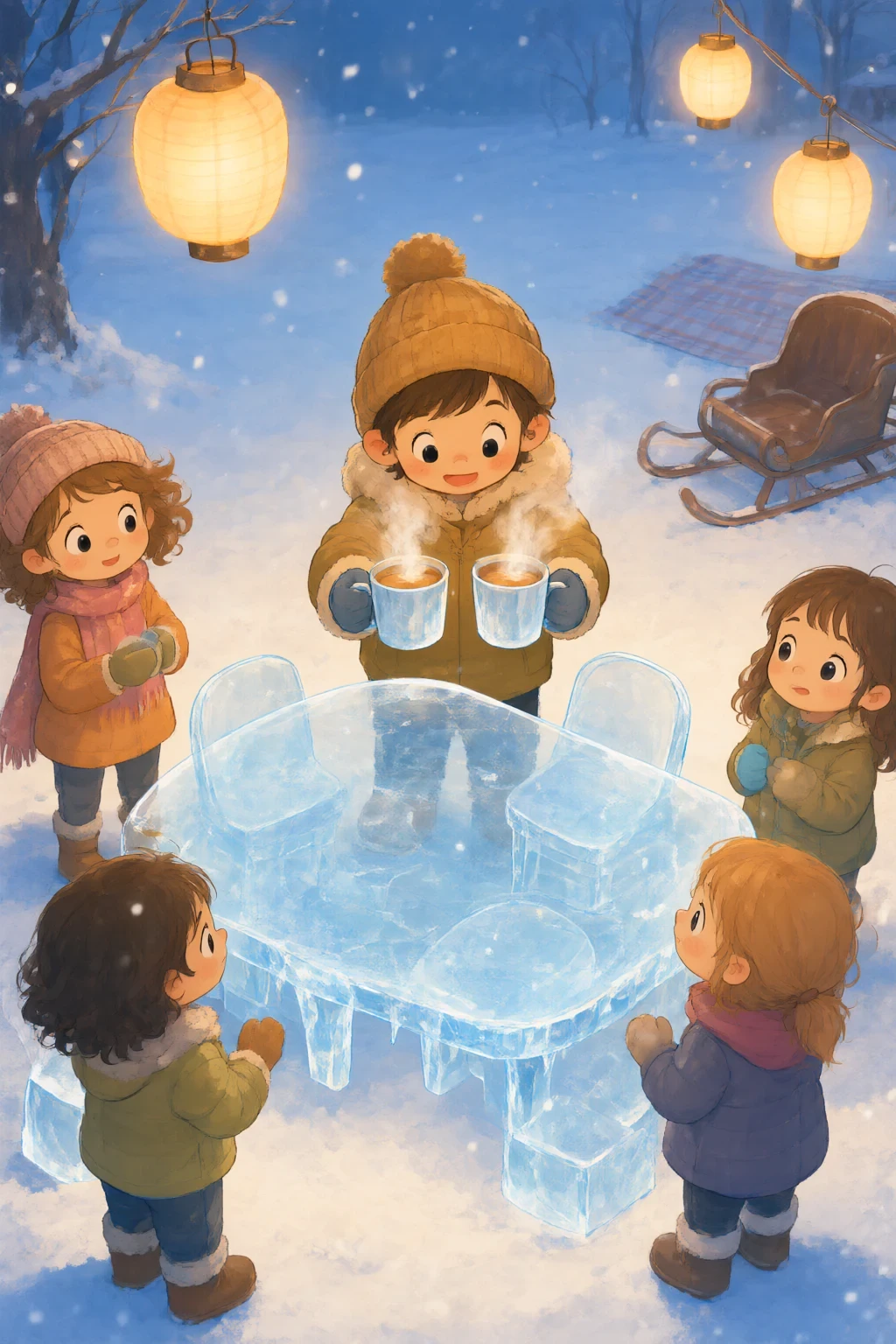
The ice-sculpture picnic began with a white fox taller than the library. Children ran around it, sliding on the frozen grass and stamping snow from their boots. In the center of the park, a long table had been set beside a carved moon. Eight wooden chairs stood around it, but only seven children were eating.
Ren counted twice. His friend Tova was missing. Tova’s family always arrived late. Today she had promised to meet him at the table, so Ren pulled the last chair a little away from the others and laid his red scarf across its back. He put his lunch on the seat beside it and guarded the space with one foot.
Soon, three newcomers came through the park gate. A girl in a green coat, her small brother, and their grandmother stood near the table. Snow collected on their hats. They looked at the chairs, then at one another. “Can we sit?” the girl asked. Ren’s foot moved in front of the last chair. “I’m saving it for Tova.”
The boy hugged his grandmother’s sleeve. The girl’s cheeks turned pink. Ren knew the words were unfair, but he could not think of another answer. Tova might come at any moment. If he gave away the seat, his friend would have nowhere to sit.
Ren’s mother was arranging cups on another table. She saw the children and walked over. “There is room in the covered pavilion,” she said to the newcomers. “We can bring another bench.” The grandmother shook her head. “The pavilion is full, and the wind is strong. The ice sculptures make a little shelter.”
Ren looked toward the moon. Its base was broad and flat, surrounded by low blocks of ice shaped like clouds. A stack of empty crates stood behind the sculpture, ready to hold coats and picnic cups. He could move them without touching the sculpture. But Tova’s chair was the only one with a clear place.
A messenger appeared through the falling snow. He wore a red hat and waved a mitten. “Tova’s sled went into a drift,” he called. “She is coming, but her grandfather is helping free it. She asked me to tell Ren she will be late.”
Ren looked at the newcomers. The little boy’s mitten had come loose, and the girl was already taking off her boots to warm her feet. The late message did not make the need disappear.
Ren pushed the chair toward the girl. “You can sit here,” he said. “I’ll find another place for Tova.” The girl hesitated. “But your friend?” “Tova has a grandfather,” Ren said, though he had not thought of that before. “And we can make more places.”
Together, they carried the empty crates to the moon’s base. Ren stacked two as a low table, while the grandmother asked a carver to check which ice blocks were firm. The carver showed them a flat white slab that could become a seat. It was cold and uneven, but a folded blanket made it kinder.
The small boy found a serving tray. Ren turned it upside down and rested it on two blocks, creating another table for his grandmother. The girl shared a thermos of cinnamon water. Everyone gave up a little space and warmth to make something that had not existed before.
Before long, there were places for the newcomers, Ren, and two more children who had been standing near the sculpture. Tova’s chair remained empty, marked by the red scarf. Ren placed the chair beside the new crate table, where Tova could sit when she arrived and still be part of the group.
Tova arrived with snow stuck to her eyelashes and a dent in her mitten. She saw the crowded table and stopped. “I saved you a seat,” Ren said.
Tova looked at the crate, the blanket, and the tray. Then she helped her grandfather set down the bent sled runner. The grandmother from the new family moved one cup closer so Tova could reach it.
The carver came with a warning: the moon sculpture was beginning to drip in the warming afternoon. The adults carried the cups and crates to the pavilion. Children helped guide each other across the slick path, leaving the red scarf on the chair until the very end. The little boy from the green coat carried the tray of cups.
The girl made a new name card for the crate table, writing carefully so the wind could not tear it loose. Ren’s mother brought a second blanket from the pavilion and folded it beneath the carver’s firmest ice slab. Every small job changed the shape of the afternoon.
At the pavilion, Tova’s grandfather thanked the newcomers for keeping the place warm. Ren’s red scarf was damp now, so the girl from the green coat offered him a dry corner of her own scarf. When Ren finally picked up the red scarf and moved the chair away from the table, the seat was no longer the last one. It had become one place among many, made by the people who needed it.